Lower Engine Block (View 2)
WARNING: This page is about a different variant/trim than selected.
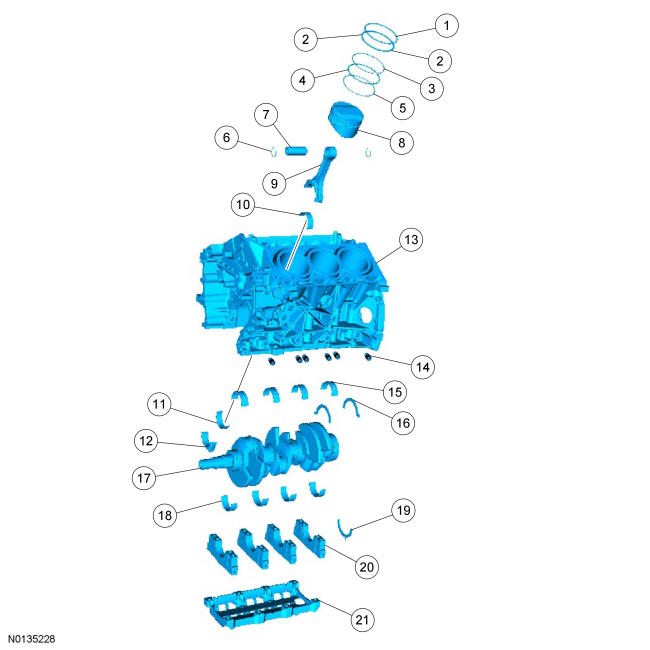
| Item | Part Number | Description |
|---|---|---|
| 1 | - | Piston compression upper ring (part of 6148) (6 required) |
| 2 | - | Piston compression lower ring (part of 6148) (6 required) |
| 3 | - | Piston oil control upper segment ring (part of 6148) (6 required) |
| 4 | - | Piston oil control spacer (part of 6148) (6 required) |
| 5 | - | Piston oil control lower segment ring (part of 6148) (6 required) |
| 6 | 6140 | Piston pin retainer (12 required) |
| 7 | 6135 | Piston pin (6 required) |
| 8 | 6110 | Piston (6 required) |
| 9 | 6200 | Connecting rod (6 required) |
| 10 | 6211 | Connecting rod upper bearing (6 required) |
| 11 | 6211 | Connecting rod lower bearing (6 required) |
| 12 | - | Connecting rod cap (part of 6200) (6 required) |
| 13 | 6010 | Cylinder block |
| 14 | 6K868 | Piston oil cool valve (6 required) |
| 15 | 6333 | Cylinder block crankshaft main bearing (4 required) |
| 16 | 6A341 | Crankshaft upper thrust washer (2 required) |
| 17 | 6303 | Crankshaft |
| 18 | 6A338 | Lower crankshaft main bearings (4 required) |
| 19 | 6K302 | Crankshaft lower thrust washer |
| 20 | - | Lower crankshaft main bearing caps (part of 6010) (4 required) |
| 21 | 6C364 | Main bearing cap support brace |
NOTE:
During engine repair procedures, cleanliness is extremely important. Any foreign material, including any material created while cleaning gasket surfaces that enters the oil passages, coolant passages or the oil pan, may cause engine failure.
NOTE:
Whenever turbocharger air intake system components are removed, always cover open ports to protect from debris. It is important that no foreign material enter the system. The turbocharger compressor vanes are susceptible to damage from even small particles. All components should be inspected and cleaned, if necessary, prior to installation or reassembly.
NOTE:
Assembly of the engine requires various inspections/measurements of the engine components (engine block, crankshaft, connecting rods, pistons and piston rings). These inspections/measurements will aid in determining if the engine components will require replacement. REFER to Engine System General Information
.
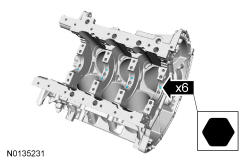
- 2.
Select the crankshaft main bearings for each crankshaft journal.- Record the code that is on the cylinder block face.
- Record the code that is on the crankshaft flange.
- The first letter is for main No. 1 and the next letters are for mains 2, 3 and 4.
NOTE:
The #1 main bearing is at the front of the engine block.
NOTE:
This step is for selecting the correct main bearings.
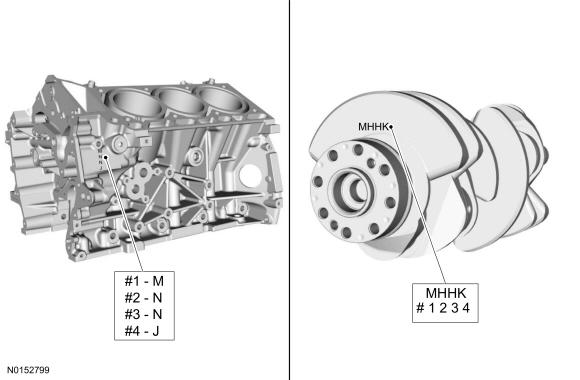
- 3.
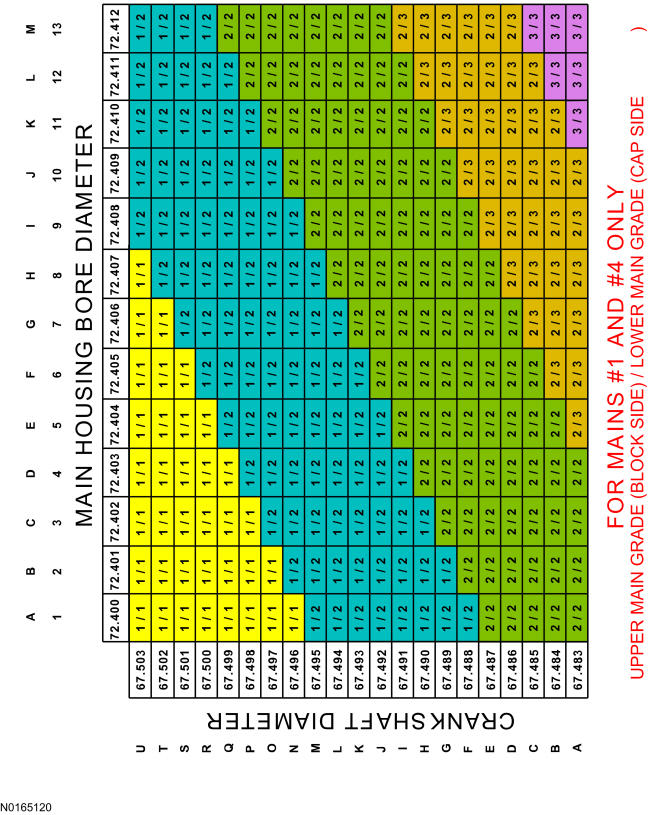
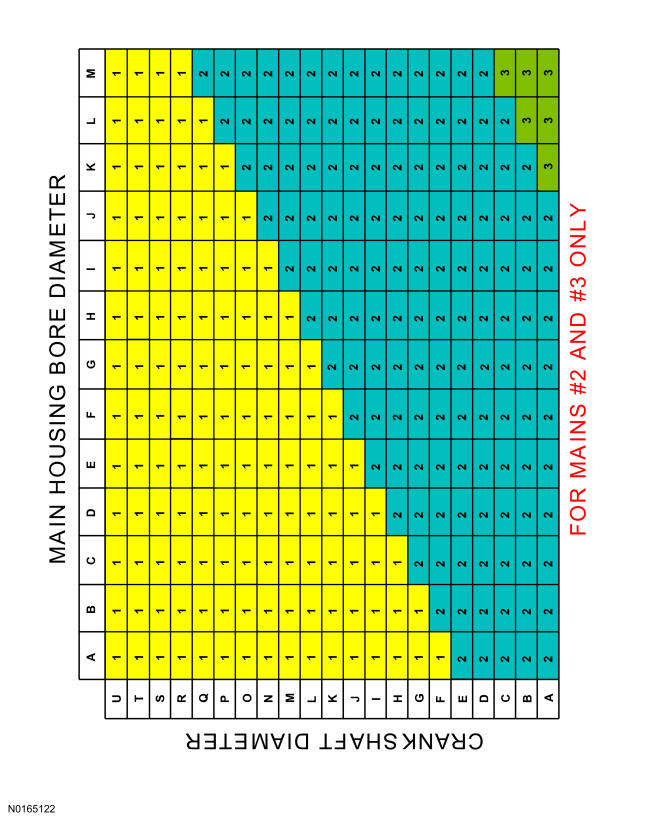
Using the data recorded earlier and the Bearing Select Fit Chart, Standard Bearings, determine the required bearing grade for main bearings 1 and 4.- Read the first letter of the engine block main bearing code and the first letter of the crankshaft main bearing code.
- Read down the column below the engine block main bearing code letter and across the row next to the crankshaft main bearing code letter, until the 2 intersect. This is the required bearing grade(s) for the No. 1 crankshaft main bearing.
- As an example, if the engine block code letter is "M" and the crankshaft code letter is "M", the correct bearing grade for this main bearing is a "2" for the upper bearing and a "2" for the lower bearing.
- Repeat the above steps using the fourth letter of the block and crankshaft codes to select the No. 4 bearing.
NOTE:
This chart is for selecting main bearings 1 and 4 only.
NOTE:
This chart is continued in the next step.
- 5.
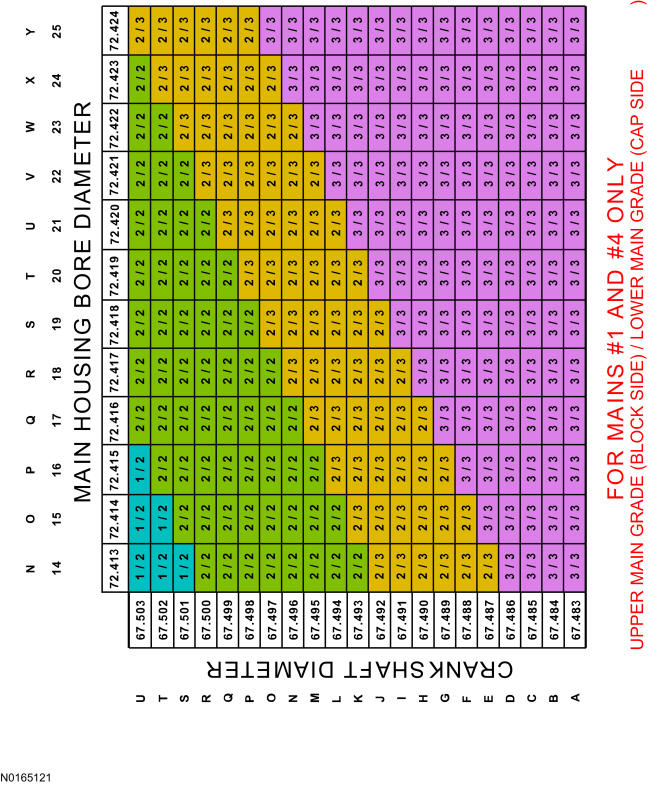
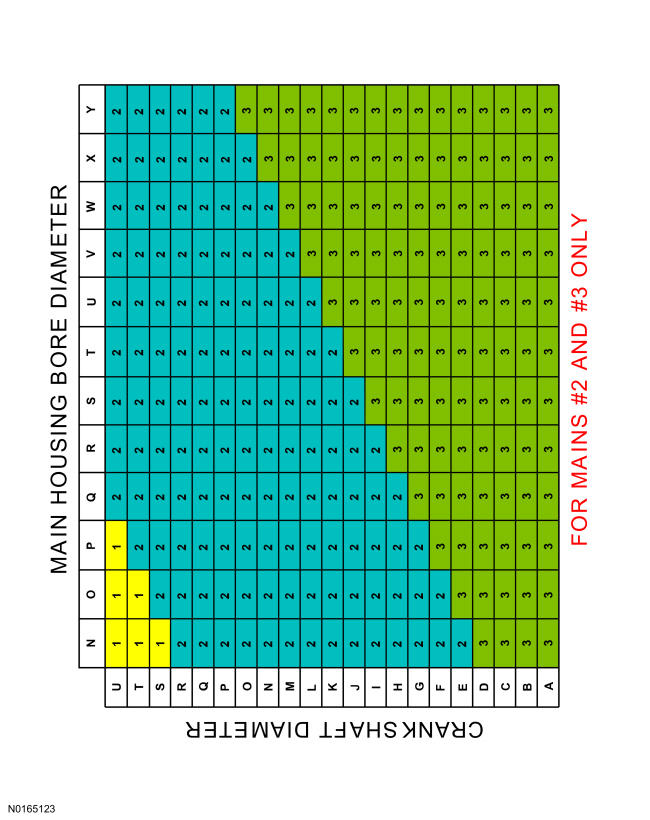
Using the data recorded earlier and the Bearing Select Fit Chart, Standard Bearings, determine the required bearing grade for main bearings 2 and 3.- Read the second letter of the engine block main bearing code and the second letter of the crankshaft main bearing code.
- Read down the column below the engine block main bearing code letter and across the row next to the crankshaft main bearing code letter, until the 2 intersect. This is the required bearing grade for the No. 2 crankshaft main bearing.
- As an example, if the engine block code letter is "N" and the crankshaft code letter is "H", the correct bearing grade for this main bearing is "2".
- Repeat the above steps using the third letter of the block and crankshaft codes to select the No. 3.
NOTE:
This chart is for selecting main bearings 2 and 3 only.
NOTE:
This chart is continued in the next step.
- 7.
Using the original connecting rod cap bolts, install the connecting rod caps and bolts.- Tighten the bolts in 3 stages.
- Stage 1: Tighten to 23 Nm (17 lb-ft).
- Stage 2: Tighten to 43 Nm (32 lb-ft).
- Stage 3: Tighten an additional 90 degrees.
NOTE:
The rod cap installation must keep the same orientation as marked during disassembly or engine damage may occur.
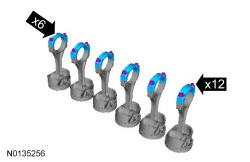
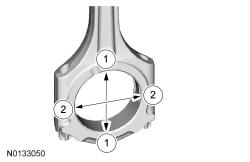
- 8.
Measure the connecting rod large end bore in 2 directions.- Remove the bolts and the rod cap.
- Discard the connecting rod cap bolts.
- Remove the bolts and the rod cap.
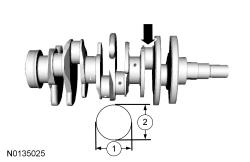
- 10.
Using the chart, select the correct connecting rod bearings for each crankshaft connecting rod journal.
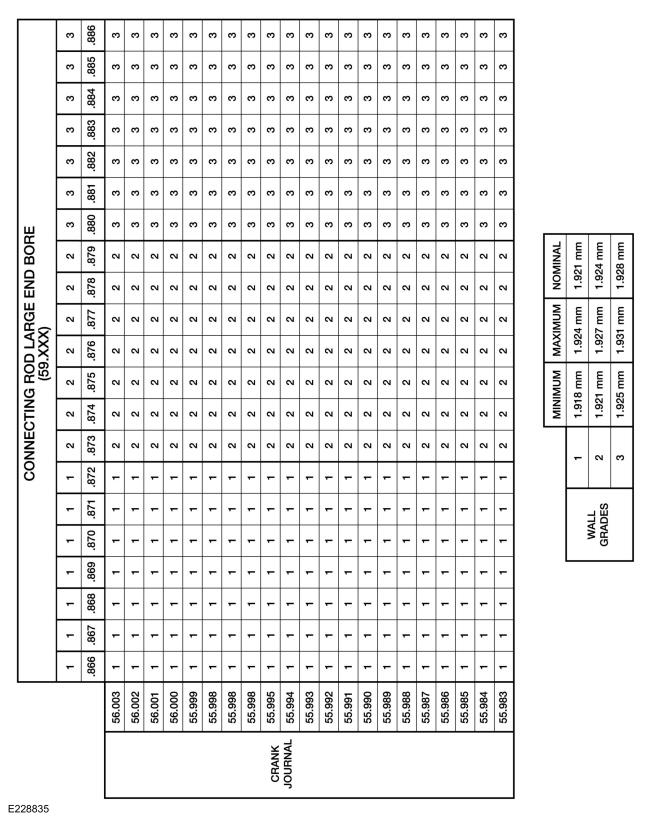
- 11.
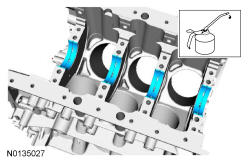
Lubricate and install the 4 crankshaft main bearings in the cylinder block.
NOTE:
Before assembling the cylinder block, all sealing surfaces must be free of chips, dirt, paint and foreign material. Also, make sure the coolant and oil passages are clear.
- 12.
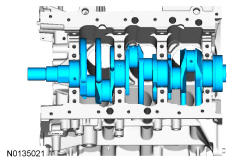
Install the crankshaft onto the upper main bearings.
NOTE:
Lubricate the thrust surfaces of the crankshaft with clean engine oil.
NOTE:
Do not install the upper thrust bearings until the crankshaft is installed.
- 13.
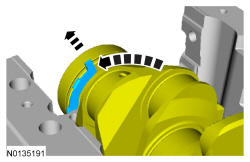
Push the crankshaft rearward and install the rear crankshaft upper thrust washer at the back of the No. 4 rear bulkhead.
NOTE:
Make sure the side of the thrust washer, with the wide oil grooves, faces the crankshaft thrust surface.
- 14.
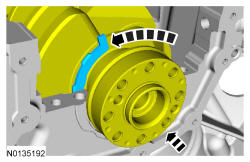
Push the crankshaft forward and install the front crankshaft upper thrust washer at the front of the No. 4 rear bulkhead.
NOTE:
Make sure the side of the thrust washer, with the wide oil grooves, faces the crankshaft thrust surface.
- 15.
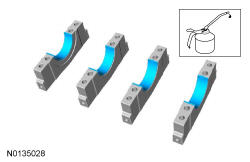
Lubricate and install the main bearing caps. Visually check seating and squareness of the bearings to make sure of proper seating in caps.
- 16.
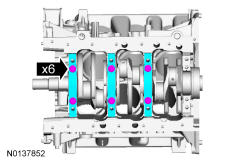
Position the No. 1, No. 2 and No. 3 main bearing caps on the cylinder block and, keeping the caps as square as possible, alternately draw the caps down evenly using the new bolts until the main bearing caps are seated.
- 17.
Install the lower crankshaft thrust washer to the back side of the No. 4 rear main bearing cap, with the tab aligned with the cutout in the main bearing cap.
NOTE:
To aid in assembly, apply petroleum jelly to the back of the crankshaft thrust washer.
NOTE:
Make sure the side of the thrust washer, with the wide oil grooves, faces the crankshaft thrust surface.
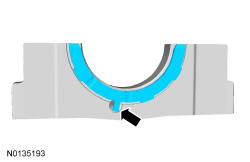
- 18.
Position main bearing cap No. 4 on the cylinder block and keeping the cap as square as possible, alternately draw the cap down evenly using the new bolts until the main bearing cap is seated.
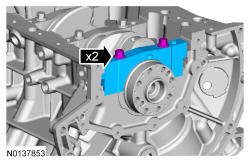
- 19.
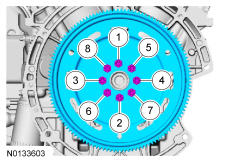
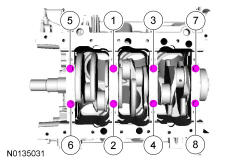
Tighten the main bearing bolts in the sequence shown in 2 stages.- Stage 1: Tighten fasteners 1 through 8 to 33 Nm (24 lb-ft).
- Stage 2: Tighten fasteners 1 through 8 an additional 135 degrees.
NOTE:
While tightening the main bearing vertical bolts, push the crankshaft forward and the No. 4 main bearing cap rearward to seat the crankshaft thrust washers.
- 20.
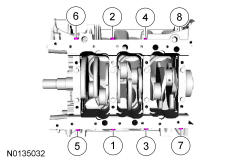
Install the new 8 main bearing cap side bolts. Tighten in the sequence shown in 2 stages.- Stage 1: Tighten fasteners 1 through 8 to 45 Nm (33 lb-ft).
- Stage 2: Tighten fasteners 1 through 8 an additional 90 degrees.
- 21.
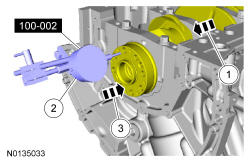
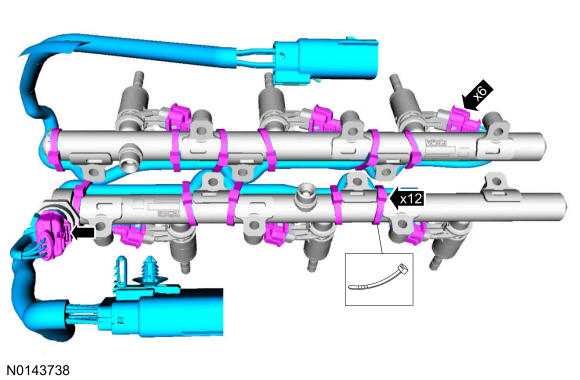
Special Tool(s): Dial Indicator Gauge with Holding Fixture 100-002 (TOOL-4201-C). Measure crankshaft end play.- Position the crankshaft to the rear of the cylinder block.
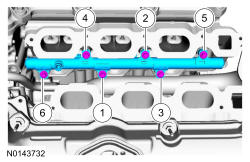
- Zero the Dial Indicator Gauge.
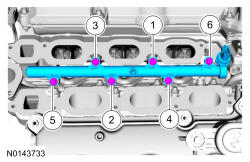
- Move the crankshaft to the front of the cylinder block. Note and record the crankshaft end play.
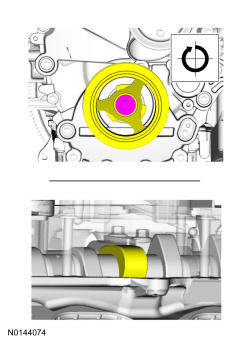
- 22.
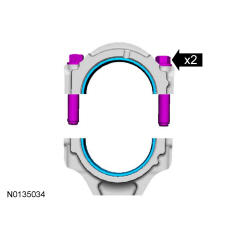
Prepare the connecting rod and cap.- Insert the new bolts in the rod cap.
- Insert the upper and lower rod bearings into the rod and cap.
NOTE:
The rod cap installation must keep the same orientation as marked during disassembly or engine damage may occur.
- 23.
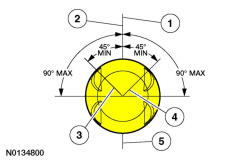
Before installing the pistons into the cylinder block, verify proper ring gap location.- 1.
Center line of the piston parallel to the wrist pin bore
- 2.
Upper compression ring gap location
- 3.
Upper oil control segment ring gap location
- 4.
Lower oil control segment ring gap location
- 5.
Expander ring and lower compression ring gap location
- 1.
- 24.
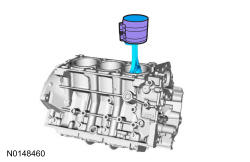
Install the piston and connecting rod assemblies.- Seat the connecting rod on the crankshaft journal.
NOTE:
If the piston and connecting rod are to be reinstalled, they must be installed in the same orientation as disassembled.
NOTE:
If the piston and or connecting rod are being installed new, the piston rod orientation marks and the arrow on the top of the dome of the piston should be facing toward the front of the engine block.
NOTE:
Make sure the piston rings are positioned to specifications for installation. Refer to Disassembly and Assembly of Subassemblies - Piston .
NOTE:
Lubricate the pistons, piston rings, connecting rod bearings and the entire cylinder bores with clean engine oil.
NOTE:
The next 3 steps are for all 6 connecting rods, rod caps and pistons. Only 1 connecting rod, rod cap and piston is shown.
NOTE:
Be sure not to scratch the cylinder wall or crankshaft journal with the connecting rod. Push the piston down until the connecting rod bearing seats on the crankshaft journal.
- 25.
Install the connecting rod cap and bolts.- Tighten the bolts in 3 stages.
- Stage 1: Tighten to 23 Nm (17 lb-ft).
- Stage 2: Tighten to 43 Nm (32 lb-ft).
- Stage 3: Tighten an additional 90 degrees.
NOTE:
After installation of each piston, connecting rod, rod cap and bolts, rotate the crankshaft to verify smooth operation.
NOTE:
The rod cap installation must keep the same orientation as marked during disassembly or engine damage may occur.
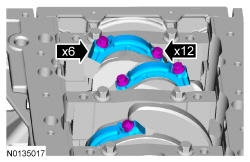
- 26.
Repeat the previous 3 steps until all 6 piston, connecting rod and connecting rod cap assemblies are installed.
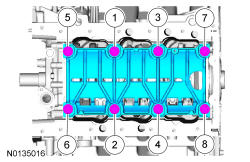
- 27.
Install the main bearing cap support brace and the new bolts. Tighten in the sequence shown in 2 steps.- Stage 1: Tighten fasteners to 24 Nm (18 lb-ft).
- Stage 2: Tighten fasteners an additional 180 degrees.
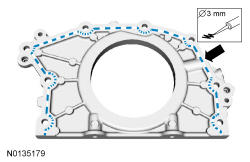
- 28.
Apply a 3 mm (0.11 in) bead of silicone to the sealing surface of the crankshaft rear seal retainer.
NOTE:
The stamped steel crankshaft rear seal retainer plate comes with the crankshaft rear seal.
NOTE:
The crankshaft rear seal retainer must be installed and the bolts tightened within 10 minutes of sealant application.
NOTE:
Failure to use Motorcraft ® High Performance Engine RTV Silicone may cause the engine oil to foam excessively and result in serious engine damage.
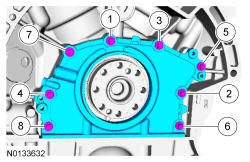
- 29.
Install the crankshaft rear seal retainer and the 8 bolts and tighten in sequence shown.- Tighten to 10 Nm (89 lb-in).
NOTE:
Lubricate the crankshaft rear seal with clean engine oil.
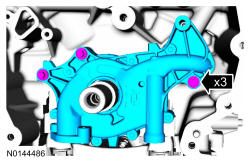
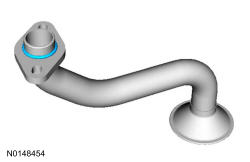
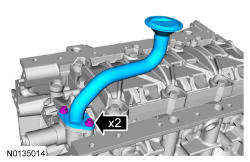
- 33.
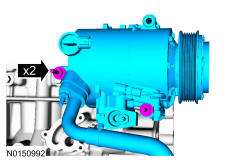
Install the A/C compressor and the 2 stud bolts.- Tighten to 25 Nm (18 lb-ft).
NOTE:
The A/C compressor must be installed on the cylinder block and the 2 bolts tightened prior to installing the oil pan for oil pan alignment.
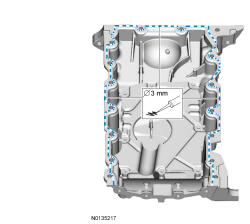
- 34.
Apply a 3 mm (0.11 in) bead of silicone to the sealing surface of the oil pan.
NOTE:
The oil pan and the 4 specified bolts must be installed and the oil pan aligned to the cylinder block and A/C compressor within 4 minutes of sealant application. Final tightening of the oil pan bolts must be carried out within 60 minutes of sealant application.
NOTE:
Failure to use Motorcraft ® High Performance Engine RTV Silicone may cause the engine oil to foam excessively and result in serious engine damage.
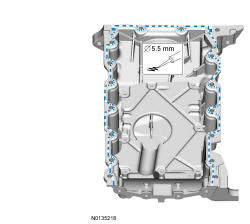
- 35.
Apply a 5.5 mm (0.21 in) bead of silicone to the 2 crankshaft seal retainer plate-to-cylinder block joint areas on the sealing surface of the oil pan.
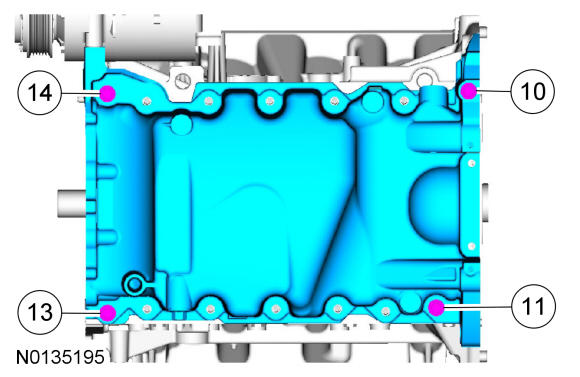
- 36.
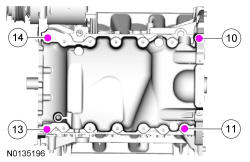
Install the oil pan and bolts 10, 11, 13 and 14.- Tighten the bolts in the sequence shown to 3 Nm (27 lb-in).
- Loosen the bolts 180 degrees.
NOTE:
The oil pan and the 4 specified bolts must be installed within 4 minutes of the start of sealant application.
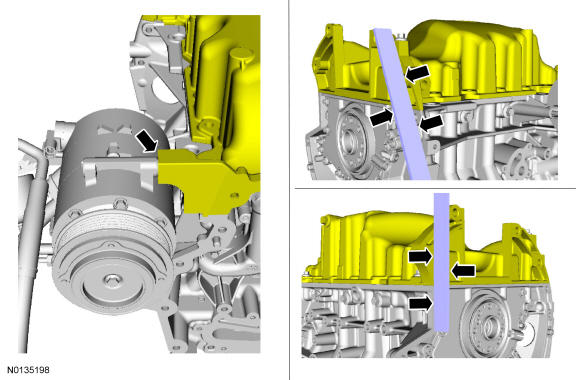
- 37.
Align the oil pan to the cylinder block and A/C compressor.- Position the oil pan so the mounting boss is against the A/C compressor and using a straightedge, align the oil pan flush with the rear of the cylinder block at the 2 areas shown.
- 39.
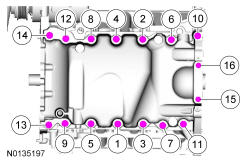
Install the remaining oil pan bolts. Tighten all the oil pan bolts in the sequence shown.- Tighten the large bolts (1-14) to 24 Nm (18 lb-ft).
- Tighten the small bolts (15 and 16) to 10 Nm (89 lb-in).
- 40.
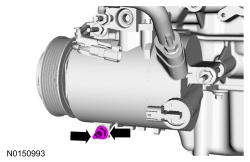
Install the A/C compressor stud and nut.- Tighten the stud to 9 Nm (80 in-ft).
- Tighten the nut to 25 Nm (18 lb-ft).
- 41.
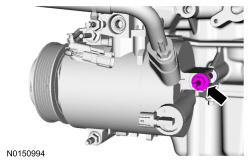
Remove the rear A/C compressor stud bolt.
NOTE:
The A/C compressor stud bolt will be install in installation.
- 42.
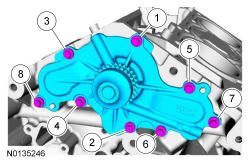
Install the coolant pump and the 8 bolts. Tighten in the sequence shown in 2 stages:- Stage 1: Tighten to 10 Nm (89 lb-in).
- Stage 2: Tighten an additional 45 degrees.
- 44.
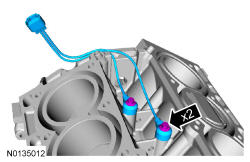
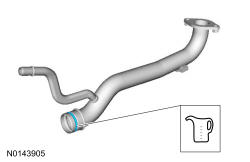
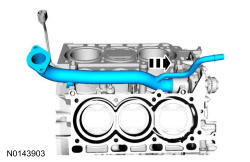
Install the new coolant inlet tube O-ring seal.
NOTE:
Apply clean engine coolant to the O-ring seal prior to installation.
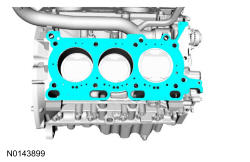
- 47.
Install the RH cylinder head and 8 new bolts. Tighten in the sequence shown in 5 stages:- Stage 1: Tighten to 20 Nm (177 lb-in).
- Stage 2: Tighten to 35 Nm (26 lb-ft).
- Stage 3: Tighten 90 degrees.
- Stage 4: Tighten 90 degrees.
- Stage 5: Tighten 45 degrees.
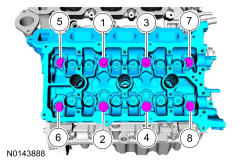
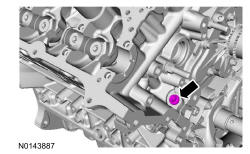
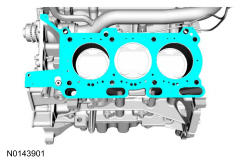
- 50.
Install a new gasket, the LH cylinder head and 8 new bolts. Tighten in the sequence shown in 5 stages:- Stage 1: Tighten to 20 Nm (177 lb-in).
- Stage 2: Tighten to 35 Nm (26 lb-ft).
- Stage 3: Tighten 90 degrees.
- Stage 4: Tighten 90 degrees.
- Stage 5: Tighten 45 degrees.
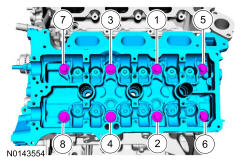
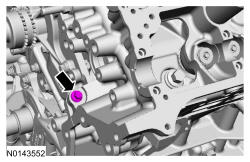
- 52.
Position the crankshaft dowel pin in the 9 o'clock position.
NOTE:
The crankshaft must remain in the freewheeling position (crankshaft dowel pin at 9 o'clock) until after the camshafts are installed and the valve clearance is checked/adjusted. Do not turn the crankshaft until instructed to do so. Failure to follow this process will result in severe engine damage.
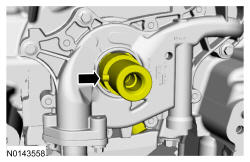
- 53.
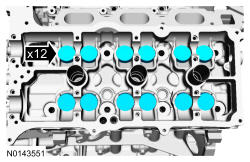
Install the 24 valve tappets.
NOTE:
LH shown, RH similar.
NOTE:
Coat the valve tappets with clean engine oil prior to installation.
NOTE:
The valve tappets must be installed in their original positions.
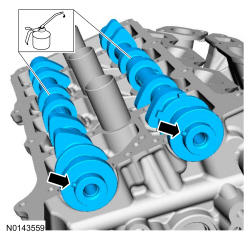
- 54.
Lubricate and position the camshafts onto the RH cylinder head in the neutral position as shown.
NOTE:
The camshafts must remain in the neutral position during installation or engine damage may occur.
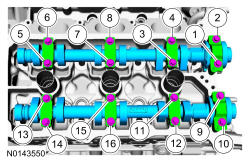
- 55.
Install the 8 RH camshaft caps and the 16 bolts. Tighten the bolts in the sequence shown in the following stages:- Stage 1: Tighten bolts 1, 2, 3 and 4 to 8 Nm (71 lb-in) then an additional 45 degrees.
- Stage 2: Tighten bolts 5 and 6 to 8 Nm (71 lb-in).
- Stage 3: Tighten bolts 7 and 8 to 8 Nm (71 lb-in) then an additional 45 degrees.
- Stage 4: Loosen bolts 5 and 6.
- Tighten bolts 5 and 6 to 8 Nm (71 lb-in) then an additional 45 degrees.
- Stage 5: Tighten bolts 9, 10, 11 and 12 to 8 Nm (71 lb-in) then an additional 45 degrees.
- Stage 6: Tighten bolts 13 and 14 to 8 Nm (71 lb-in).
- Stage 7: Tighten bolts 15 and 16 to 8 Nm (71 lb-in) then an additional 45 degrees.
- Stage 8: Loosen bolts 13 and 14.
- Tighten bolts 13 and 14 to 8 Nm (71 lb-in) then an additional 45 degrees.
NOTE:
Cylinder head camshaft bearing caps are numbered to verify that they are assembled in their original positions.
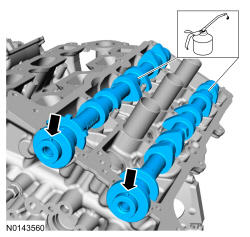
- 56.
Lubricate and position the camshafts onto the LH cylinder head in the neutral position as shown.
NOTE:
The camshafts must remain in the neutral position during installation or engine damage may occur.
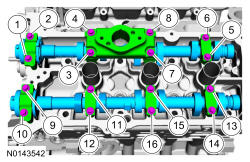
- 57.
Install the 8 LH camshaft caps and the 16 bolts. Tighten the bolts in the sequence shown in the following stages:- Stage 1: Tighten bolts 1, 2, 3 and 4 to 8 Nm (71 lb-in) then an additional 45 degrees.
- Stage 2: Tighten bolts 5 and 6 to 8 Nm (71 lb-in).
- Stage 3: Tighten bolts 7 and 8 to 8 Nm (71 lb-in) then an additional 45 degrees.
- Stage 4: Loosen bolts 5 and 6.
- Tighten bolts 5 and 6 to 8 Nm (71 lb-in) then an additional 45 degrees.
- Stage 5: Tighten bolts 9, 10, 11 and 12 to 8 Nm (71 lb-in) then an additional 45 degrees.
- Stage 6: Tighten bolts 13 and 14 to 8 Nm (71 lb-in).
- Stage 7: Tighten bolts 15 and 16 to 8 Nm (71 lb-in) then an additional 45 degrees.
- Stage 8: Loosen bolts 13 and 14.
- Tighten bolts 13 and 14 to 8 Nm (71 lb-in) then an additional 45 degrees.
NOTE:
Cylinder head camshaft bearing caps are numbered to verify that they are assembled in their original positions.
- 58.
Confirm that the valve tappet clearances are within specification. Refer to Valve Clearance Check .
NOTE:
Use a camshaft sprocket bolt to turn the camshafts.
NOTE:
If any components are installed new, the engine valve clearance must be checked/adjusted or engine damage may occur.
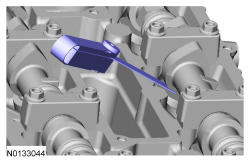
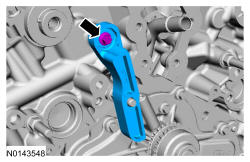
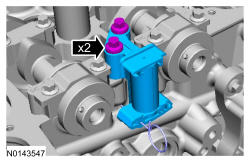
- 61.
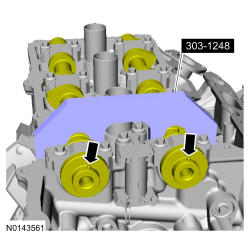
Rotate the RH camshafts to the Top Dead Center (TDC) position. Install the Special Tool(s): Tool, Camshaft Holding 303-1248.
NOTE:
Use a camshaft sprocket bolt to turn the camshafts.
- 62.
Assemble the RH Variable Camshaft Timing (VCT) assembly, the RH exhaust camshaft sprocket and the RH secondary timing chain.- Align the colored links with the timing marks.
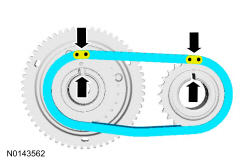
- 63.
Position the RH secondary timing assembly onto the camshafts and install the new VCT bolt and the exhaust camshaft bolt and the original washer. Tighten in 4 stages.- Stage 1: Tighten to 40 Nm (30 lb-ft).
- Stage 2: Loosen one full turn.
- Stage 3: Tighten to 10 Nm (89 lb-in).
- Stage 4: Tighten 90 degrees.
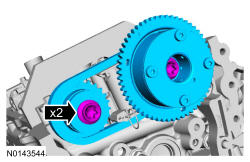
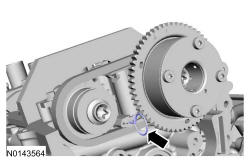
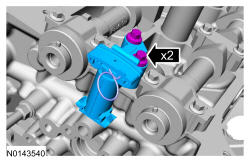
- 66.
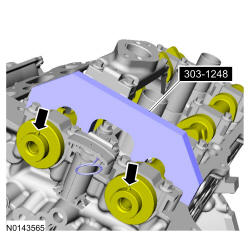
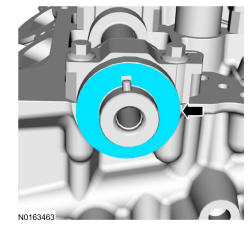
Rotate the LH camshafts to the TDC position. Install the Special Tool(s): Tool, Camshaft Holding 303-1248.
NOTE:
Use a camshaft sprocket bolt to turn the camshafts.
- 68.
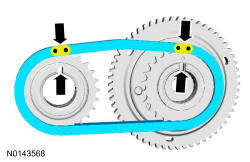
Assemble the LH VCT assembly, the LH exhaust camshaft sprocket and the LH secondary timing chain.- Align the colored links with the timing marks.
- 69.
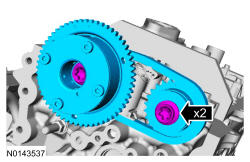
Position the LH secondary timing assembly onto the camshafts and install the new VCT bolt and the exhaust camshaft bolt and the original washer. Tighten in 4 stages.- Stage 1: Tighten to 40 Nm (30 lb-ft).
- Stage 2: Loosen one full turn.
- Stage 3: Tighten to 10 Nm (89 lb-in).
- Stage 4: Tighten 90 degrees.
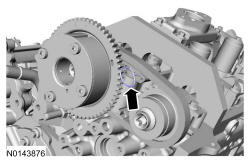
- 71.
Rotate the crankshaft clockwise 60 degrees to the TDC position (crankshaft dowel pin at 11 o'clock).
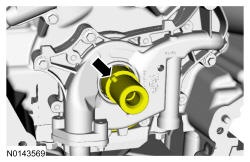
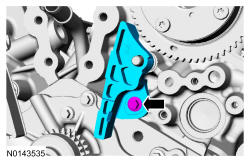
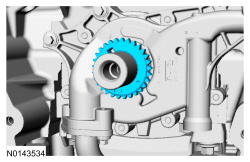
- 74.
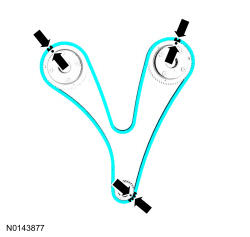
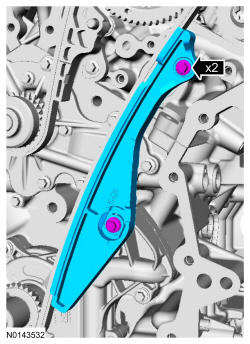
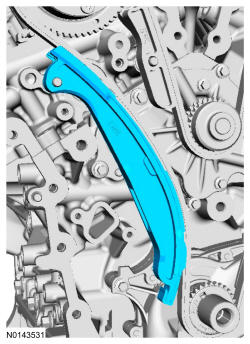
Install the primary timing chain with the colored links aligned with the timing marks on the VCT assemblies and the crankshaft sprocket.
NOTE:
The crankshaft sprocket timing mark should be between the 2 colored links.
- 77.
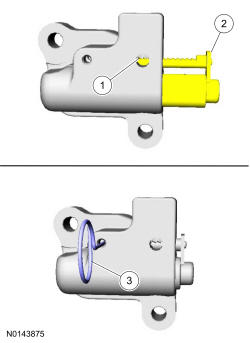
Reset the primary timing chain tensioner.- 1.
Release the ratchet detent.
- 2.
Using a soft-jawed vise, compress the ratchet plunger.
- 3.
Align the hole in the ratchet plunger with the hole in the tensioner housing and install a suitable lockpin.
- 1.
- 78.
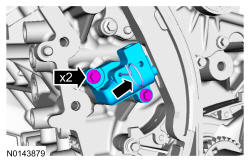
Install the primary tensioner and the 2 bolts.- Tighten to 10 Nm (89 lb-in).
- Remove the Lock Pin.
NOTE:
It may be necessary to rotate the crankshaft slightly to remove slack from the timing chain and install the tensioner.
- 79.
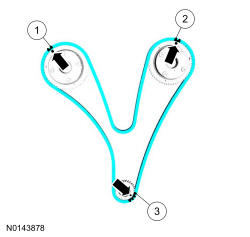
As a post-check, verify correct alignment of all timing marks.- There are 48 links between the RH intake VCT assembly colored link (1) and the LH intake VCT assembly colored link (2).
- There are 35 links between the LH intake VCT assembly colored link (2) and the 2 crankshaft sprocket colored links (3).
- 80.
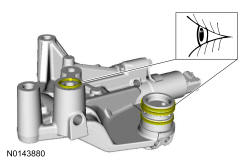
Visual check the VCT housing-to-cylinder head O-ring seals and VCT housing seals for damage and replace as necessary.
NOTE:
During removal, the O-ring seal may remain on the cylinder head. If so, remove the O-ring seal from the cylinder head, inspect the seal (replace as necessary) and install the O-ring seal on the VCT housing.
NOTE:
RH shown, LH similar.
- 81.
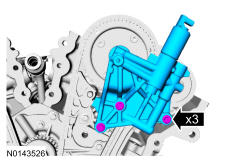
Install the LH VCT housing and the 3 bolts.- Tighten in the sequence shown to 10 Nm (89 lb-in).
NOTE:
Make sure the dowels on the Variable Camshaft Timing (VCT) housing are fully engaged in the cylinder head prior to tightening the bolts. Failure to follow this process will result in severe engine damage.
- 82.
Install the RH VCT housing and the 3 bolts.- Tighten in the sequence shown to 10 Nm (89 lb-in).
NOTE:
Make sure the dowels on the Variable Camshaft Timing (VCT) housing are fully engaged in the cylinder head prior to tightening the bolts. Failure to follow this instruction will result in severe engine damage.
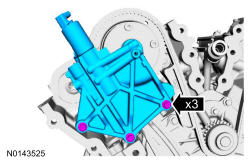
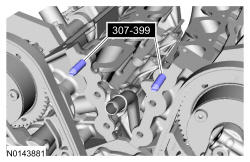
- 84.
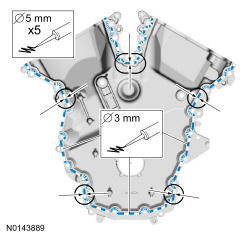
Apply a 3.0 mm (0.11 in) bead of silicone to the engine front cover sealing surfaces including the 3 engine mount bracket bosses.- Apply a 5.5 mm (0.21 in) bead of silicone to the oil pan-to-cylinder block joint and the cylinder head-to-cylinder block joint areas of the engine front cover in 5 places as indicated.
NOTE:
The engine front cover and bolts 17, 18, 19 and 20 must be installed within 4 minutes of the initial sealant application. The remainder of the engine front cover bolts and the engine mount bracket bolts must be installed and tightened within 35 minutes of the initial sealant application. If the time limits are exceeded, the sealant must be removed, the sealing area cleaned and sealant reapplied. To clean the sealing area, use silicone gasket remover and metal surface prep. Failure to follow these instructions can cause future oil leakage.
NOTE:
Failure to use Motorcraft ® High Performance Engine RTV Silicone may cause the engine oil to foam excessively and result in serious engine damage.
- 85.
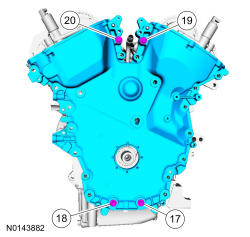
Install the engine front cover and bolts 17, 18, 19 and 20.- Tighten in sequence to 3 Nm (27 lb-in).
NOTE:
Make sure the 2 locating dowel pins are seated correctly in the cylinder block.
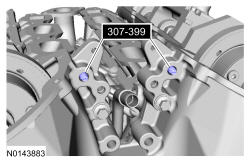
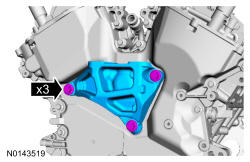
- 88.
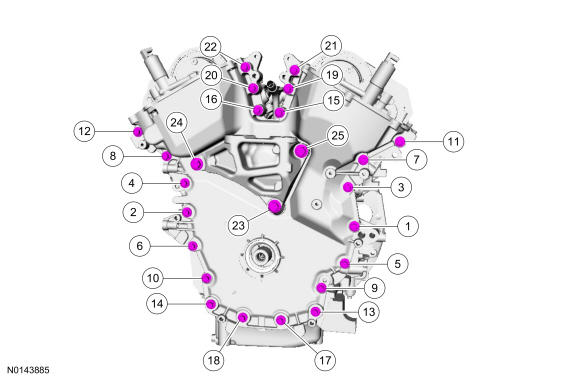
Install the remaining engine front cover bolts. Tighten all of the engine front cover bolts and engine mount bracket bolts in the sequence shown in 2 stages:- Stage 1: Tighten bolts 1 thru 22 to 10 Nm (89 lb-in) and bolts 23, 24 and 25 to 15 Nm (133 lb-in).
- Stage 2: Tighten bolts 1 thru 22 to 24 Nm (18 lb-ft) and bolts 23, 24 and 25 to 75 Nm (55 lb-ft).
NOTE:
Do not expose the Motorcraft ® High Performance Engine RTV Silicone to engine oil for at least 90 minutes after installing the engine front cover. Failure to follow this instruction may cause oil leakage.
- 89.
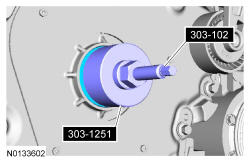
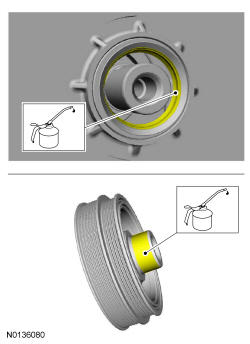
Special Tool(s): Installer, Front Crankshaft Seal 303-1251 and Installer, Crankshaft Vibration Damper 303-102 (T74P-6316-B). Install a new crankshaft front seal.
NOTE:
Apply clean engine oil to the crankshaft front seal bore in the engine front cover.
- 91.
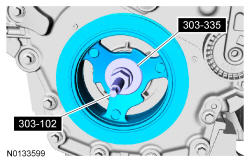
Special Tool(s): Installer, Front Cover Oil Seal 303-335 and Installer, Crankshaft Vibration Damper 303-102 (T74P-6316-B). Install the crankshaft pulley.
- 92.
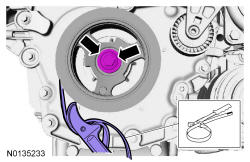
Install the crankshaft pulley washer and new bolt and tighten in 4 stages.- Stage 1: Tighten to 120 Nm (89 lb-ft).
- Stage 2: Loosen one full turn.
- Stage 3: Tighten to 50 Nm (37 lb-ft).
- Stage 4: Tighten an additional 90 degrees.
- 93.
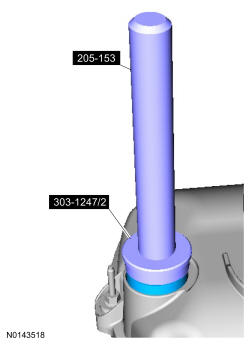
Special Tool(s): Installer, VCT Spark Plug Tube Seal 303-1247/2 and Handle 205-153 (T80T-4000-W). Install new VCT solenoid and/or spark plug tube seals.
NOTE:
Installation of new seals is only required if damaged seals were removed during disassembly of the engine.
NOTE:
VCT solenoid seal installation shown, spark plug tube seal removal similar.
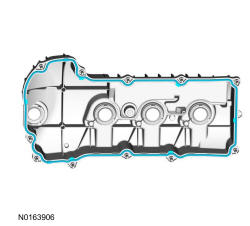
- 95.
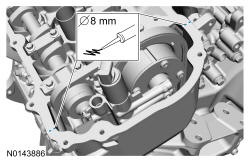
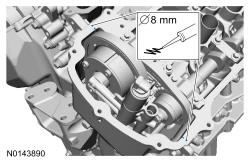
Apply an 8 mm (0.31 in) bead of silicone to the engine front cover-to-RH cylinder head joints.
NOTE:
If the valve cover is not installed and the fasteners tightened within 4 minutes, the sealant must be removed and the sealing area cleaned. To clean the sealing area, use silicone gasket remover and metal surface prep. Failure to follow these instructions can cause future oil leakage.
NOTE:
Failure to use Motorcraft ® High Performance Engine RTV Silicone may cause the engine oil to foam excessively and result in serious engine damage.
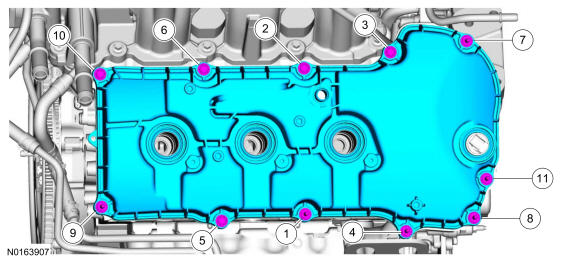
- 96.
Install the RH valve cover. Tighten the 6 stud bolts and the 5 bolts.- Tighten in the sequence shown to 10 Nm (89 lb-in).
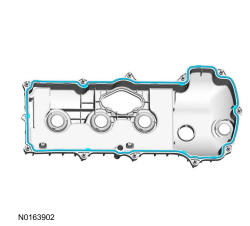
- 98.
Apply an 8 mm (0.31 in) bead of silicone to the engine front cover-to-LH cylinder head joints.
NOTE:
If the valve cover is not installed and the fasteners tightened within 4 minutes, the sealant must be removed and the sealing area cleaned. To clean the sealing area, use silicone gasket remover and metal surface prep. Failure to follow these instructions can cause future oil leakage.
NOTE:
Failure to use Motorcraft ® High Performance Engine RTV Silicone may cause the engine oil to foam excessively and result in serious engine damage.
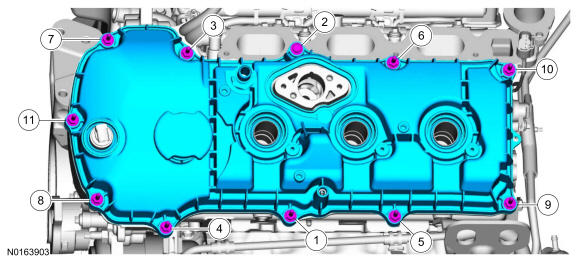
- 99.
Install the LH valve cover. Tighten the 10 stud bolts and the bolt.- Tighten in the sequence shown to 10 Nm (89 lb-in).
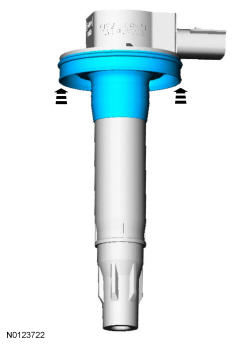
- 100.
Inspect the 6 ignition coil-on-plug seals for rips, nicks or tears. Remove and discard any damaged ignition coil-on-plug seals.- Slide the new ignition coil-on-plug seal onto the ignition coil-on-plug until it is fully seated at the top of the coil-on-plug.
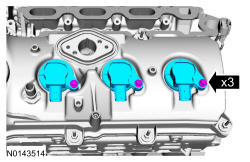
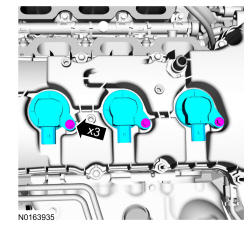
- 101.
Install the 3 LH ignition coil-on-plugs and the 3 bolts.- Tighten to 7 Nm (62 lb-in).
NOTE:
Apply a small amount of dielectric grease to the inside of the ignition coil-on-plug boots before attaching to the spark plugs.
- 102.
Install the 3 RH ignition coil-on-plugs and the 3 bolts.- Tighten to 7 Nm (62 lb-in).
NOTE:
Apply a small amount of dielectric grease to the inside of the ignition coil-on-plug boots before attaching to the spark plugs.
- 103.
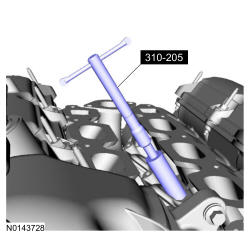
Special Tool(s): Brush, Fuel Injector 310-205. Clean the fuel injector orifices.
NOTE:
Make sure to thoroughly clean any residual fuel or foreign material from the cylinder head, block and the general surrounding area of the fuel rails and injectors.
NOTE:
A clean working environment is essential to prevent dirt or foreign material contamination.
- 105.
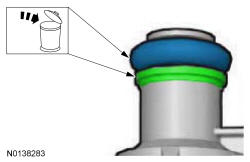
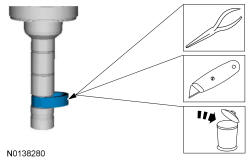
Remove the Teflon ® seal from the fuel injector.- 1.
Pull the Teflon ® seal away from the injector with narrow tip pliers.
- 2.
Carefully cut and remove the 6 lower fuel injector Teflon ® seals.
- 3.
Discard the 6 lower fuel injector Teflon ® seals.
- 1.
NOTE:
Be very careful when removing the lower Teflon ® seals, not to scratch, nick or gouge the fuel injectors.
NOTE:
Do not attempt to cut the lower Teflon ® seal without first pulling it away from the fuel injector or damage to the injector may occur.
- 106.
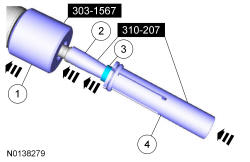
Place the Teflon ® Seal Sizer, knurled side out, over the fuel injector tip until the fuel injector seal recess is exposed.- 1.
Special Tool(s): Sizer, Teflon ® Seal 303-1567.
- 2.
Special Tool(s): Seal Installer, Fuel Injector 310-207.
- 3.
NOTE: Make sure that new lower fuel injector Teflon ® seals are installed.- 4.
Special Tool(s): Seal Installer, Fuel Injector 310-207.
- 1.
- 107.
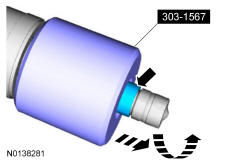
Special Tool(s): Sizer, Teflon ® Seal 303-1567.
NOTE:
Install the fuel injectors into the cylinder head within 15 minutes of sizing the seals due to Teflon ® seal expansion.
NOTE:
Make sure the Teflon ® seal is fully seated in the groove on the fuel injector before sizing the seal.
- 108.
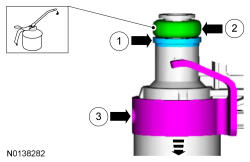
Install the O-ring seal, injector support disc and clip.
NOTE:
Make sure that new upper fuel injector O-ring seals, upper fuel injector O-ring seal support rings and fuel injector retainer clips are installed.
NOTE:
Do not lubricate the new lower Teflon ® fuel injector seals.
NOTE:
Use fuel injector O-ring seals that are made of special fuel-resistant material. The use of ordinary O-ring seals may cause the fuel system to leak. Do not reuse the O-ring seals.
- 109.
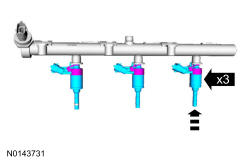
NOTE:
The fuel rail pressure sensor must be replaced if it is removed from the fuel rail. REFER to Electronic Engine Controls
.
NOTE:
The anti-rotation finger of the fuel injector clip must slip into the groove of the fuel rail cup.
NOTE:
LH shown, RH similar.
- 110.
Install the fuel charge wire harnesses and tie straps to the index-marked locations on the fuel rails. Start by attaching the first tie strap farthest down the wire harness and continue to the connector end of the harness, leaving ample slack between the fuel injectors.
NOTE:
It is very important to note the routing of the fuel charge wiring harnesses on the fuel rails and index-mark the location of the tie straps prior to removal or damage may occur to the wire harnesses during installation. The illustration details the correct fuel charge wire harness routing and tie strap positioning for installation.
- 111.
Install the 6 new bolts and the RH fuel rail assembly.- Push down on the fuel rail face above the injectors and begin tightening the outer bolts first and then proceed inward.
- To install, tighten to 10 Nm (89 lb-in).
- Tighten an additional 45 degrees.
NOTE:
Tighten the bolts in a method that draws the fuel rail evenly to the head, preventing a rocking motion.
NOTE:
It is very important to visually inspect the routing of the fuel charge wire harness to make sure that they will not be pinched or damaged between the fuel rail and the cylinder head during installation.
- 112.
Install the 6 new bolts and the LH fuel rail assembly.- Push down on the fuel rail face above the injectors and begin tightening the outer bolts first and proceed inward.
- To install, tighten to 10 Nm (89 lb-in).
- Tighten an additional 45 degrees.
NOTE:
Tighten the bolts in a method that draws the fuel rail evenly to the head, preventing a rocking motion.
NOTE:
It is very important to visually inspect the routing of the fuel charge wire harness to make sure that they will not be pinched or damaged between the fuel rail and the cylinder head during installation.
- 113.
Using the crankshaft pulley bolt, turn the crankshaft until the fuel injection pump cam lobe is at BDC.
NOTE:
The cam lobe for the fuel injection pump must be at Bottom Dead Center (BDC) for the fuel injection pump installation.
- 114.
Install the fuel injection pump roller tappet.
NOTE:
Lubricate the fuel injection pump roller tappet and bore with clean engine oil.
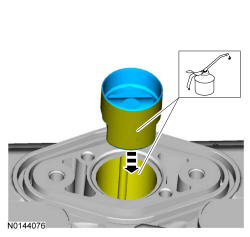
- 115.
Inspect the fuel injection pump mounting plate-to-valve cover gasket and replace if necessary.
NOTE:
Lubricate the valve cover gasket with clean engine oil.
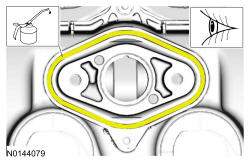
- 116.
Inspect the 2 fuel injection pump mounting plate O-ring seals and replace if necessary.
NOTE:
Lubricate the O-ring seals with clean engine oil.
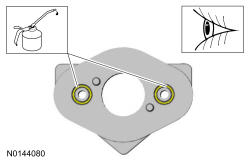
- 117.
Install a new fuel injection pump O-ring seal.
NOTE:
Lubricate the O-ring seal with clean engine oil.
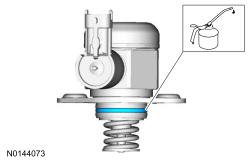
- 118.
Install the fuel injection pump mounting plate on the fuel injection pump.
NOTE:
Orient the arrow on the fuel injection pump mounting plate towards the front of the engine.
NOTE:
Make sure the mating surfaces are free of any dirt or foreign material.
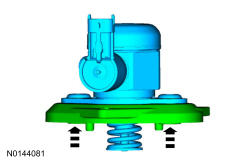
- 119.
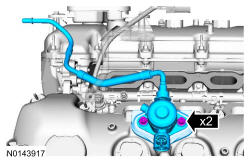
Install the fuel injection pump, mounting plate and the 2 new bolts finger-tight.- Tighten to 10 Nm (89 lb-in).
- Tighten an additional 45 degrees.
- 120.
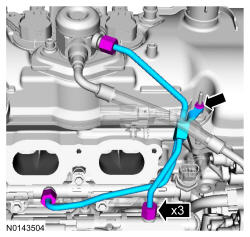
Install the high-pressure fuel tube and tighten the 3 flare nuts in the following 3 stages.- Stage 1: Tighten to 32 Nm (24 lb-ft).
- Stage 2: Wait 10 minutes to minimize pre-stress.
- Stage 3: Tighten to 32 Nm (24 lb-ft).
- Install the new high-pressure fuel tube bracket nut.
- Tighten the nut to 8 Nm (71 lb-in).
NOTE:
Apply clean engine oil to the threads of the 3 high-pressure fuel tube flare nuts.
- 121.
Install the RH cylinder block drain plug or if equipped, the block heater.- Tighten the cylinder block drain plug to 10 Nm (89 lb-in) plus an additional 720 degrees.
- Tighten the block heater to 40 Nm (30 lb-ft).
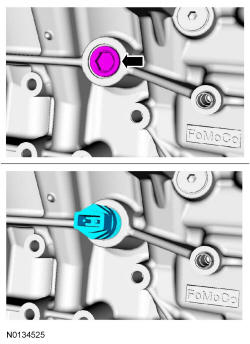
- 122.
Install the LH cylinder block drain plug.- Tighten to 16 Nm (142 lb-in) plus an additional 180 degrees.
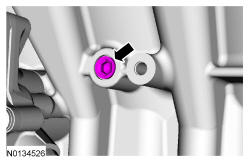
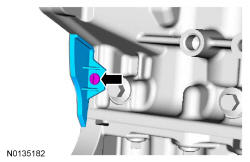
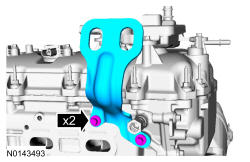
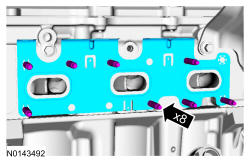
- 126.
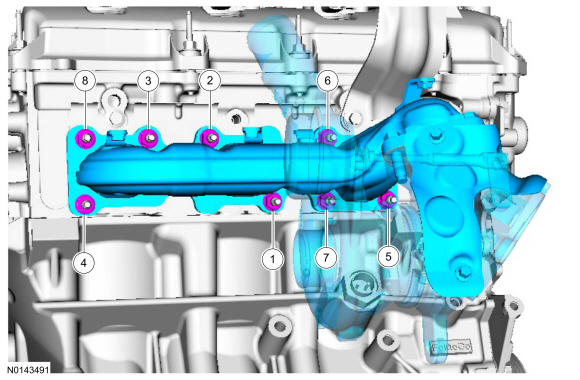
Install a new gasket, RH exhaust manifold and 8 new nuts. Tighten in 2 stages in the sequence shown:- Stage 1: Tighten to 15 Nm (133 lb-in).
- Stage 2: Tighten to 20 Nm (177 lb-in).
NOTE:
Failure to tighten the exhaust manifold nuts to specification a second time will cause the exhaust manifold to develop an exhaust leak.
- 127.
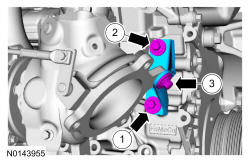
Install the upper RH turbocharger-to-cylinder block bracket and the 3 bolts and position the bracket as far clockwise as possible and tighten the bolts in the following sequence:- 1.
Tighten the lower bolt to 26 Nm (19 lb-ft).
- 2.
Tighten the upper bolt to 26 Nm (19 lb-ft).
- 3.
Tighten the turbocharger bolt to 19 Nm (168 lb-in).
- 1.
 Courtesy of FORD MOTOR CO.
- 128.
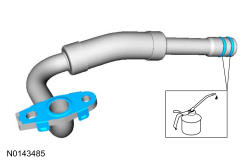
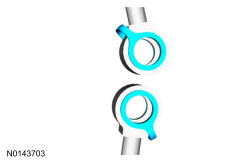
Install 2 new O-ring seals and new gasket on the oil return tube.
NOTE:
Lubricate the O-ring seals with clean engine oil.
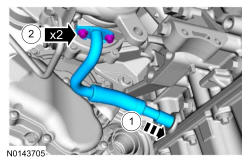
- 129.
Install the RH turbocharger oil return tube and the 2 bolts.- Tighten to 10 Nm (89 lb-in).
NOTE:
Lubricate the cylinder block bore with clean engine oil.
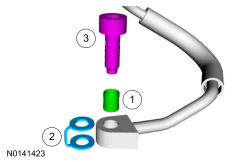
- 131.
Install the oil supply tube filter, washer and bolt.- 1.
Install the oil supply tube filter in the oil supply tube block.
- 2.
Slide the new washer onto the oil supply tube block.
- 3.
Install the banjo bolt into the oil supply tube block.
- 1.
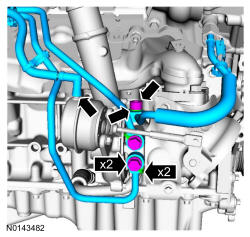
- 132.
Install the 2 RH turbocharger coolant tubes, RH turbocharger oil supply tube and the 3 banjo bolts.- Tighten to 40 Nm (30 lb-ft).
- Connect the turbocharger wastegate regulating valve hose to the RH turbocharger assembly
NOTE:
Make sure the turbocharger wastegate regulating valve hose does not contact the exhaust manifold heat shield.
- 133.
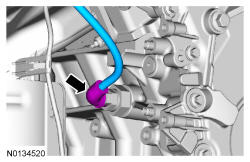
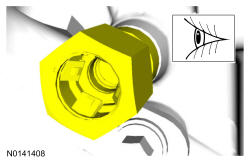
Visual check. If necessary, replace the quick connect fitting.- Tighten to 8 Nm (71 lb-in) plus an additional 540 degrees.
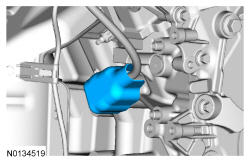
- 134.
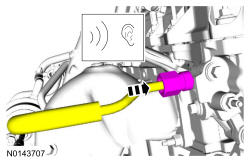
Install the RH oil supply tube into the quick connect fitting. REFER to Fuel System General Information . Noise check.
NOTE:
Listen for audible click when installing the oil supply tube into the quick connect fitting.
- 135.
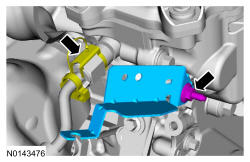
Install the RH oil supply tube secondary latch and the HO2S bracket and stud bolt to the engine front cover.- Tighten the stud bolt to 10 Nm (89 lb-in).
- 136.
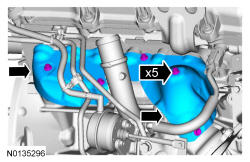
Install the 2 upper RH exhaust manifold heat shield and the 5 bolts.- Tighten to 14 Nm (124 lb-in).
NOTE:
Make sure the heat shield does not contact the wastegate arm.
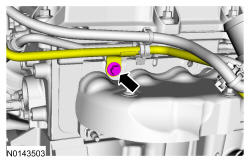
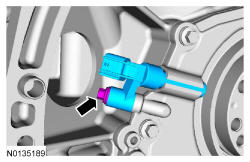
- 139.
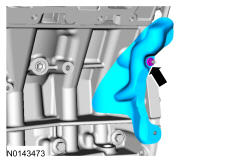
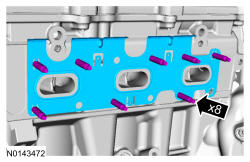
Install the wiring harness and the stud bolt and connect the CKP sensor electrical connector.- Tighten to 10 Nm (89 lb-in).
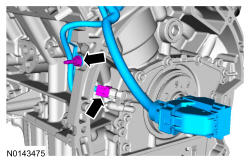
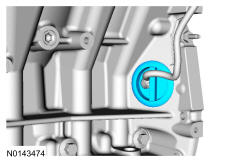
- 143.
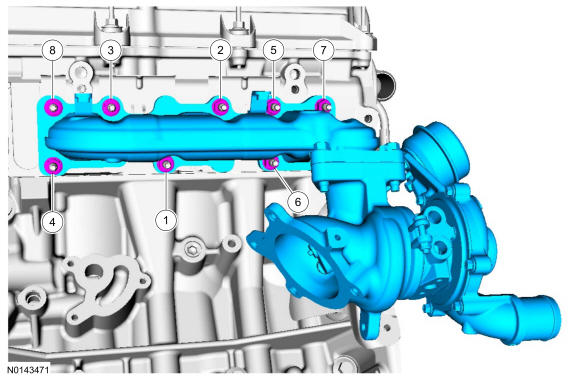
Install the LH exhaust manifold and turbocharger assembly and 8 new nuts. Tighten the nuts in 2 stages in the sequence shown:- Stage 1: Tighten to 15 Nm (133 lb-in).
- Stage 2: Tighten to 20 Nm (177 lb-in).
NOTE:
Failure to tighten the exhaust manifold nuts to specification a second time will cause the exhaust manifold to develop an exhaust leak.
 Courtesy of FORD MOTOR CO.
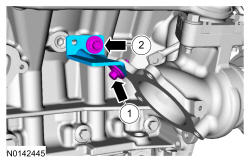
- 144.
Install the upper turbocharger bracket-to-cylinder block and the 2 bolts.- Do not tighten the bolts at this time.
- 145.
Install the lower turbocharger-to-cylinder block bracket and the 2 bolts.- Do not tighten the bolts at this time.
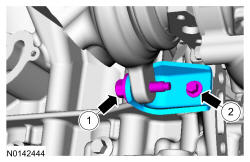
NOTE:
The next 4 steps must be performed in order or damage to the turbocharger may occur.
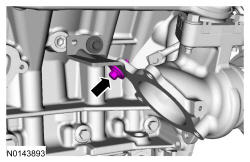
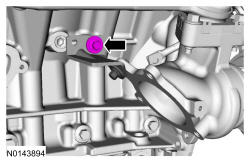
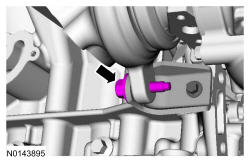
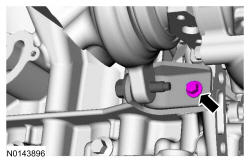
- 150.
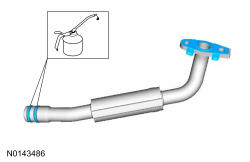
Install 2 new O-ring seals and new gasket on the oil return tube.
NOTE:
Lubricate the O-ring seals with clean engine oil.
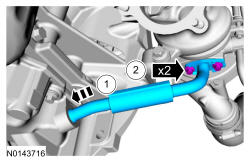
- 151.
Install the LH turbocharger oil return tube in the oil pan and install the 2 bolts.- Tighten to 10 Nm (89 lb-in).
NOTE:
Lubricate the oil pan bore with clean engine oil.
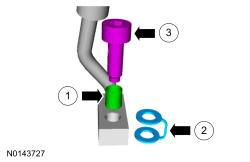
- 153.
Install the oil supply tube filter, washer and bolt.- 1.
Install the oil supply tube filter in the oil supply tube block.
- 2.
Slide the new washer onto the oil supply tube block.
- 3.
Install the banjo bolt into the oil supply tube block.
- 1.
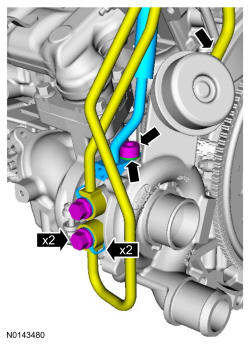
- 154.
Install the 2 LH turbocharger coolant tubes, LH turbocharger oil supply tube and banjo bolts.- Tighten to 40 Nm (30 lb-ft).
- Connect the turbocharger wastegate regulating valve hose to the LH turbocharger assembly
NOTE:
Make sure the turbocharger wastegate regulating valve hose does not contact the exhaust manifold heat shield.
- 155.
Visual check. If necessary, replace the quick connect fitting.- Tighten to 8 Nm (71 lb-in) plus an additional 540 degrees.
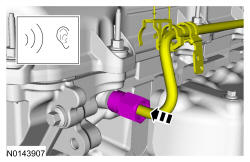
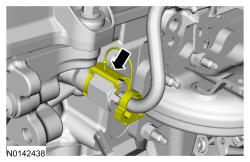
- 156.
Install the LH oil supply tube into the quick connect fitting. REFER to Fuel System General Information . Noise check.
NOTE:
Listen for audible click when installing the oil supply tube into the quick connect fitting.
- 159.
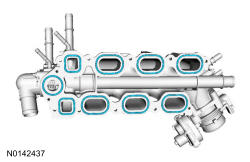
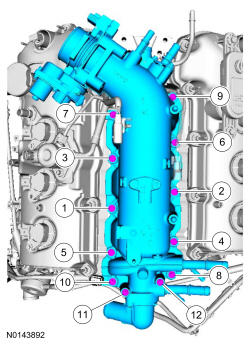
Install the intake manifold and the 12 bolts. Tighten in the sequence shown in 2 stages.- Stage 1: Tighten to 10 Nm (89 lb-in).
- Stage 2: Tighten an additional 45 degrees.
NOTE:
Installing the 2 long bolts first will aid in installing the intake manifold.
NOTE:
Make sure the fuel rail wiring harnesses are routed correct.
NOTE:
If the engine is repaired or replaced because of upper engine failure, typically including valve or piston damage, check the intake manifold for metal debris. If metal debris is found, install a new intake manifold. Failure to follow these instructions can result in engine damage.
- 160.
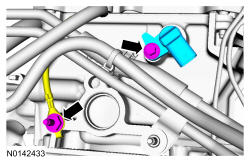
Install LH CMP sensor and the bolt and install the ground wire and the stud bolt.- Tighten to 10 Nm (89 lb-in).
- 161.
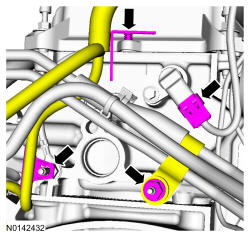
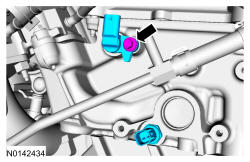
Connect the LH CMP sensor electrical connector and install the coolant tube retainer nut.- Tighten to 10 Nm (89 lb-in).
- Attach the 2 wiring harness retainers.
- 163.
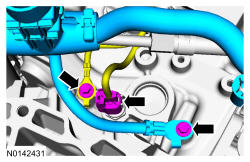
Install the battery wiring harness, 2 ground wires and the 2 bolts.- Tighten to 10 Nm (89 lb-in).
- Connect the Cylinder Head Temperature (CHT) sensor electrical connector.
- 164.
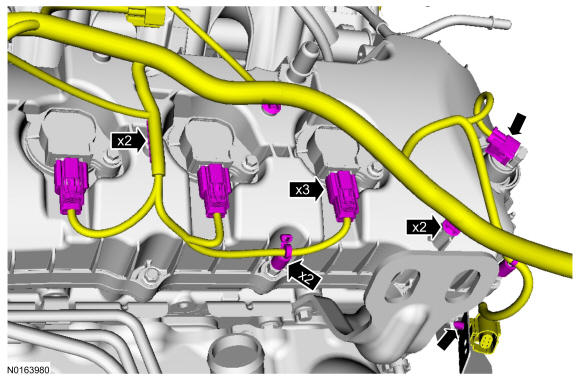
Connect the RH VCT solenoid and the 3 ignition coil-on-plug electrical connectors.- Attach all the wiring harness retainers.
- 165.
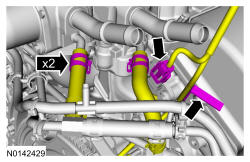
Connect the 2 turbocharger coolant hoses to the intake manifold and connect the CMP sensor electrical connector.- Attach the wiring harness retainer.
- 166.
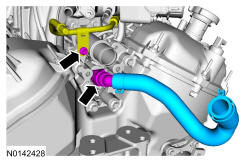
Position the fuel tube and install the fuel tube-to-engine front cover bracket bolt and install the coolant tube.- Tighten to 10 Nm (89 lb-in).
- 167.
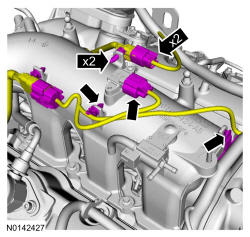
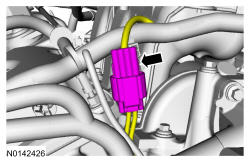
Connect the Manifold Absolute Pressure (MAP) /Intake Air Temperature 2 (IAT2) sensor electrical connector.- Connect and attach the 2 fuel injector wiring harness electrical connectors and the 2 wiring harness retainers.
- 169.
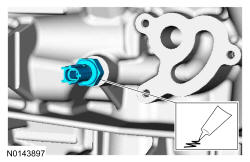
Install the EOP switch.- To install, tighten to 14 Nm (124 lb-in) plus an additional 180 degrees.
NOTE:
Apply thread sealant with PTFE to the Engine Oil Pressure (EOP) switch threads.
- 171.
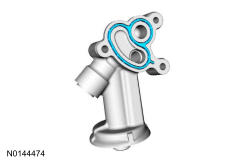
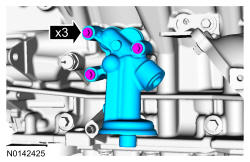
Using a new gasket, install the oil filter adapter and the 3 bolts.- Tighten to 10 Nm (89 lb-in) plus an additional 45 degrees.
- 172.
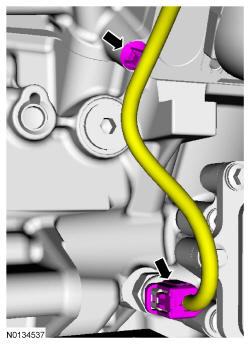
Connect the Engine Oil Pressure (EOP) electrical connector.- Attach the EOP wiring harness retainer to the engine block.
- 173.
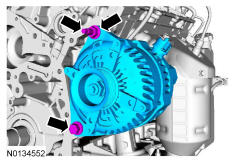
Install the stud, generator and the nut and bolt.- Tighten the stud to 8 Nm (71 lb-in).
- Tighten the nut and bolt to 47 Nm (35 lb-ft).
- 174.
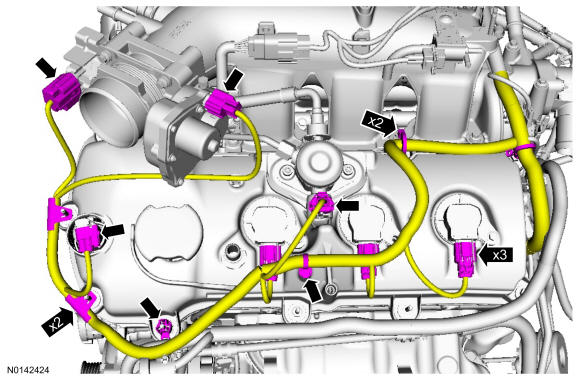
Connect the Throttle Position (TP) sensor, electronic TB, LH Variable Camshaft Timing (VCT) solenoid and the 3 ignition coil-on-plugs electrical connectors.- Attach all the wiring harness retainers from the LH valve cover and stud bolts.
- 175.
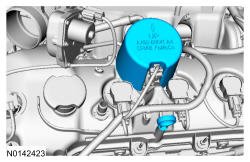
Install the noise insulator shield for the fuel injection pump and install the oil level indicator.
- 176.
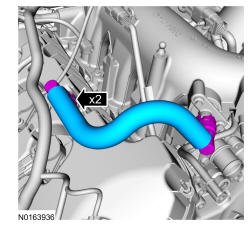
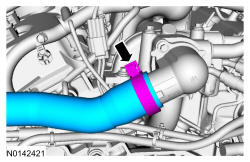
Install the PCV tube and connect the 2 quick connect couplings. REFER to Fuel System General Information .
- 178.
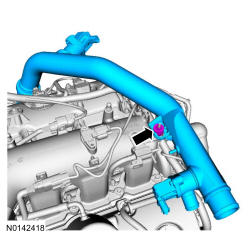
Install the RH Charge Air Cooler (CAC) tube and turbocharger intake tube as an assembly and install the RH CAC tube nut to the intake manifold.- Tighten to 6 Nm (53 lb-in).
NOTE:
The compression limiter bushing may fall out of the mounting bracket grommet on the Charge Air Cooler (CAC) tube during service. Make sure the bushing is in place when reinstalling the tube or damage to the tube may occur.
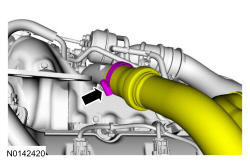
- 179.
Install the RH CAC tube to the RH turbocharger and tighten the clamp.- Tighten to 5 Nm (44 lb-in).
NOTE:
Align the index marks for the RH CAC tube.
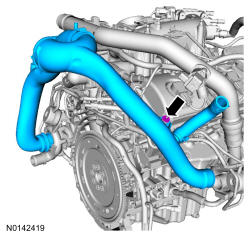
- 180.
Install the RH turbocharger intake tube and the nut.- Tighten to 6 Nm (53 lb-in).
NOTE:
The compression limiter bushing may fall out of the mounting bracket grommet on the turbocharger intake tube during service. Make sure the bushing is in place when reinstalling the tube or damage to the tube may occur.
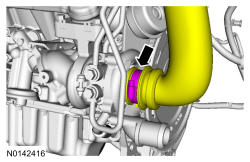
- 181.
Install the LH turbocharger intake tube to the LH turbocharger and tighten the clamp.- Tighten to 5 Nm (44 lb-in).
NOTE:
Align the index marks for the LH turbocharger intake tube.
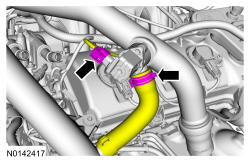
- 182.
Install the turbocharger bypass valve hose and connect the RH turbocharger bypass valve electrical connector.
- 183.
Install the turbocharger wastegate regulating valve hoses to the RH CAC tube and turbocharger wastegate regulating valve.- Connect the turbocharger wastegate regulating valve electrical connector.
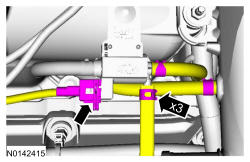
- 184.
Install the bypass valve hose and connect the LH turbocharger bypass valve electrical connector.
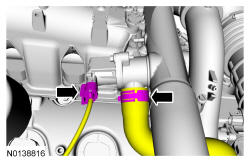
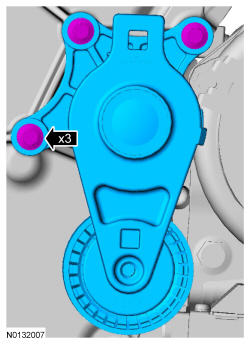
- 186.
If equipped, install the block heater wiring harness to the engine.- Connect the block heater electrical connector.