Refrigerant System Tests
SPECIAL TOOL(S)
| R-134A Side Wheel Manifold with Hoses 023-00047300-ROB40134AE | |
| R134A REFRIGERANT RECOVERY RECYCLING And RECHARGE MA (R-134a Refrigerant Management Machine (SAE Compliant)) 300-ROB34288 | |
| A/C SERVICE MACHINE PRINTER 199-00067 |


Ambient Temperature at or Below 38°C (100°F)
NOTE:
The system performance can be evaluated and diagnosed by analysis of the compressor suction and discharge pressures. The following procedure is used to determine if the system is operating at normal pressures.
NOTE:
The procedure varies depending on the ambient (shop) temperature. If the ambient temperature is 38°C (100.3°F) or lower, follow Procedure 1. If the ambient temperature is over 38°C (100.3°F), follow Procedure 2.
NOTE:
If the A/C compressor cycles at any time during this test, refer to the diagnostic table.
- 3.
Set the climate controls.- If equipped with manual climate control, set the A/C controls for normal A/C -PANEL mode, full COOL temperature, FRESH air, HI blower. If the vehicle has a fresh air/recirc button, set it to FRESH. If the vehicle has an A/C switch or compressor on switch, set it to A/C ON.
- If equipped with EATC, set temperature to 15°C (59°F) (lowest possible temp setting) with the dual function disabled (if equipped). Manually set blower on HI. If the vehicle has a fresh air/recirc button, set it to FRESH. If the vehicle has an A/C switch or compressor on switch, set it to A/C ON.
- 5.
Confirm the compressor clutch is engaged and the engine cooling fan(s) are operating or engaged. Allow the vehicle to idle until the suction (low-side) and discharge (high-side) pressures are stable or fluctuate in a range that repeats.
- 8.
Determine if the discharge pressure falls within the normal operating limits using the Normal Refrigerant Discharge Pressures chart in illustration.
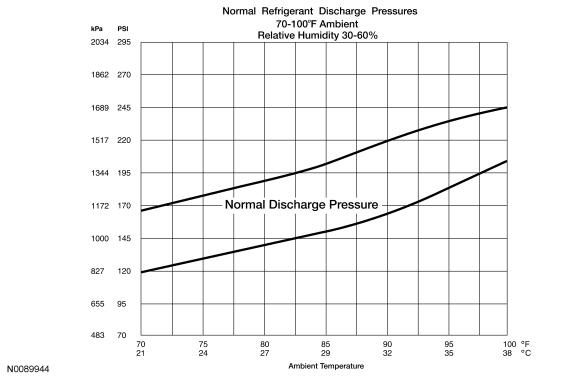
- 10.
Determine if the suction pressure falls between normal operating limits using the Normal Refrigerant Suction Pressures chart in illustration.
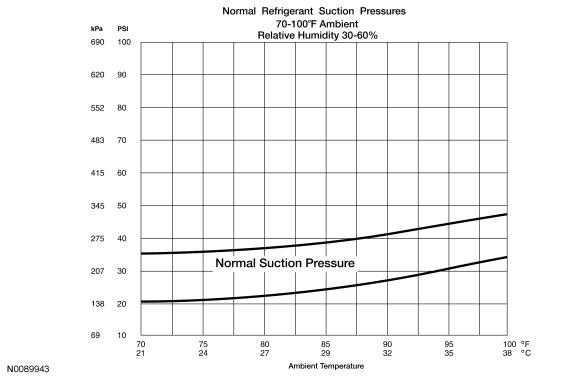
Ambient Temperature Above 38°C (100°F)
NOTE:
The system performance can be evaluated and diagnosed by analysis of the compressor suction and discharge pressures. The following procedure is used to determine if the system is operating at normal pressures.
NOTE:
The procedure varies depending on the ambient (shop) temperature. If the ambient temperature is 38°C (100.3°F) or lower, follow Procedure 1. If the ambient temperature is over 38°C (100.3°F), follow Procedure 2.
NOTE:
If the A/C compressor cycles at any time during this test, refer to the diagnostic table.
- 3.
Set the climate controls.- If equipped with manual climate control, set the A/C controls for normal A/C -PANEL mode, full COOL temperature, FRESH air, MED-LO blower. If the vehicle has a fresh air/recirc button, set it to FRESH. If the vehicle has an A/C switch or compressor on switch, set it to A/C ON.
- If equipped with EATC, set temperature to 15°C (59°F) (lowest possible temp setting). Manually set blower to MED-LO (3 to 4 bars). If the vehicle has a fresh air/recirc button, set it to FRESH. If the vehicle has an A/C switch or compressor on switch, set it to A/C ON.
- 4.
Open all vehicle windows and leave the hood open for the test. Open the rear hatch and/or rear doors (if equipped).
- 5.
Confirm the compressor clutch is engaged and the engine cooling fan(s) are operating or engaged. Allow the vehicle to idle until the suction (low-side) and discharge (high-side) pressures are stable or fluctuate in a range that repeats.
- 8.
Determine if the discharge pressure falls within the normal operating limits using the Normal Refrigerant Discharge Pressures chart in illustration.
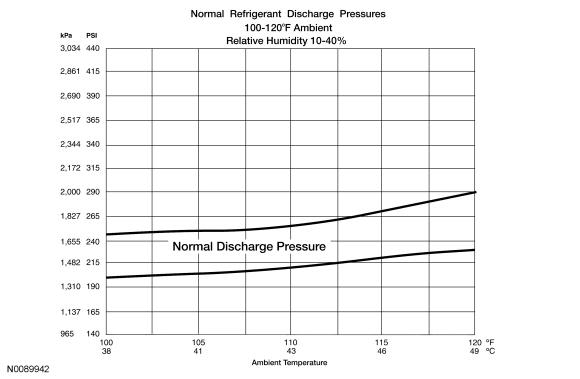
- 10.
Determine if the suction pressure falls between normal operating limits using the Normal Refrigerant Suction Pressures chart in illustration.
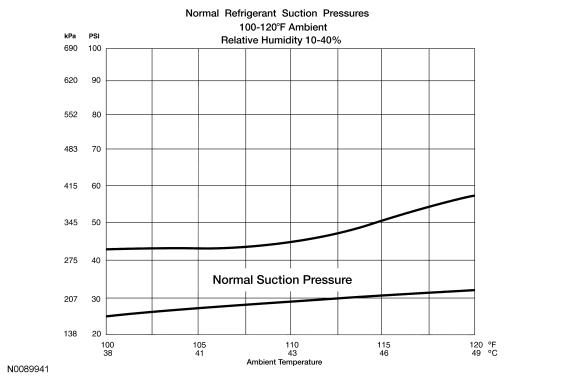
Diagnostic Table
NOTE:
The following table is used to guide diagnosis of the refrigerant system if operating pressures are outside normal limits.
- 1.
Refer to the chart below.High (Discharge) Pressure Low (Suction) Pressure Component - Causes High or Clutch Cycling High Condenser - inadequate airflow. High Normal to High Engine - overheating. Normal to High Normal Refrigerant overcharge - air in refrigerant. Normal to Low Normal to High A/C suction line - partially restricted or plugged.(1) Normal to Low Low or Clutch Cycling Low refrigerant charge, A/C suction line -partially restricted or plugged.(2) Erratic Operation or Compressor Not Running Evaporator discharge air temperature sensor or A/C pressure transducer - poor connection at A/C clutch connector. A/C electrical circuit erratic - see A/C Electrical Circuit Wiring Diagram. Normal to Low High Compressor - low performance. Additional Possible Cause Components Associated With Inadequate Compressor Operation Compressor drive belt - loose
Compressor clutch - slipping
Clutch coil open - shorted, or loose mounting
HVAC module
Clutch wiring circuit - high resistance, open or blown fuse
Compressor operation interrupted by PCMAdditional Possible Cause Components Associated With a Damaged Compressor Incorrect clutch air-gap
Refrigerant leaks(1) Low pressure reading will be normal to high if restriction is downstream of service access valve. (2) Low pressure reading will be low if restriction is upstream of service access valve.