Refrigerant Oil Adding
SPECIAL TOOL(S)
| R134A LOOP/ADD ON KIT-SET 219-00069 |

MATERIAL
| Item | Specification |
|---|---|
| Motorcraft® PAG Refrigerant Compressor Oil YN-12-D | WSH-M1C231-B |
Refrigerant Oil Adding
NOTE:
During normal A/C operation, oil is circulated through the system with the refrigerant, and a small amount is retained in each component. If certain components of the system are removed, some of the Polyalkylene Glycol (PAG) oil will go with the component. To maintain the original total oil charge, it is necessary to compensate for the oil lost by adding oil to the system with the new part.
- 1.
Refer to the chart below for refrigerant oil adding amounts and methods of installation.Component Polyalkylene Glycol (PAG) Oil Amount Method of Adding A/C Compressor - 2.0L GTDI Service compressor already contains full system charge of oil. No oil matching is required. - A/C Compressor - 3.5L Service compressor already contains full system charge of oil. No oil matching is required. - Receiver/Drier 60 ml (2.03 fl. oz) Inject to low-side service port during system charging. Receiver/Drier Cartridge 30 ml (1.01 fl. oz) Inject to low-side service port during system charging. Evaporator Core 45 ml (1.52 fl. oz) added to the amount collected during refrigerant recovery Add directly to evaporator core inlet tube or inject to low-side service port during system charging. Condenser Core 60 ml (2.03 fl. oz) added to the amount collected during refrigerant recovery Add directly to condenser core inlet or inject to low-side service port during system charging. Evaporator Core Orifice or TXV The amount collected during refrigerant recovery Inject to low-side service port during system charging. A/C Pressure Relief Valve 60 ml (2.03 fl. oz) added to the amount collected during refrigerant recovery Inject to low-side service port during system charging. Refrigerant Hose/Line 60 ml (2.03 fl. oz) added to the amount collected during refrigerant recovery(1) Inject to low-side service port during system charging. O-ring Leak Repair 60 ml (2.03 fl. oz) added to the amount collected during refrigerant recovery(2) Inject to low-side service port during system charging. Service Port Leak Repair 60 ml (2.03 fl. oz) added to the amount collected during refrigerant recovery Inject to low-side service port during system charging. (1) If an excessive amount of Polyalkylene Glycol (PAG) oil is lost due to a hose rupture/separation or other damage, the total system Polyalkylene Glycol (PAG) oil capacity must be added. (2) The amount specified may be used for one or multiple O-ring leak repairs. Do not multiply the Polyalkylene Glycol (PAG) oil amount by the number of O-ring leaks being repaired.
Oil Injection Using a Dye/Lubricant Injector
NOTE:
If fluorescent leak detection dye is also to be added during A/C charging, the dye may be added to the dye/lubricant injector, from the R-134a Loop/Add On Injector Kit-Set, along with the Polyalkylene Glycol (PAG) oil.
- 1.
Evacuate the refrigerant system. REFER to Climate Control - EMTC .
- 2.
Assemble the dye/lubricant injector and the correct adapters from 219-00069 to match the amount of refrigerant compressor oil to be injected.
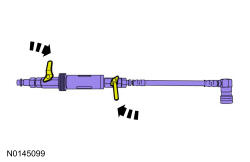
- 4.
Fill the dye/lubricant injector with the correct amount of clean, new Polyalkylene Glycol (PAG) oil.
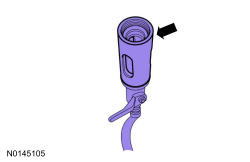
- 5.
Install the dye/lubricant injector between the low-side service gauge port valve and the refrigerant service station or manifold gauge set.
- 6.
Open all valves and charge the refrigerant system. REFER to Climate Control - EMTC .