Interior Lighting: Notes
Overview
The interior lighting system consists of:
- Courtesy lamps
- Demand lamps
- Ambient lighting (if equipped)
The courtesy lamps subsystem consists of:
- interior lamps
- puddle lamps
- door ajar switches (integrated into the door latches)
- liftgate ajar switch (manual liftgate)
- LTM (power liftgate)
- courtesy lamp switch (integrated into the FLM)
- BCM
The courtesy lamps provide illumination to the interior of the vehicle when entering or exiting the vehicle or when requested using the courtesy lamp switch.
The demand lamps subsystem consists of:
- interior lamps
- vanity mirror lamps
- BCM
The demand lamps are used to provide illumination to specific areas within the vehicle, such as a map/reading lamp or vanity mirror. The BCM energizes the battery saver relay to supply voltage to the demand lamps when the battery saver feature is not active.
The ambient lighting subsystem consists of:
- ambient lighting harnesses
- HVAC module
- APIM
The ambient lighting provides aesthetically colored illumination to the center console cup holders, the door map pockets, the door pull handles, the door release handles, and the front and rear footwells for illuminated entry or when the ignition is in run with the parking lamps on. The ambient lighting is controlled using the touchscreen display in the center of the instrument panel.
System Operation
System Diagram
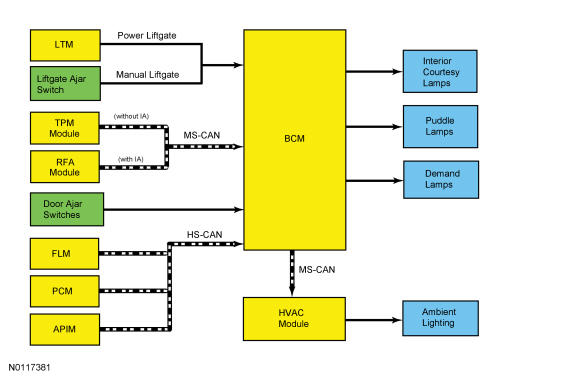
Network Message Chart BCM Network Message Chart
| Broadcast Message | Originating Module | Message Purpose |
|---|---|---|
| Vehicle speed | PCM | Indicates vehicle speed to the BCM. When the courtesy lamps are on from an open door or liftgate, the courtesy lamps turn off when the vehicle speed is greater than 15 kmh (9.3 mph). |
| Headlamp switch status | FLM | Commands the courtesy lamps on or off when the courtesy lamp switch is pressed. |
| Passive entry_lock request Passive entry_lock status Passive entry_lock event number | RFA module | Provides information regarding the RKE system for the BCM to activate or deactivate the illuminated entry/exit features. |
| RKE data | TPM module | Provides information regarding the RKE system for the BCM to activate or deactivate the illuminated entry/exit features. |
HVAC Module Network Message Chart
| Broadcast Message | Originating Module | Message Purpose |
|---|---|---|
| Parking lamp status | BCM | Indicates whether the parking lamps are on or off to activate the ambient lighting. |
| Courtesy delay status | BCM | Indicates whether the courtesy delay feature is active or inactive. |
| Door courtesy light status | BCM | Indicates whether the courtesy lamps are on from an open door. The ambient lighting defaults to a preset color when a door is open. |
| Illuminated entry status | BCM | Indicates whether the illuminated entry feature is on or off. The ambient lighting defaults to a preset color when the illuminated entry feature is active. |
| Illuminated exit status | BCM | Indicates whether the illuminated exit feature is on or off. The ambient lighting defaults to a preset color when the illuminated exit feature is active. |
| Ambient light color request | APIM | Indicates the color selected from the display interface. This commands the ambient color setting as requested by the operator. |
| Ambient light intensity request | APIM | Indicates brightness setting selected from the display interface. This commands the ambient brightness setting as requested by the operator. |
Battery Saver
To save battery voltage, the BCM provides automatic shut-off of the interior and exterior lamps after a time-out period when the ignition is off. The BCM monitors the ignition state and input from the RKE system to determine when to energize or de-energize the battery saver relay and to shut the power off to the lamps. A timer in the BCM starts when:
- the ignition changes to OFF,
- any door or liftgate becomes ajar while the ignition is off,
- an UNLOCK button of the RKE transmitter is pressed while the ignition is off,
- a valid keypad code is entered while the ignition is off,
- or the courtesy lamp switch (integrated into the FLM) is used to turn the courtesy lamps on while the ignition is off.
When 10 minutes have elapsed, the BCM automatically shuts off voltage to the lamps. The timer restarts (voltage is restored if the BCM is in battery saver mode) if:
- the ignition transitions out of OFF,
- any door or liftgate becomes ajar,
- the UNLOCK button of the RKE transmitter is pressed,
- a valid keypad code is entered,
- the courtesy lamp switch is pressed.
Courtesy Lamps
The BCM controls all the interior lighting functions and timing by monitoring inputs from the:
- door ajar switches
- liftgate ajar switch (manual liftgate)
- LTM (power liftgate)
- ignition state
- courtesy lamp switch (integrated into the FLM)
- RKE system
- vehicle speed
The BCM sends a 12 volt signal to each door ajar switch and the liftgate latch (manual liftgate) or the LTM (power liftgate). When the doors and liftgate are closed, the voltage signals are pulled low, indicating a closed door or liftgate.
The BCM monitors input from the RKE transmitter (messaged from the TPM module on vehicles without Intelligent Access (IA) or from the RFA on vehicles With Intelligent Access) to determine when to activate/deactivate the illuminate entry feature.
The BCM monitors input from the FLM over the communication network to determine when to activate/deactivate the courtesy lamps. When the courtesy lamp button is pressed on the FLM, it sends a headlamp switch status message to the BCM indicating the request.
The BCM monitors the ignition state to determine when to activate/deactivate the illuminated exit feature.
Based on the input, the BCM controls the solid state relays to provide power to the courtesy lamps.
The BCM also provides an overload protection of the interior courtesy and puddle lamp output circuits. When an excessive current draw is detected, the BCM disables the affected interior courtesy or puddle lamp circuit driver. REFER to Multifunction Electronic Modules .
Illuminated Entry
The illuminated entry requests the dimmable backlighting, the parking lamps and the courtesy lamps to illuminate when the ignition is off and a door or liftgate is opened, the RKE transmitter UNLOCK button is pressed, or the vehicle is unlocked using the keyless entry keypad. If no doors are open, the illuminated entry requests the lamps off after 25 seconds have elapsed, the ignition is switched out of off, the RKE transmitter LOCK button is pressed, or the vehicle is locked using the keyless entry keypad.
Interior Lighting Delay
The interior lighting delay feature provides temporary illumination of the dimmable backlighting, the parking lamps and the courtesy lamps after the doors are opened and then closed. The interior lighting delay feature keeps the lamps on for a period of 25 seconds after all the doors are closed. If during the 25 second delay time the ignition has been switched out of off, or if the vehicle is locked using the RKE transmitter or the keyless entry keypad, the lamp illumination is discontinued.
Illuminated Exit
The illuminated exit requests the dimmable backlighting, the parking lamps, and the courtesy lamps to illuminate for 25 seconds after all doors are closed and the ignition is turned off. The illuminated exit deactivates when the ignition transitions out of off, a door or liftgate becomes ajar, or 25 seconds have elapsed.
Theater Lighting
The theater lighting feature ramps-up the courtesy lamps over 0.7 second when courtesy lamp activation is requested. The theater lighting feature ramps-down the courtesy lamps over 1.7 seconds when interior lighting deactivation is requested by any feature other than the panic alarm or battery saver.
Dark Car Feature
The dark car feature disables activation of courtesy lamps and backlighting due to a door unlock, door ajar or removing the key from the ignition cylinder. The courtesy lamps may still be activated by the instrument panel dimmer switch, post crash alert, and perimeter and panic alarms.
The dark car feature is enabled/disabled through programmable parameters in the BCM.
Interior Lamp Arbitrator
The interior lamp arbitrator (programming within the BCM) chooses between the interior lighting delay, the illuminated entry and exit, the battery saver, and the alarm flash processing to determine which feature has precedence of activating and deactivating the interior lamps.
Demand Lamps
The BCM monitors the ignition state and inputs from the RKE system to determine when to energize the battery saver relay. When the battery saver relay is energized, voltage is provided to the demand lamps. Refer to Interior Lighting , Battery Saver.
When the BCM is not in battery saver mode, the battery saver relay is energized to provide voltage to the demand lamps.
Ambient Lighting
The HVAC module provides the power and ground to the ambient lighting system, while the touchscreen is used to cycle through the different color variations or turn the ambient lighting feature on or off. There are 3 LEDs (red, blue and green) housed within each LED assembly. By illuminating various color combinations, the LEDs are able to produce 7 different colors of ambient light.
The ambient lighting LEDs provide illumination to the:
- cupholders (located in the center console)
- storage compartment(s)/map pocket (located in the center console)
- front footwells (located under the instrument panel)
- rear footwells (located in the rear of the center console)
- inside pull handles (located in each door trim panel)
- door map pockets (located in each door trim panel)
The APIM uses software to monitor the user interface from the touchscreen. Based on the ambient lighting system selections made using the touchscreen, the APIM sends ambient light color request and ambient light intensity request messages over the communication network for color and brightness settings. The HVAC module retains the last color and brightness setting between uses.
The BCM transmits parking lamps on, illuminated entry/exit feature active, and open door information over the communication network to the HVAC module.
Based on the input received from the FCIM (user preferences) and the BCM (parking lamps on, illuminated entry/exit, open door) over the communication network, the HVAC module provides voltage to the ambient lighting LEDs. The HVAC module also provides the ground source for the ambient lighting LEDs.