Pinpoint Test B : System Voltage Low Or Battery Is Discharged
NOTE:
Make sure battery voltage is greater than 12.2 volts prior to and during this pinpoint test.
NOTE:
Do not have a battery charger attached during vehicle testing.
- B1 PERFORM INSPECTION AND VERIFICATION
- Perform the Inspection and Verification
Was an obvious cause for an observed or reported concern found?
Yes CORRECT conditions as necessary. No GO to B2. - B2 RETRIEVE PCM DTCs
- Using a scan tool, perform PCM self-test.
Is DTC P0620, P0625, P0626 or P065B present?
Yes For DTC P0620, GO to Pinpoint Test C . For DTCs P0625 and P0626, GO to Pinpoint Test D . For DTC P065B, GO to Pinpoint Test E No GO to B3. - B3 CHECK THE GENERATOR CONNECTIONS
- Ignition OFF.
- Disconnect and inspect all generator connectors.
- Repair:
- corrosion (install new connector or terminals - clean module pins)
- damaged or bent pins - install new terminals/pins
- pushed-out pins - install new pins as necessary
- Connect the generator connectors. Make sure they seat, latch correctly and are tightened to specification. REFER to Battery, Mounting and Cables , Torque Specifications.
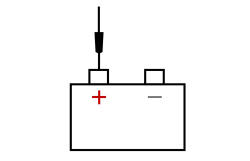
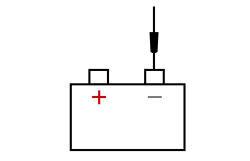
- Measure and record:
Positive Lead Measurement / Action Negative Lead
Battery Positive Post
Battery Negative Post
Is the voltage within 0.5 volt of battery voltage?
Yes GO to B4. No VERIFY the fusible links are OK. If OK, REPAIR the circuit. If not OK, REFER to the SYSTEM WIRING DIAGRAMS article to identify the Possible Sources of the circuit short. - B4 CHECK THE VOLTAGE DROP IN THE B+ CIRCUIT
- Start the engine.
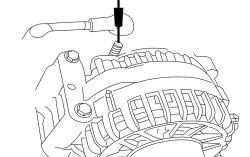
- With the engine running at idle, headlamps on and blower on high, measure:
Positive Lead Measurement / Action Negative Lead C102B-1
Battery Positive Post
- Carry out a wiggle test of the generator wiring and connections while measuring voltage drop.
Is the voltage drop less than 0.5 volt?
Yes GO to B5. No INSPECT and REPAIR any corrosion in the generator B+ circuit or positive battery cable connections. - B5 CHECK THE VOLTAGE DROP IN THE VEHICLE GROUNDS
- With the engine still running at idle, headlamps on and blower on high, measure:
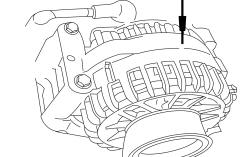
Positive Lead Measurement / Action Negative Lead
Generator Case Ground
Battery Negative Post
Is the voltage drop less than 0.5 volt?
Yes GO to B6. No INSPECT and REPAIR the engine ground, generator ground or the battery ground for corrosion. - With the engine still running at idle, headlamps on and blower on high, measure:
- B6 MONITOR THE GENERATOR VOLTAGE DESIRED (GENVDSD) PID WHILE COMMANDED
- Using a scan tool, view the PCM PIDs.
- Using the active command, set PID GENVDSD to 14 volts.
- Monitor the PCM PID GENVDSD.
- With the engine still running at idle, measure and record the battery voltage at the battery.
Is the recorded battery voltage within ±0.5 volt of the PID ?
Yes GO to B7. No INSTALL a new generator. REFER to Generator - 2.0L GTDI or REFER to Generator - 3.5L GTDI or REFER to Generator - 3.5L Ti-VCT . - B7 COMPARE THE SUPPLY VOLTAGE (VPWR) PID TO BATTERY VOLTAGE
- With the engine still running at idle, headlamps on and blower on high, measure and record the battery voltage at the battery.
- Using a scan tool, view the PCM PIDs.
- Monitor the PCM PID VPWR.
Does the PID accurately display battery voltage within ±0.5 volt of the recorded battery voltage?
Yes GO to B8. No REPAIR high resistance or loose connections in the affected PCM power circuit(s). - B8 CHECK PCM GROUND FOR HIGH RESISTANCE
- Monitor PCM PID VPWR.
- With the engine still running at idle, turn off all accessory loads, measure the battery voltage at the battery and note the PCM PID VPWR.
- With the engine still running at idle, turn headlamps on and blower on high, measure the battery voltage at the battery and monitor the PCM PID VPWR.
Does the PID read within ±0.5 volt with accessory loads on as compared to accessory loads off?
Yes GO to B9. No REPAIR the affected PCM ground circuits. - B9 MONITOR THE SUPPLY VOLTAGE (VPWR) PID
- With the engine still running at idle, turn off all accessory loads, measure and record the battery voltage at the battery and monitor the PCM PID VPWR.
- Monitor the PID VPWR and momentarily accelerate the engine to WOT and release. Repeat this step 4-5 times while continuing to monitor the PID.
Does the PID stay within 0.5 volt of the recorded battery voltage when the engine Revolutions Per Minute (RPM) are increased?
Yes The system is operating correctly at this time. The concern may have been caused by a loose or corroded connector. INSPECT and REPAIR any connector or pin issues found. If no connector or pin issues are found, CARRY OUT the battery drain test. REFER to Battery, Mounting and Cables No GO to B10. - B10 CHECK FOR CORRECT PCM OPERATION
- Ignition OFF.
- Disconnect and inspect all PCM connectors.
- Repair:
- corrosion (install new connector or terminals - clean module pins)
- damaged or bent pins - install new terminals/pins
- pushed-out pins - install new pins as necessary
- Reconnect the PCM and generator connectors. Make sure they seat and latch correctly.
- Operate the system and determine if the concern is still present.
Is the concern still present?
Yes CHECK OASIS for any applicable TSBs. If a TSB exists for this concern, DISCONTINUE this test and FOLLOW the TSB instructions. If no TSBs address this concern, INSTALL a new PCM. REFER to Electronic Engine Controls - 2.0L GTDI or REFER to Electronic Engine Controls - 3.5L GTDI or REFER to Electronic Engine Controls - 3.5L Ti-VCT. No The system is operating correctly at this time. The concern may have been caused by module connections. ADDRESS the root cause of any connector or pin issues.