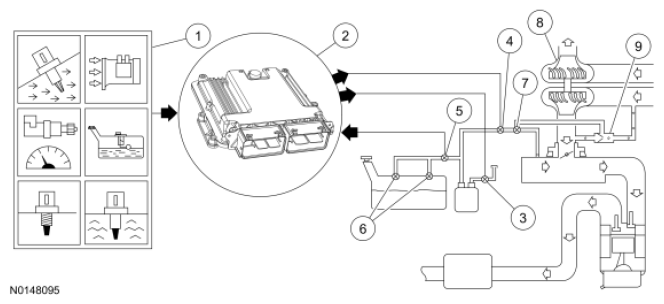
Enhanced Evaporative Emission (EVAP) System
The enhanced EVAP system consists of a fuel tank, fuel filler cap or capless fuel tank filler pipe, fuel tank mounted or inline fuel vapor control valve, fuel vapor vent valve, EVAP canister, fuel tank mounted or fuel pump mounted or inline fuel tank pressure (FTP) sensor, EVAP purge valve, EVAP check valve (if equipped), intake manifold hose assembly, EVAP canister vent valve, PCM and connecting wires, and fuel vapor hoses. The enhanced EVAP system, including all the fuel vapor hoses, can be checked when a leak is detected by the PCM. For additional information on the EVAP system components, refer to ENGINE CONTROL COMPONENTS in this service information.
- The enhanced EVAP system uses inputs from the engine coolant temperature (ECT) sensor or cylinder head temperature (CHT) sensor, the intake air temperature (IAT) sensor, the mass airflow (MAF) sensor (if equipped), the FTP sensor and vehicle speed to provide information about engine operating conditions to the PCM. The PCM uses the fuel level input (FLI) and FTP sensor signals to determine activation of the EVAP leak check monitor based on the presence of vapor generation or fuel sloshing.
- The PCM determines the desired amount of purge vapor flow to the intake manifold for a given engine condition. The PCM then outputs the required signal to the EVAP purge valve. The PCM uses the enhanced EVAP system inputs to evacuate the system using the EVAP purge valve, seal the enhanced EVAP system from the atmosphere using the EVAP canister vent valve, and uses the FTP sensor to observe total vacuum lost for a period of time.
- The EVAP canister vent valve seals the enhanced EVAP system to atmosphere during the EVAP leak check monitor.
- The PCM outputs a duty cycle between 0% and 100% to control the EVAP purge valve.
- The FTP sensor monitors the fuel tank pressure during engine operation and continuously transmits an input signal to the PCM. During the EVAP monitor testing, the FTP sensor monitors the fuel tank pressure or vacuum bleed up.
On some vehicles, a vapor blocking valve is used to isolate the fuel tank from the rest of the EVAP system for more efficient canister purging.
- A valve inside the fuel tank mounted fuel vapor tube assembly prevents liquid fuel from entering the EVAP canister and the EVAP purge valve under any vehicle altitude, handling, or rollover condition.
- On turbocharged engines, the EVAP check valve prevents boost pressure from entering the EVAP system.
- On turbocharged engines, the turbocharger creates boost pressure in the intake manifold.
- On turbocharged engines, an EVAP ejector is used to create a vacuum in the purge line during boost conditions. When in boost conditions a percentage of the boost pressure is applied to the EVAP ejector to create a vacuum. This vacuum draws purge vapors through the EVAP ejector into the intake air system upstream of the turbocharger.