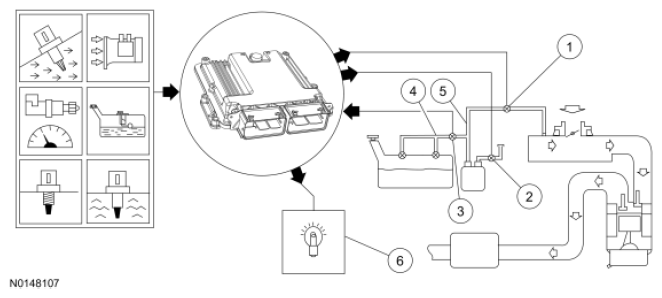
Engine On EVAP Leak Check Monitor
The engine on EVAP leak check monitor is executed by the individual components of the enhanced EVAP system as follows:
- The EVAP purge valve controls the flow of vacuum from the engine and creates a target vacuum on the fuel tank.
- The EVAP canister vent valve seals the EVAP system from the atmosphere. It is closed by the PCM (100% duty cycle) to allow the EVAP purge valve to achieve the target vacuum on the fuel tank.
- The FTP sensor is used by the engine on EVAP leak check monitor to determine if the target vacuum necessary to carry out the leak check on the fuel tank is reached. Some vehicle applications with the engine on EVAP leak check monitor use a remote inline FTP sensor. Once the target vacuum on the fuel tank is achieved, the change in fuel tank vacuum over a calibrated period of time determines if a leak exists.
- If the initial target vacuum cannot be reached, DTC P0455 (gross leak detected) sets. The engine on EVAP leak check monitor aborts and does not continue with the leak check portion of the test.
For some vehicle applications, if the initial target vacuum cannot be reached after a refueling event and the purge vapor flow is excessive, DTC P0457 (fuel cap off) sets.
If the initial target vacuum is exceeded, a system flow concern exists and DTC P1450 (unable to bleed up fuel tank vacuum) is set. The engine on EVAP leak check monitor aborts and does not continue with the leak check portion of the test.
If the vacuum increase is quicker than expected, a blocked fuel vapor tube is suspected and if confirmed after an intrusive test, DTC P144A sets.
If the target vacuum is achieved on the fuel tank, the change in the fuel tank vacuum (bleed up) is calculated for a calibrated period of time. The calculated change in fuel tank vacuum is compared to a calibrated threshold for a leak from an opening of 1.016 mm (0.040 inch) in the enhanced EVAP system. If the calculated bleed up is less than the calibrated threshold, the enhanced EVAP system passes. If the calibrated bleed up exceeds the calibrated threshold, the test aborts. The test can be repeated up to 3 times.
If the bleed up threshold is still being exceeded after 3 tests, a vapor generation test is carried out before DTC P0442 (small leak detected) sets. This is accomplished by returning the enhanced EVAP system to atmospheric pressure by closing the EVAP purge valve and opening the EVAP canister vent valve. Once the FTP sensor observes the fuel tank is at atmospheric pressure, the EVAP canister vent valve closes and seals the enhanced EVAP system.
The fuel tank pressure build up over a calibrated period of time is compared to a calibrated threshold for pressure build up due to vapor generation.
If the fuel tank pressure build up exceeds the threshold, the leak test results are invalid due to vapor generation. The engine on EVAP leak check monitor attempts to repeat the test again.
If the fuel tank pressure build up does not exceed the threshold, the leak test results are valid and DTC P0442 sets.
- If the 1.016 mm (0.040 inch) test passes, the test time is extended to allow the 0.508 mm (0.020 inch) test to run.
The calculated change in fuel vacuum over the extended time is compared to a calibrated threshold for a leak from a 0.508 mm (0.020 inch) opening.
If the calculated bleed up exceeds the calibrated threshold, the vapor generation test is run. If the vapor generation test passes (no vapor generation), an internal flag sets in the PCM to run a 0.508 mm (0.020 inch) test at idle (vehicle stopped).
On the next start following a long engine OFF period, the enhanced EVAP system is sealed and evacuated for the first 10 minutes of operation.
If the appropriate conditions are met, a 0.508 mm (0.020 inch) leak check is conducted at idle.
If the test at idle fails, DTC P0456 sets. There is no vapor generation test with the idle test.
- The malfunction indicator lamp (MIL) is activated any enhanced EVAP system component DTCs.