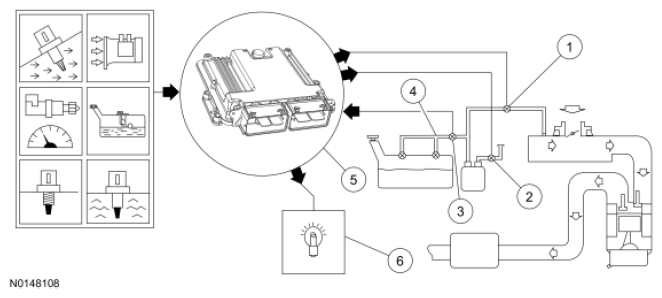
Engine Off Natural Vacuum (EONV) EVAP Leak Check Monitor
The EONV EVAP leak check monitor is executed during ignition OFF, after the engine on EVAP leak check monitor is completed. The EONV EVAP leak check monitor determines a leak is present when the naturally occurring change in fuel tank pressure or vacuum does not exceed a calibrated limit during a calibrated amount of time. A separate, low power consuming, microprocessor in the PCM manages the EONV leak check. The engine OFF EVAP leak check monitor is executed by the individual components of the enhanced EVAP system as follows:
- The EVAP purge valve is normally closed at ignition OFF.
- The normally open EVAP canister vent valve remains open for a calibrated amount of time to allow the fuel tank pressure to stabilize with the atmosphere. During this time period the FTP sensor is monitored for an increase in pressure. If pressure remains below a calibrated limit the EVAP canister vent valve is closed by the PCM (100% duty cycle) and seals the EVAP system from the atmosphere.
- The EONV EVAP leak check monitor uses the FTP sensor to determine if the target pressure or vacuum necessary to complete the EONV EVAP leak check monitor on the fuel tank is reached. Some vehicle applications with the EONV EVAP leak check monitor use a remote inline FTP sensor. If the target pressure or vacuum on the fuel tank is achieved within the calibrated amount of time, the test is complete.
- The EONV EVAP leak check monitor uses the naturally occurring change in fuel tank pressure as a means to detect a leak in the EVAP system. At ignition OFF, a target pressure and vacuum is determined by the PCM. These target values are based on the fuel level and the ambient temperature at ignition OFF. As the fuel tank temperature increases, the pressure in the tank increases and as the temperature decreases a vacuum develops. If a leak is present in the EVAP system the fuel tank pressure or vacuum does not exceed the target value during the testing time period. The EONV EVAP leak check monitor begins at ignition OFF. After ignition OFF the normally open EVAP canister vent valve remains open for a calibrated amount of time to allow the fuel tank pressure to stabilize with the atmosphere. During this time period the FTP sensor is monitored for an increase in pressure. If pressure remains below a calibrated limit the EVAP canister vent valve is closed by the PCM (100% duty cycle) and seals the EVAP system from the atmosphere.
If the pressure on the fuel tank decreases after the EVAP system is sealed, the EONV EVAP leak check monitor begins to monitor the fuel tank pressure. When the target vacuum is exceeded within the calibrated amount of time the test completes and the fuel tank pressure and time since ignition OFF information is stored. If the target vacuum is not reached in the calibrated amount of time, a leak is suspected and the fuel tank pressure and time since ignition OFF information is stored.
If the pressure on the fuel tank increases after the EVAP system is sealed, but does not exceed the target pressure within a calibrated amount of time, the EVAP canister vent valve is opened to allow the fuel tank pressure to again stabilize with the atmosphere. After a calibrated amount of time the EVAP canister vent valve is closed by the PCM and seals the EVAP system. When the fuel tank pressure exceeds either the target pressure or vacuum within the calibrated amount of time, the test completes and the fuel tank pressure and time since ignition OFF information is stored. If the target pressure or vacuum is not reached in the calibrated amount of time, a leak is suspected and the fuel tank pressure and time since ignition OFF information is stored.
On ISO 14229 vehicles, a fast initial response occurs during the first 4 tests after the battery is disconnected or the DTCs are cleared. The PCM processes unfiltered data to quickly indicate a fault is present. The MIL illuminates if the PCM suspects a leak within 2 consecutive trips after a DTC clear or a battery disconnect using the fast initial response logic.
A step change logic becomes active after the 4th EONV monitor test. The step change logic detects an abrupt change from a no leak condition to a suspected leak condition. The MIL illuminates if the PCM suspects a leak within 2 consecutive trips using the step change logic.
During the EONV monitor test the PCM uses an exponentially weighted moving average to filter test data. The PCM uses this average after the fourth EONV test and illuminates the MIL on the first trip when the exponentially weighted moving average is greater than a calibrated threshold.
When a leak is suspected a DTC sets and the MIL is illuminated.
On non ISO 14229 vehicles, when a leak is suspected, the PCM uses the stored fuel tank pressure and time since ignition OFF information from an average run of 4 tests to suspect a leak. Some vehicles use an alternative method of a single run of 5 tests to determine the presence of a leak. If a leak is still suspected after 2 consecutive runs of 4 tests, (8 total tests) or one run of 5 tests, a DTC sets and the MIL is illuminated.
- The EONV EVAP leak check monitor is controlled by a separate low power consuming microprocessor inside the PCM. The fuel level input, fuel tank pressure, and battery voltage are inputs to the microprocessor. The microprocessor outputs are the EVAP canister vent valve and the stored test information. If the separate microprocessor is unable to control the EVAP canister vent valve or communicate with other processors a DTC sets.
- The MIL is activated for any enhanced EVAP system component DTCs.