Passive Anti-Theft System (PATS) - Without Intelligent Access (IA): Notes
Overview
PATS protects the vehicle from theft by preventing the engine from starting unless a programmed PATS key is in the ignition. PATS cannot disable an already running engine.
System Operation
System Diagram
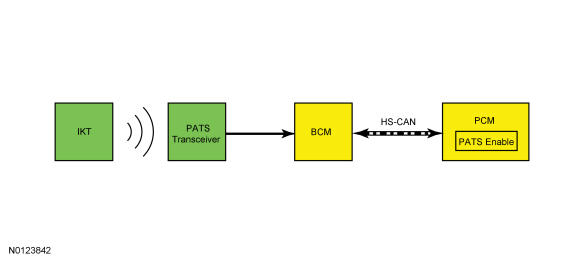
Network Message Chart
PCM Network Message Chart
| Broadcast Message | Originating Module | Message Purpose |
|---|---|---|
| PATS start request target data | BCM | A request to check the PCM ID. |
BCM Network Message Chart
| Broadcast Message | Originating Module | Message Purpose |
|---|---|---|
| PATS status enable/disable target data | PCM | The response from the BCM request for the PCM ID. If the PCM ID response is incorrect, then PATS is disabled. |
Passive Anti-Theft System
The PATS is controlled by the BCM. There are 2 main checks that PATS performs before allowing the engine to start. If either of these checks fail, PATS does not allow the engine to start and STARTING SYSTEM FAULT is displayed in the message center. These 2 checks are the BCM verifying the PCM identification to make sure it matches the PCM identification stored in memory and to verify that a programmed key was used to turn the ignition to the RUN or START position.
The first check is initiated by the BCM waking up the PCM by supplying voltage on the wakeup control circuit. The BCM only activates the wakeup circuit 5 times. After that the wakeup circuit remains off until the ignition is cycled to RUN. The BCM activates the wakeup control circuit when:
- the driver door is opened.
- a remote start request is received (if equipped with factory remote start).
- the brake pedal is pressed.
- a key is inserted into the ignition.
- or when the ignition is in the RUN or START position.
Once the PCM is awake, the BCM sends the PCM a challenge message over the HS-CAN. When the PCM receives the challenge message, it generates a response and sends it back to the BCM. If the response from the PCM does not match the response in the BCM memory, this first check fails and the engine will not start.
Once the PCM identification has been verified, PATS performs the second check to make sure a programmed key is in the ignition. When the BCM determines the ignition has been turned to the RUN or START position, it generates a challenge message. It sends the challenge message to the PATS transceiver on the transmit (TX) circuit. The transceiver in turn reads the key and generates a response message that is sent back to the BCM on the receive (RX) circuit. If the message received from the transceiver does not match a key stored in the BCM memory, the engine will not start.
If both the PCM identification and key verification pass, PATS is enabled and allows the engine to start. PATS cannot disable or stall an engine that has already been started.
PATS PIDs
In conjunction with DTCs, the PATS PIDs are a useful tool when diagnosing PATS concerns.
Passive Anti-Theft System
| Acronym | Name | Description |
|---|---|---|
| MIN_KEYS_RQD | Minimum number of keys required | Minimum number of programmed keys required. This PID always reads 2. |
| KEYS_PROGMD | PATS Number of Ignition Key Codes Supported | Number of keys currently programmed into the BCM (If unlimited key mode is enabled, this PID only reads 2 regardless of how many keys are programmed). |
| START_ENABLD | Vehicle Enable Status | Indicates if PATS will allow the engine to start. Must read enabled for the engine to start. |
| PCM_ID | PCM ID Status Stored | Indicates if there is a PCM identification currently stored in the BCM. Must read stored for the engine to start. |
| PCM_VERIFY | PCM Verify OK | Indicates if the PCM identification received by the BCM matches the PCM identification stored in the BCM memory. Must read yes for the engine to start. |
| UNL_KEY_MODE | PATS Unlimited Key Mode | 8-digit unlimited transponder security key code that is selected by the customer. This can only be viewed while performing the unlimited key mode programming. |
Unlimited Key Mode
PATS contains a feature called unlimited key mode. This feature allows a customer to program more than 8 keys to their vehicle if they request it. Each vehicle in unlimited key mode is set up with a special unlimited transponder security key code. This allows all of the customer vehicles to share the same mechanically cut keys. For an individual customer, any randomly selected security key that has been previously mechanically cut and electronically programmed to the vehicle is acceptable. Refer to Unlimited Key Mode Programming .