Component Description
Integrated Keyhead Transmitter (IKT)
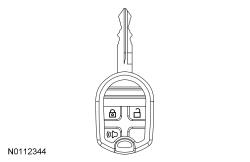
The IKT incorporates both the PATS functions and the RKE transmitter functions in a single device.
During key programming procedures, the PATS and RKE transmitter of an IKT are both programmed into the BCM. Refer to Key Programming Using Diagnostic Equipment or Refer to Key Programming Using Two Programmed Keys to program the IKTs. Conventional PATS keys can also be programmed to the vehicle if requested by the customer.
Up to a maximum of 4 IKTs can be programmed. If more than 4 IKTs are programmed, INT KEY COULD NOT PROGRAM is displayed in the message center during the key programming procedure and the RKE function of that IKT is non-functional.
Passive Anti-Theft System (PATS) Transceiver
The PATS transceiver reads any key that is placed in the ignition. When the ignition is turned to the ON or START position, the BCM activates the PATS transceiver. Once the transceiver is activated, it in turn activates the key in the ignition and receives the key data. Once the transceiver receives the key data, it sends the data to the BCM.
Body Control Module (BCM)
The BCM is responsible for checking the identification from the PCM and checking the key in the ignition. It also controls the ignition states and determines the ignition mode or if the engine should be started depending upon input from the ignition switch.
If the BCM is replaced, at least two keys must be programmed and the parameter reset procedure must be performed to enable PATS.
Powertrain Control Module (PCM)
The PCM is responsible for allowing starter and fuel injector operation. The PCM receives an enable or disable message from the BCM over the HS-CAN.
If the PCM is replaced, the parameter reset procedure must be performed to enable PATS.