Handles, Locks, Latches and Entry Systems - With Intelligent Access (IA)
Overview
The power lock/unlock feature locks or unlocks the doors upon a customer request from either door lock control switch in the vehicle, RKE transmitter, or keyless entry keypad. The power door locking system functions independently of ignition status or vehicle speed.
The Intelligent Access (IA) feature allows easy locking and unlocking of the vehicle and opening the power liftgate without having to use a key.
System Operation
System Diagram
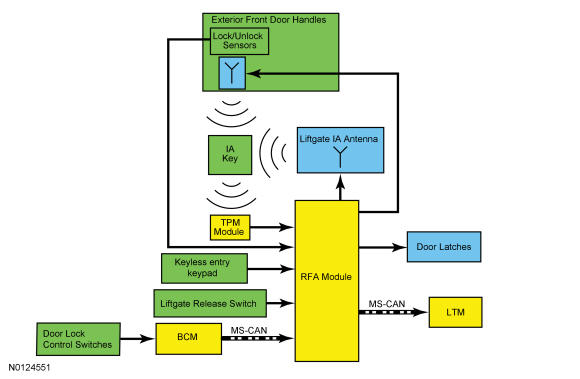
Network Message Chart
LTM Network Message Chart
| Broadcast Message | Originating Module | Message Purpose |
|---|---|---|
| RFA power liftgate open/close request | RFA module | Used by the LTM to either open or close the power liftgate. The RFA module sends this message to the LTM when there is a liftgate Intelligent Access (IA) or RKE request. |
RFA Module Network Message Chart
| Broadcast Message | Originating Module | Message Purpose |
|---|---|---|
| Vehicle lock status | BCM | Used by the RFA module to either lock or unlock the doors. The BCM sends this message to the RFA module when a door lock control switch is pressed. |
| Door ajar status | BCM | Used by the RFA module for the smart unlock feature. |
Autolock
The autolock feature locks all of the doors when:
- all the doors are closed
- the ignition is in the RUN position
- the vehicle is shifted into any gear
- the vehicle attains a speed greater than 20 kmh (12.4 mph)
The autolock feature repeats when:
- any door is opened then closed while the ignition is in the RUN position and the vehicle speed is 15 kmh (9.3 mph) or lower
- the vehicle attains a speed greater than 20 kmh (12.4 mph)
The autolock feature can be enabled/disabled. Refer to Autolock Programming for programming information.
Auto-Unlock
The auto-unlock feature unlocks all of the doors when:
- the ignition is in the RUN position, all the doors are closed and the vehicle has been in motion at a speed greater than 20 kmh (12.4 mph)
- the vehicle has come to a stop and the ignition is turned to the OFF or ACC position
- the driver door is opened within 10 minutes of the ignition being transitioned to the OFF or ACC position
The auto-unlock feature can be enabled/disabled. Refer to Auto-Unlock Programming for programming information.
Smart Unlock
The smart unlock feature prevents the doors from electronically locking when an Intelligent Access (IA) key is left inside the vehicle. When a door lock control switch is pressed, the RFA module receives a lock message over the MS-CAN from the BCM, and if an Intelligent Access (IA) key is inside the vehicle with one of the doors open, the RFA module commands all of the doors to unlock and the horn will chirp. To override the smart unlock feature and intentionally lock a key in the vehicle, close all of the doors and lock the vehicle using the keyless entry keypad, press the lock button on another Intelligent Access (IA) key, or lock the doors manually with the lock rod before closing the door.
Driver Door Intelligent Access (IA)
The driver door Intelligent Access (IA) feature allows the doors to be locked or unlocked without having to use the door lock cylinder or the RKE transmitter feature. With a programmed Intelligent Access (IA) key within 1 m (3.28 ft) outside the driver front door, touch the lock or unlock sensor on the exterior door handle. The doors lock or unlock depending upon which sensor was touched on the handle. The unlock button is located on the inside of the handle and the lock button is located on the outside face of the handle.
The driver door Intelligent Access (IA) feature either unlocks just the driver door or all four doors. If stepped unlock is enabled, the driver door is the only door that unlocks from the driver door Intelligent Access (IA) feature. If stepped unlock is disabled, then all four doors unlock. The driver door Intelligent Access (IA) feature always locks all four doors. Refer to Stepped Unlock Programming for programming information.
When the RFA module detects that a lock or unlock sensor is touched on a front exterior door handle, it activates the low frequency antenna in the corresponding exterior front door handle. The low frequency antenna sends out a signal to the Intelligent Access (IA) key. The low frequency signal activates the Intelligent Access (IA) key and the Intelligent Access (IA) key then sends a high frequency signal back to the TPM module. The TPM module interprets the high frequency signal from the Intelligent Access (IA) key and sends the information to the RFA module. If the RFA module determines that it is a programmed key, it either unlocks the driver door, unlocks all 4 doors, or locks all 4 doors.
Passenger Door Intelligent Access (IA)
The passenger door Intelligent Access (IA) feature allows the doors to be locked or unlocked without having to use the door lock cylinder or the RKE transmitter feature. With a programmed Intelligent Access (IA) key within 1 m (3.28 ft) outside the passenger front door, touch the lock or unlock sensor on the exterior door handle. The doors lock or unlock depending upon which sensor was touched on the handle. The unlock button is located on the inside of the handle and the lock button is located on the outside face of the handle.
The passenger door Intelligent Access (IA) feature always locks or unlocks all four doors.
When the RFA module detects that a lock or unlock sensor is touched on a front exterior door handle, it activates the low frequency antenna in the corresponding exterior front door handle. The low frequency antenna sends out a signal to the Intelligent Access (IA) key. The low frequency signal activates the Intelligent Access (IA) key and the Intelligent Access (IA) key then sends a high frequency signal back to the TPM module. The TPM module interprets the high frequency signal from the Intelligent Access (IA) key and sends the information to the RFA module. If the RFA module determines that it is a programmed key, it either unlocks all 4 doors or locks all 4 doors.
Liftgate Intelligent Access (IA)
The liftgate Intelligent Access (IA) feature allows the liftgate to be opened without having to use an interior liftgate switch or a RKE transmitter. With a programmed Intelligent Access (IA) key within 1 m (3.28 ft) outside the liftgate, press the liftgate release button on the liftgate, and the power liftgate opens.
When the RFA module detects a signal from the exterior liftgate switch, it activates the low frequency antenna in the rear bumper cover. The low frequency antenna sends out a signal to the Intelligent Access (IA) key. The low frequency signal activates the Intelligent Access (IA) key and the Intelligent Access (IA) key then sends a high frequency signal back to the TPM module. The TPM module interprets the high frequency signal from the Intelligent Access (IA) key and sends the information to the RFA module. If the RFA module determines that it is a programmed key, it sends a message to the LTM over the MS-CAN. When the LTM receives an open request message, it opens the liftgate.
Remote Keyless Entry (RKE)
The RKE system uses an Intelligent Access (IA) key. The Intelligent Access (IA) key incorporates both the PATS and the RKE transmitter functions in a single device.
The RKE transmitters initiate the following electronic system functions:
- Unlocks the driver door
- Unlocks all doors
- Locks all doors
- Opens the power liftgate
- Arms/disarms the perimeter alarm
- Activates/deactivates the panic alarm
- Commands the interior lamps on (when unlocking) and off (when locking)
- Provides a long flash of the turn signals when unlock is pressed
- Recalls the memory seat position associated with a particular remote entry device (when enabled)
- Remotely start the engine (if equipped with the factory installed system)
- Sounds the horn once when lock is pressed twice within 3 seconds, and the doors are closed
- Sounds the horn twice when lock is pressed twice within 3 seconds, and any door is ajar
The RKE transmitters have a normal operating range of 10 m (33 ft).
RKE Lock/Unlock Control - Unlock
The RKE feature provides lock/unlock functions independently of key position, vehicle speed, or transmission position. The RKE feature provides a stepped (if enabled) process for unlocking the doors. Upon receipt of the first request for unlocking the doors, the RKE control feature unlocks the driver door only and provides a long flash of the turn signals. If another unlock request is received within 3 seconds of the first, the RKE feature unlocks all the doors. This feature can be disabled so that all the doors unlock on the first press of the unlock button. Refer to Stepped Unlock Programming for programming information.
RKE Lock/Unlock Control - Lock
The RKE feature requests that all of the doors be locked when the lock button is pressed. On any press of the lock button with all doors closed, the doors lock and the turn signals flash one time. If any door or liftgate is ajar, no flash occurs. As soon as the last door or liftgate is closed, the turn signals flash. If 2 presses of the lock button are received within 3 seconds, the horn chirps once and the turn signals flash twice to indicate that all of the doors and liftgate are closed and locked. If any door is ajar when the second lock request is received within 3 seconds of the first, the RKE transmitter feature chirps the horn twice without flashing the turn signals to indicate it locked all of the doors but one or more doors or the liftgate is ajar. When the ignition is in the RUN or START position, the turn signal flashes and horn chirp confirmations do not occur.
Panic Alarm
The panic alarm feature provides audible and visual alarms which are evident from the exterior of the vehicle. The panic alarm feature requests that the turn signals flash and the horn sounds until deactivation. The flashing of the outputs occurs simultaneously. Activation of the panic alarm is accomplished by pressing the panic button on an RKE transmitter whenever the key is in the OFF position. At all other times this feature is disabled. Deactivation of an active panic alarm is accomplished by any of the following actions:
- a second press of the RKE transmitter panic button
- the ignition is switched out of the OFF position
- a period of 2 minutes and 45 seconds has elapsed since the initial activation
RKE Power Liftgate
The RKE feature provides a power liftgate open/close function independently of key position. The power liftgate button must be pressed twice within 3 seconds for the power liftgate to open or close.
Remote Start
The factory installed remote start is controlled by a RKE transmitter and allows the engine to be started from outside the vehicle. For information on the remote start feature, REFER to Starting System .
RKE Transmitter Memory Seat
The RKE transmitter feature provides a memory seat, mirrors, and pedal recall feature. When the unlock button is pressed, the driver's seat, exterior mirrors, and adjustable pedals move to the desired memory position (the seat, mirror, and pedal position corresponds to the transmitter being used). This feature can be enabled/disabled. Refer to Remote Memory Activation and Refer to Remote Memory Deactivation for programming information.
Keyless Entry Keypad
The keyless entry keypad carries out the following functions:
- Unlocks the driver door
- Unlocks all the doors
- Locks all doors
- Enables/disables auto-unlocking
- Enables/disables autolocking
- Arms/disarms the perimeter alarm
- Recalls the memory seat position associated with a particular customer key code (when enabled)
- Programs/erases the customer key code
- Illuminates the keyless entry keypad lamp and issues illuminated entry on/off requests
The keypad feature operates independently of key position status, vehicle speed, or transmission position. When a keypad button is touched, the keypad buttons illuminate to provide better visibility. The keypad is also illuminated any time that the courtesy lighting is on. If the lock all doors command is entered or 5 seconds have elapsed since the last button press, the illumination is turned off. When entering codes each digit must be entered within 5 seconds of the previous button press.
Each vehicle equipped with a keypad is programmed with a 5-digit entry code. This code is provided to the customer through a wallet card in the Owner's Literature. In addition, this code is available through a scan tool and is also printed on the BCM label.
Locking the Doors with the Keyless Entry Keypad System
It is not necessary to enter the factory set or personal code prior to locking all doors. To lock all doors, touch and hold the 7/8 and 9/0 buttons at the same time for approximately 2 seconds.
Unlocking the Doors with the Keyless Entry Keypad System
To unlock the driver door, enter either the factory set code or a personal code; each digit must be pressed within 5 seconds of the prior digit. The interior lamps illuminate.
To unlock all doors, enter either the factory set code or a personal code (driver door unlocks) and press the 3/4 button within 5 seconds. This feature can be changed to a 1-step unlock so that all of the doors unlock on receipt of the factory set or personal code. Refer to Stepped Unlock Programming for programming information.
Keyless Entry Keypad Memory Seat Feature
The keypad provides a memory seat, mirror, and adjustable pedal recall feature. The feature is associated with the personal entry codes and positions the driver seat, exterior mirrors, and adjustable pedals to the memory 1 or memory 2 setting. Refer to Keyless Entry Keypad Code Programming for programming information.
Anti-Scan Feature
To provide added security, the keypad is disabled for 1 minute after 35 button presses without a valid entry code being entered. The keypad flashes during this 1 minute mode with all functionality disabled except for 7/8 and 9/0 still being allowed to lock the vehicle.
Anti-scan is turned off after 1 minute of keypad inactivity, the unlock button is pressed on an RKE transmitter, or the ignition is switched to the RUN position.
Factory Keycode Retrieval
The factory keycode for the keyless entry keypad can be retrieved from a label on the BCM or using a diagnostic scan tool.
Component Description
Door Latch
The door latches are sealed units and contain the door lock actuator and the door ajar switch. The door latches can be lubricated if needed. Refer to Latch Lubrication .
Liftgate Latch
For information on the power liftgate latch, REFER to Body Closures .
Door Lock Control Switch
The door lock control switches receive voltage signals from the BCM on the lock and unlock input circuits. When the switch is pressed to lock or unlock, the corresponding input circuit is routed to ground, signalling the BCM the occupants request to lock or unlock the doors. The door lock control switches have a dedicated ground circuit.
The BCM sends the lock and unlock requests from the door lock control switches to the RFA module over the MS-CAN.
Keyless Entry Keypad
The keyless entry keypad is a touch sensitive capacitive sensor. When a finger touches the keypad it changes the capacitance of the sensor in the area of the finger touch. The keypad is then able to determine which area was touched and sends a ground signal to the RFA module on the corresponding reference circuit(s). The keypad only works when touched with a finger. The keyless entry keypad may not work when gloves are worn. The gloves act as an insulator and do not allow the finger to change the sensor capacitance.
The RFA module monitors for a ground signal on the keyless entry keypad signal input circuits. When an individual keypad button is touched, an individual or combination of the input circuits is routed to ground. The RFA module then determines which button was touched based on which circuit(s) are grounded. The keypad has dedicated voltage supply and ground circuits.
Liftgate Release Switch
The exterior power liftgate switch is a momentary contact switch that supplies a ground signal to the RFA module.
When the exterior liftgate switch is pressed, the RFA module activates the power liftgate Intelligent Access (IA) feature.
Intelligent Access (IA) Key
The Intelligent Access (IA) key receives the low frequency signals from the Intelligent Access (IA) antennas. When the Intelligent Access (IA) key is activated by one of the low frequency signals, it sends out a high frequency signal that is received by the TPM module. The Intelligent Access (IA) key also contains a key blade used to enter the vehicle as a backup.
Exterior Front Door Handles
The exterior front door handles both contain an Intelligent Access (IA) antenna and a capacitive touch lock and unlock sensor. The antennas and lock/unlock sensors are hardwired to the RFA module. When a lock or unlock sensor is touched, it signals to the RFA module there is an Intelligent Access (IA) request. When the RFA module receives the request it activates the Intelligent Access (IA) antenna in the corresponding door handle. The low frequency signal from the Intelligent Access (IA) antenna activates an Intelligent Access (IA) key.
Liftgate Intelligent Access (IA) Antenna
The liftgate Intelligent Access (IA) antenna is hardwired to the RFA module and, when activated by the RFA module, it transmits a low frequency signal that activates an Intelligent Access (IA) key.
Tire Pressure Monitor (TPM) Module
The TPM module has a dedicated power and ground. It communicates all Intelligent Access (IA) and RKE information to the RFA module through a dedicated single circuit network. The TPM module is a receiving antenna that receives the high frequency signals from an Intelligent Access (IA) key. It also receives the signals from an RKE command.
Remote Function Actuator (RFA) Module
The RFA module is responsible for controlling the power door locks and the Intelligent Access (IA) features. It uses the antennas in the front exterior door handles and the liftgate Intelligent Access (IA) antenna and the TPM module to receive the Intelligent Access (IA) key data. The RFA module receives direct input from the TPM module over a dedicated single wire network and is hardwired to the antennas. The power door lock actuators, exterior power liftgate switch, and the keyless entry keypad are also hardwired to the RFA module. The RFA module receives the door lock control switch input from the BCM over the MS-CAN.