Cruise Control - Non-Adaptive: Notes
Overview
The cruise control system is controlled by the PCM.
The cruise control mode is selected from the steering wheel mounted switches (ON/OFF, SET, CNCL and RES) which are integrated into the LH steering wheel switch.
The cruise control system maintains a selected vehicle speed between 29 kmh (18 mph) and the maximum limited vehicle speed. When a MyKey® restricted key is in use and max speed limiter is turned on, vehicle speed is limited to 128.7 kmh (80 mph).
During normal driving, the vehicle speed can vary slightly from the set speed due to road conditions. The vehicle speed can fluctuate when driving up and down a steep hill. If the vehicle speed decreases more than 16.1 kmh (10 mph) below the set speed, the cruise control disengages.
System Operation
System Diagram
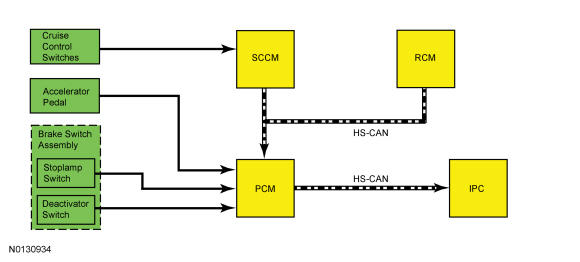
Network Message Chart
Network Message Chart - C-CM
| Broadcast Message | Originating Module | Message Purpose |
|---|---|---|
| Cruise control mode (vehicles with adaptive cruise control only) | PCM | Toggles between speed control and adaptive cruise control. |
| Cruise control override | PCM | Driver overriding cruise control with accelerator pedal. |
| Cruise control set speed | PCM | Data used for set speed display. |
| Cruise control status | PCM | Data used for speed control indicator status. |
Network Message Chart - PCM
| Broadcast Message | Originating Module | Message Purpose |
|---|---|---|
| Steering wheel switch_speed control | SCCM | Used for speed control enable/disable and operating mode request. |
| Speed control deactivation request | ABS module | Deactivates speed control when requested. |
| Stability control event in progress | ||
| Traction control event in progress | ||
| Vehicle lateral acceleration | RCM | Deactivates speed control when requested. |
| Vehicle longitudinal acceleration | ||
| Vehicle roll sense | ||
| Vehicle yaw rate |
Cruise Control Operation
The cruise control functions include:
- turning on the cruise control system.
- setting and maintaining the desired vehicle speed.
- accelerating the vehicle speed.
- coasting down to a lower speed.
- resuming the prior vehicle speed.
- turning off the cruise control system.
Hardwired inputs to the PCM are:
- Digital TR sensor
- Stoplamp switch
- Cruise control deactivator switch (integral to the stoplamp switch)
- APP sensor
Hardwired outputs of the PCM are:
- ETB command
The vehicle speed is controlled by the PCM through the ETC subsystem.
The cruise control system provides self-diagnostics. Cruise control is disabled anytime an error is detected in the system. No IPC indicator or message center messages are displayed when faults occur. Fault codes are logged by the PCM or SCCM.
An ETC system fault also causes the cruise control system to be disabled. In this case, an ETC system powertrain malfunction (wrench) warning indicator is displayed.
Additionally, certain conditions cause the cruise control system to deactivate:
- Transmission gear selector is put into a position other than D or OD
- Cruise control set speed is overridden with the accelerator pedal for a period longer than 5 minutes
- Cruise control switch is pressed or stuck longer than 2 minutes
- ABS fault
Cruise Control Indicator
The cruise control indicator, located in the IPC, illuminates gray to indicate the cruise control system is in standby mode. The cruise control indicator illuminates green to indicate the cruise control system is active.
Steering Wheel Switch Function
Pressing up (ON) and releasing the ON/OFF switch turns the cruise control system on. Pressing up (SET+) or down (SET-) on the SET switch while the vehicle is traveling at the desired speed activates the cruise control system.
Pressing up or down on the SET switch while in the active mode increases or decreases the maintained vehicle speed by 1.6 kmh (1 mph) per press. If the respective switch is pressed and held, the vehicle speed continues to accelerate or decelerate until the switch is released.
Pressing down (OFF) and releasing the ON/OFF switch, or turning the ignition switch to the OFF position, turns the cruise control system off. While the cruise control system is active, applying the brake pedal or pressing the CNCL (CANCEL) switch puts the cruise control system into standby mode. Pressing the RES (RESUME) switch when the cruise control system is in standby mode causes the vehicle to accelerate to the last set speed. Resume does not function if the OFF switch is pressed, the ignition switch is cycled OFF, or if the current vehicle speed is below the minimum operational speed.
Cruise Control Deactivation Event PID)
The PCM has PIDs available, through the powertrain DataLogger, that indicate the event that caused the last cruise control deactivation. When the cruise control is turned ON, all current deactivation (or non-activation) conditions are recorded. When the cruise control is turned OFF, event recording stops. The recorded events are stored until the ignition is turned OFF.
The PCM has 24 cruise control deactivation event PIDs, identified as CRUISEOFF_00 through 24. The event PIDs should be read when deactivation or non-activation exists.