Adjustable Pedals: Notes
Overview
The adjustable pedal feature uses an electrical motor to adjust the brake and accelerator pedal positions forward and rearward.
System Operation
System Diagram
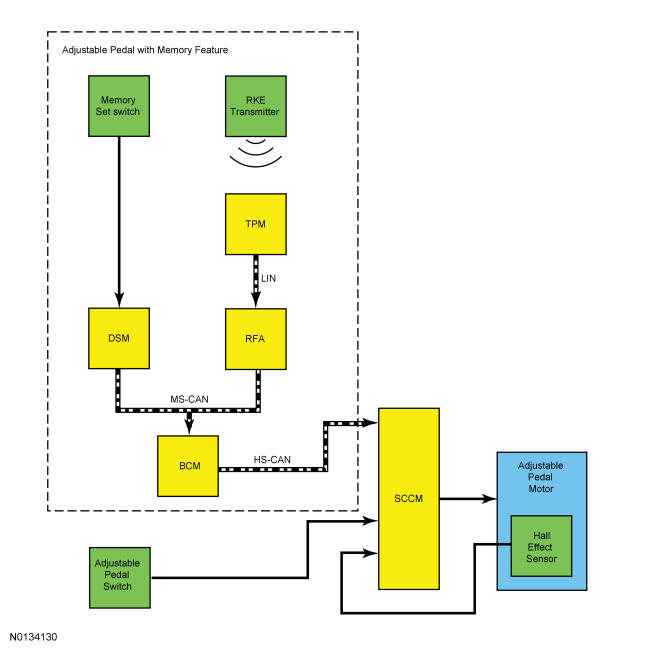
Network Message Chart
| Broadcast Message | Originating Module | Message Purpose |
|---|---|---|
| Driver seat memory command | DSM | Message to recall a saved driver seat/adjustable pedal position when the memory set switch is pressed. The message is transmitted from the DSM to the SCCM, through the BCM, which acts as a gateway module. |
| RKE data | TPM Module | Message to recall a saved driver seat/adjustable pedal position when the RKE button is pressed. Transmitted from the TPM module to the SCCM, through the BCM, which acts as a gateway module. |
Adjustable Pedal System
The adjustable pedal motor is attached to the brake pedal bracket and directly controls the accelerator pedal through the use of a pinion and worm gear set. The other end of the motor is attached to a cable inside a sleeve, which is connected to another worm gear set on the brake pedal for the adjustment of the brake pedal. When the motor rotates, the worm gear set on the accelerator pedal and the worm gear set on the brake pedal both rotate simultaneously. The motor direction of rotation determines the direction of pedal movement, forward or rearward.
The pedals can be adjusted with the ignition in OFF, ON, ACC or RUN, regardless of the gear selector position.
The SCCM monitors the adjustable pedal motor and circuits for concerns. If a concern is detected, the SCCM is capable of setting DTCs.
Adjustable Pedals without Memory Feature
The adjustable pedals without memory feature are controlled by the SCCM and the pedal adjust switch.
Adjustable Pedals with Memory Feature
The adjustable pedals with memory feature are controlled by the SCCM, BCM and DSM. The pedals can be adjusted in 3 different ways:
- Using the pedal adjust switch
- Using the memory SET switch, when associated with the seat/mirror/pedal position programmed into the memory that is recalled using the memory set switch.
- Using the RKE feature, when associated with a memory setting, will recall the seat/mirror/pedal positions associated with that setting.
Operating with Memory Set Switch
When 1 of the 3 memory set positions is recalled by pressing the memory set switch (part of the drivers side door lock control switch), the DSM senses continuity to ground on the memory set switch circuit and sends a message to adjust the pedal position over the MS-CAN to the BCM. The BCM acts as a gateway module and transmits the message over the HS-CAN to the SCCM. The SCCM then provides voltage to the adjustable pedal motor to move the pedals. The SCCM monitors the Hall-effect sensor in the adjustable pedal motor and stops sending voltage to the motor when the required pedal position is reached. If the SCCM receives a pedal position input from the pedal adjust switch during a memory position recall, the module stops the memory recall and responds to the new pedal position input.
For information on setting and recalling a memory pedal position, REFER to Seating 1st Row .
Operating with RKE Transmitter
When the RKE button is pressed on the IA key, the transmitted signal is received by the TPM module. The TPM module sends a message to the RFA along a hard wired LIN. The RFA then sends the message to the BCM over the MS-CAN. The BCM acts as a gateway module and transmits the message over the HS-CAN to the SCCM. The SCCM then provides voltage to the adjustable pedal motor to move the pedals to the position programmed into the IA key.
Operating with Pedal Adjust Switch
When the pedal position is adjusted using the pedal adjust switch, voltage is applied from the SCCM to the adjustable pedal motor to move the pedals in the required direction.