Four Wheel Drive (4WD) Systems: Notes
Component Location
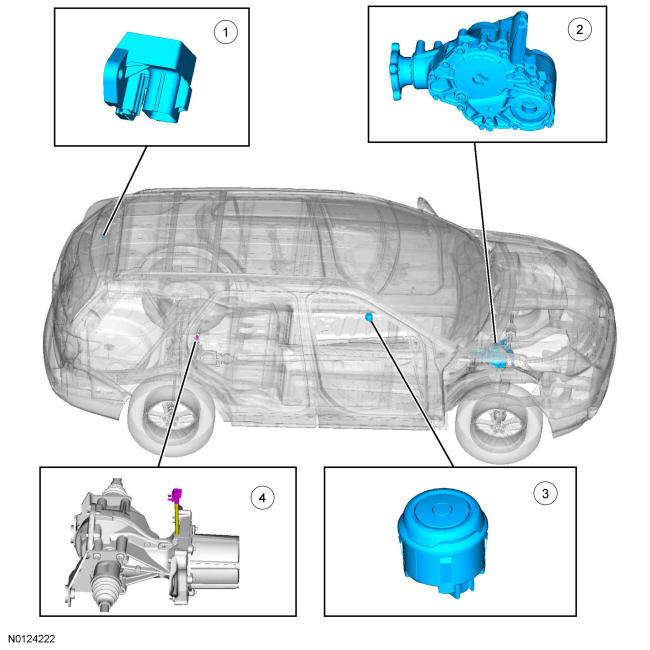
| Item | Description |
|---|---|
| 1 | AWD relay module |
| 2 | PTU |
| 3 | ATCM |
| 4 | ATC solenoid (part of rear differential) |
Overview
The AWD system is always active and only requires the operator to select terrain. Torque from the engine is transferred through the transaxle to the PTU. The PTU is a mechanical device attached to the transaxle. This torque is transferred through the driveshaft to the rear axle, which drives the rear halfshafts. The driver can optimize the AWD system by setting the ATCM switch for the correct terrain.
System Operation
System Diagram
Network Message Chart
Network Message Chart
| Broadcast Message | Originating Module | Message Purpose |
|---|---|---|
| Terrain display request | ATCM | Provides the IPC with ATCM switch mode via the HS-CAN. |
| Terrain mode command | ATCM | Provides the IPC, ABS module and PCM with ATCM switch command via the HS-CAN. |
| ePRNDL mode | IPC | Provides the AWD system with gear selector mode via the HS-CAN. Data is used by the PCM in determining AWD system operation. |
| Wheel speed data | ABS | Provides the AWD system with wheel speed data via the HS-CAN. Data is used by the PCM in determining AWD system operation. |
| AWD and off road message displays | PCM | Provides the AWD system mode information to the IPC via the HS-CAN. |
| Illumination dimming level | BCM-B | Used to command the illumination brightness level of the ATCM switch via the HS-CAN. |
| Vehicle lateral acceleration | Restraints Control Module | Provides the AWD system with lateral acceleration data via the HS-CAN. Data is used by the PCM in determining AWD system operation. |
| Vehicle longitudinal acceleration | Restraints Control Module | Provides the AWD system with longitudinal acceleration data via the HS-CAN. Data is used by the PCM in determining AWD system operation. |
| Vehicle roll sense | Restraints Control Module | Provides the AWD system with roll sense data via the HS-CAN. Data is used by the PCM in determining AWD system operation. |
| Vehicle yaw rate | Restraints Control Module | Provides the AWD system with yaw data via the HS-CAN. Data is used by the PCM in determining AWD system operation. |
| Steering wheel component angle | ABS | Provides the AWD system with steering wheel angle data via the HS-CAN. Data is used by the PCM in determining AWD system operation. |
| AWD minimum lock torque required | ABS | The PCM provides the ABS module with its current clutch duty cycle and determines whether or not the brake system takes command of the ATC solenoid duty cycle via the HS-CAN. |
| AWD maximum lock torque required | ABS | The PCM provides the ABS module with its current clutch duty cycle and determines whether or not the brake system takes command of the ATC solenoid duty cycle via the HS-CAN. |
| Hill descent control active/standby status | ABS | Used to command when the hill descent control lamp should be on or in standby mode via the HS-CAN. |
| Terrain mode status | ABS PCM | Confirmation of change in mode provided by the ABS module and the PCM to the ATCM via the HS-CAN. |
| Terrain mode ready for change | ABS PCM | Indicates the availability to change of the ABS module and the PCM to the ATCM via the HS-CAN. |
| Engine off status | BCM-B | Provides the All Terrain Control Module (ATCM) with engine mode via the HS-CAN. When the ignition is switched to on, the ATCM system starts in Normal Mode. |
| Engine RPM | PCM | Provides engine RPM data via the HS-CAN. Data is used by the AWD system to help determine torque application. |
All-Wheel Drive (AWD)
The vehicle is equipped with an AWD system that continuously monitors vehicle conditions and automatically adjusts the power distribution between the front and rear wheels. The system is always active and only requires the operator to select terrain.
During normal operation, most of the torque is delivered to the front wheels. If wheel slip between the front and rear wheels is detected, or if the vehicle is under acceleration, the PCM commands torque delivery to the rear wheels to prevent or control wheel slip. When the AWD system is functioning properly, there should be no perceived speed difference between the front and rear axles when launching or driving the vehicle on any uniform surface. Traction should be similar to a part time 4WD system in 4H (4X4 HIGH), but have no binding in turns.
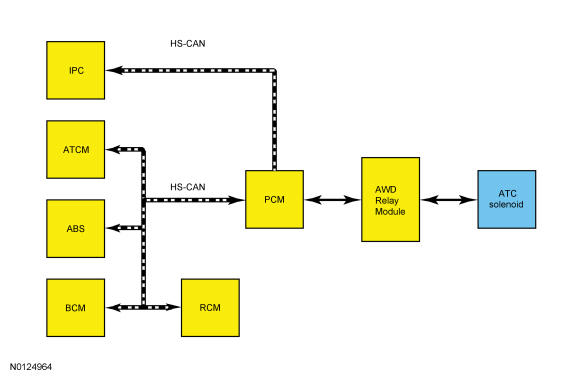
All AWD control logic resides in the PCM. The PCM continuously calculates if torque is required at the rear wheels and when torque is required, sends a low-current PWM signal to the AWD relay module over a hard wired circuit. The AWD relay module then outputs a high-current PWM signal which varies the current and duty cycle sent to the ATC solenoid, which is located inside the rear axle.
The PWM current supplied to the ATC solenoid increases as demand for rear wheel torque increases. The AWD relay module returns a signal to the PCM throughout AWD operation over a hard-wired circuit to monitor system capabilities.
AWD faults are indicated by the powertrain malfunction (wrench) warning indicator in the IPC as well as the CHECK AWD warning indicator in the message center.
A spare tire of a different size other than the tire provided should never be used. A dissimilar spare tire size (other than the spare tire provided) or major dissimilar tire sizes between the front and rear axles could cause the AWD system to stop functioning correctly. If the incorrect spare tire or dissimilar tire sizes between the front and rear axles is installed, the AWD system disables automatically and enters FWD only mode to protect driveline components. This condition could be indicated by an AWD OFF message in the message center. If there is an AWD OFF message in the message center from using the spare tire, this message should disappear after reinstalling the repaired or replaced normal road tire and driving a short distance. It is recommended to reinstall the repaired or replaced road tire as soon as possible.
The PCM also provides the ABS with its current clutch duty cycle and determines whether or not the ABS may take command of the clutch duty cycle.
The active, on-demand AWD system uses data from other systems as inputs to the PCM. The PCM uses the inputs to determine the appropriate duty cycle to send to the AWD relay module and ATC solenoid that delivers the desired torque to the rear wheels. Specific inputs to the PCM are:
- ATCM switch mode via the HS-CAN.
- Engine off status from the BCM-B via the HS-CAN.
- Steering wheel angle from the ABS module via the HS-CAN
- Yaw rate and Lateral acceleration from the Restraints Control Module via the HS-CAN.
- Brake system status from the ABS module via the HS-CAN.
- Wheel speed from all 4 wheels from the ABS module via the HS-CAN.
- AWD relay module diagnostic.
PCM outputs are:
- PWM signal to the AWD relay module to the ATC solenoid for control of the solid-state clutch.
- Amount of torque transfer commanded signal to the ABS module via the HS-CAN.
- AWD system information to the IPC via the HS-CAN.
- Returns terrain mode status and ready for change information to the ATCM via the HS-CAN.
Terrain Management
Based on road conditions, the driver selects what mode the system is in by moving the ATCM switch. The ATCM sends information via the HS-CAN to the:
- IPC.
- ABS module.
- PCM.
The AWD system adapts the responses of the vehicle's engine, transmission, suspension and stability control systems to match the demands of the terrain based on the ATCM switch positions:
- Normal - This mode is for on-road conditions. If not already active, Normal should be selected before driving on surfaces which are similar to a hard road surface. This mode should be selected once the need for a special mode has passed.
- Grass/Gravel/Snow - This mode should be used where a firm surface is covered with loose or slippery material. Surfaces covered in packed snow, ice, water, grass, gravel, or a thin coating of sand for example. For deep gravel, it is recommended that the Sand mode is selected. If the vehicle is unable to gain traction in deep snow, switching traction control off may help. Traction control should be switched on again as soon as the difficulty is overcome.
- Sand - This mode should be used for soft dry sand, or deep gravel terrain. If the sand to be crossed is damp/wet, and sufficiently deep enough to cause the wheels to sink into the surface, the Mud/Ruts mode should be selected.
- Mud/Ruts - This mode should be used for muddy, rutted, soft, or uneven terrain.
If the terrain management system becomes inoperable due to a system malfunction, all of the mode indicators on the control turns off and the message center displays one of the these messages:
- TERRAIN MANAGEMENT SYSTEM FAULT: If this message is displayed, cycling the key may clear the fault.
- MODE CHANGE NOT ACCEPTED, RETRY: If this message is displayed, a vehicle system cannot support a mode change at the time of driver request. Try the mode change again.
PTU Cooling
Severe heavy duty vehicles and Police vehicles are equipped with a PTU cooling system. It Is cooled with engine coolant. The PTU cooling system consists of a cover, power take off temperature sensor and coolant hoses.
PTU Oil Life Monitor
Severe heavy duty vehicles and Police vehicles are equipped with PTU oil minder information. The PTU in the police interceptor vehicles does not require any normal scheduled maintenance. The system is electronically monitored and notifies the driver of required service by displaying the message "Change AWD Power Transfer Unit Lube" in the information display. The PTU lube will be more likely to require a fluid change if the vehicle has experienced extended periods of extreme/severe duty cycle driving. Do not check or change the PTU lubricant unless the unit has been submerged in water, shows signs of leakage or a message indicating required service is displayed. To reset the PTU lube life monitor, refer to Power Transfer Unit (PTU) Oil Life Monitor Reset .
Heat Protection Mode
The AWD system utilizes a heat protection mode to protect the PTU and the ATC solenoid from damage due to heat build up caused by clutch slippage while driving in extremely slippery road conditions. If the AWD system detects an overheat condition, it increases the duty cycle to keep the clutches from slipping. If the heat in the system continues to rise, the AWD relay module disables the ATC solenoid. This condition may be indicated by an AWD OFF message in the message center. Allow the system to cool down at least 10 minutes with the ignition ON (RUN). For concerns with the PTU, REFER to Transfer Case - Power Transfer Unit (PTU) , Symptom Chart: PTU.