Seating - Power-Fold
Overview
The third row power fold seat features a one-touch operation that can adjust the LH and RH seats independently or combined into a NORMAL, STOW or FOLD position with a single activation of the seat control switch. The third row power fold seat also includes obstacle detection that allows the seat to stop and reverse direction if it hits an obstacle so that the obstacle can be removed.
The seat control switch is located behind the third row seat on the LH quarter trim panel. The third row power fold seat only operates when the vehicle is in park and the liftgate is open. The folding head restraints must be manually returned to the upright position. Power to the seat will time-out after 10 minutes but can be enabled by opening any door, turning the ignition on, pressing any keyless entry keypad button or the unlock button on the key fob.
System Operation
System Diagram
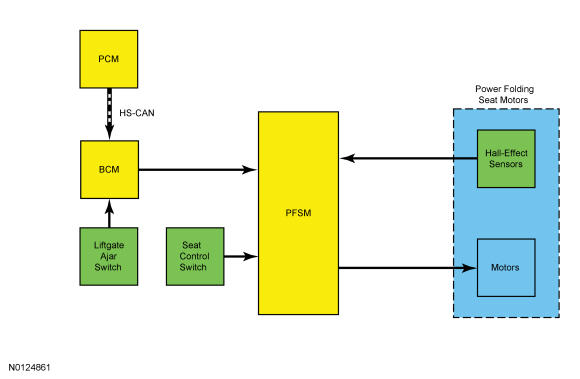
Network Message Chart
| Broadcast Message | Originating Module | Message Purpose |
|---|---|---|
| Selector lever (PRNDL) status | PCM | Provides the status of the selector lever position. The selector lever position is one of the inputs the BCM requires before supplying a signal to the PFSM to enable the power folding seat feature. |
Seating - Power-Fold
The third row power seat system includes the following components:
- Third row power seat relay
- PFSM
- Seat control switch
- Power-stow seat motor assembly (contains LH and RH motors and sensors)
- LH and RH power-fold seat motor and sensor assemblies (backrest)
- LH and RH latch assemblies (contains latch motor and latch switch)
The third row power seat relay coil receives voltage from the battery saver relay in the BCM (courtesy lamp circuit) and ground from the chassis. When energized, the relay switch closes and supplies battery voltage from the BJB to the PFSM. Sufficient battery voltage is required for PFSM operation. If battery voltage drops below 8 volts, a started seat movement stops.
When the gear selector lever is in the PARK position and the liftgate is open, the BCM supplies voltage to the PFSM enable circuit for 30 minutes. With the ignition OFF, the BCM disables the battery saver relay after 10 minutes. The system can be re-enabled by opening any door, pressing the unlock button on the RKE transmitter or turning the ignition ON. A short to voltage on the PFSM enable circuit can result in the third row power seat being operational any time the battery saver relay is energized, regardless of gear selector lever or tailgate position.
The seat control switch contains the seat selector switch button and seat position switch buttons. The PFSM receives a voltage signal from the seat selector switch for 3 modes:
- LH seat
- RH seat
- BOTH seats
The PFSM receives voltage signals from the seat position switches for 3 possible seat positions:
- NORMAL
- FOLD
- STOW
The power-stow seat motor assemblies rotate the LH or RH seat cushion assemblies together or separately (based on seat[s] selected). The motor assemblies contain Hall-effect sensors that indicate seat position to the PFSM. The power-stow seat motor assemblies are part of the third row seat pivot tube assembly and are not serviceable separately.
The power-fold motor assemblies rotate the LH or RH seat backrests. The motor assemblies contain Hall-effect sensors that indicate seat backrest position to the PFSM. The LH and RH power-fold motor assemblies are serviceable individually.
The LH and RH latch motors receive voltage from the PFSM. The motors share a common ground supplied by the PFSM. The seat latch motors energize and release the seat latch mechanism(s) when the STOW position is selected.
The latch switches are normally open and receive approximately 12 volts from the PFSM. The LH and RH latch switches share a common return circuit in series to the PFSM. The PFSM monitors the latch switch circuits to determine if the seat latches are open or closed. The latch switch is not serviceable separately, a new power seat latch must be installed.
When STOW or FOLD is selected the backrest folds forward enough to release the spring loaded headrest. If the head restraint is not folded prior to achieving FOLD or STOW positions, the head restraint becomes an obstruction and prevents the seat from completing the seat movement. When an obstruction is detected during any seat movement, the seat stops, reverses movement a few inches and then stops again until the obstruction is removed. When the obstruction has been removed the seat control switch must be pressed again to reset the request. The seat moves to the home position (seat folded and latched to the floor) and then continues to the requested seat position.
On the first press of the seat control switch after the seat is repaired and a new system component has been installed, the PFSM moves the seat to the home position (seat folded and latched to the floor) before continuing to move to the selected seat position. This allows the PFSM to relearn the position of the affected motors.
Power-Fold Seat Motor
The power-fold seat motor is a bi-directional motor that contains a Hall-effect sensor which is used by the PFSM to monitor motor movement and seat position.
Component Description
Power-Fold Seat Module (PFSM)
The PFSM controls the operation of the third row power seat. The PFSM does not communicate on any vehicle communication network.
Power-Fold Seat Motor
The power-fold seat motor is a bi-directional motor that contains a Hall-effect sensor which is used by the PFSM to monitor motor movement and seat position.
Power-Stow Seat Motor
The power-stow seat motor is a bi-directional motor that contains a Hall-effect sensor which is used by the PFSM to monitor motor movement and seat position.
Seat Control Switch
The third row seat control switch is an input to the PFSM. The PFSM provides the ground to the control switch. The seat control switch assembly contains 4 momentary contact switches:
- Seat select (LH, RH, BOTH)
- FOLD
- STOW
- NORMAL
Resistors within the switch assembly allow the PFSM to determine the direction each switch is activated.