Symptom Chart: Tire Wear
Diagnostics in this service information assume a certain skill level and knowledge of Ford-specific diagnostic practices. REFER to Service Information
Preliminary Inspection
Verify the customer concern by carrying out a road test on a smooth road. If any vibrations are apparent, refer to Symptom Chart: NVH below.
To maximize tire performance, inspect for signs of incorrect inflation and uneven wear, which may indicate a need for balancing, rotation or front suspension alignment.
Correct tire pressure and driving techniques have an important influence on tire life. Heavy cornering, excessively rapid acceleration and unnecessary sharp braking increase tire wear.
Replacement tires must follow the recommended:
- tire sizes.
- speed rating.
- load range.
- tire construction type.
The use of any other tire/wheel size, load range or type can seriously affect:
- ride.
- handling.
- speedometer/odometer calibration.
- vehicle ground clearance.
- tire clearance between the body and chassis.
- wheel bearing life.
- braking performance.
New wheels need to be installed when the vehicle wheels:
- are bent.
- are cracked.
- are dented.
- are heavily corroded.
- are leaking.
- have elongated wheel hub bolt holes.
- have excessive lateral or radial runout.
It is mandatory to use only the tire sizes recommended on the tire label located on the driver door or door pillar attached to the vehicle. Larger or smaller tires can damage the vehicle, affect durability and require changing the speedometer calibration. Make sure wheel size and offsets match those recommended for the tire in use.
Inspect the tires for signs of uneven wear. Refer to the following descriptions to identify the type of wear. (See chart below)
Check the tires for:
- cuts.
- stone bruises.
- abrasions.
- blisters.
- embedded objects.
Check the valve stems for:
- cracks.
- cuts.
Install a new valve stem when damage is found or anytime a new tire is installed.
Tread wear indicators are molded into the bottom of the tread grooves. Install a new tire when the indicator bands become less than 0.063 mm (0.0025 in).
Tire Wear
Tire wear is commonly defined as a loss of tread depth. Tire tread wear occurs due to friction with the contact surface (road/pavement). The tread should wear down uniformly all the way around the circumference of the tire and all the way across the tread face. When this does not occur, the tire may have abnormal/incorrect wear.
Normal Tire Wear
Normal tire wear is identified as even wear around and across the tread. Because there are many factors (driving style, road surfaces, type of vehicle, type of tire) that can affect tire wear, there is no absolute mileage expectation for a normal wear condition. A tire is considered worn-out when the tread has worn to the level of the tread-wear indicators.
Abnormal/Incorrect Tire Wear
Abnormal/incorrect tire wear is identified as tire wear that is not even around or across the tread and that creates performance-related issues.
Abnormal/incorrect wear can be caused by numerous factors, some of which include driving style (aggressive, passive), climate (hot, cold), road conditions, vehicle loading and maintenance (correct tire pressure, rotation intervals and balance). It is important to determine the root cause of wear on a vehicle before carrying out repair. Tires exhibiting abnormal/incorrect tire wear may still be serviceable provided that the minimum tread depth is greater than 0.063 mm (0.0025 in) and the tire is not causing a vehicle performance (noise/vibration) concern.
Some abnormal/incorrect wear patterns look the same all the way around the tread of the tire, other wear patterns are not consistent and can occur in various spots on the tread area. The underlying causes of the 6 wear categories are different. Refer to the following descriptions to identify the type of wear. (See chart below)
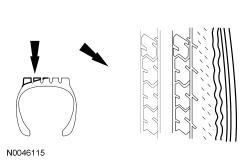
Inner Edge/Shoulder Wear
Inner edge (or shoulder) wear occurs on the inside edge of the tire and is usually caused by excessive toe out and/or excessive negative camber. If the tread depth of the outer shoulder is at least 50% greater than the tread depth of the inner shoulder, the tire is experiencing inner edge/shoulder wear. To determine whether tires have this type of wear, visually inspect the tires. In some instances, it may be necessary to measure the tread depth of each rib and compare it to that of the shoulder.
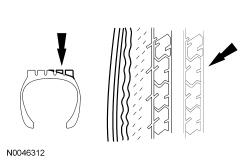
Outer Edge/Shoulder Wear
Outer edge (or shoulder) wear occurs on the outside edge of the tire and is usually caused by excessive toe in and/or excessive positive camber. If the tread depth of the inner shoulder is at least 50% greater than the tread depth of the outer shoulder, the tire is experiencing outer edge/shoulder wear. To determine whether tires have this type of wear, visually inspect the tires. In some instances, it may be necessary to measure the tread depth of each rib and compare it to that of the shoulder.
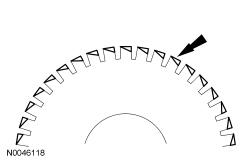
Heel/Toe Wear
Heel/toe wear (also known as feathering) occurs along the outside or inside edge/shoulder of the tire. To determine whether tires have this type of wear, visually inspect the tires in both the inside and outside shoulder ribs. In some instances, it may be necessary to measure the difference in tread depth of leading versus trailing edge of each lug in the inside and outside shoulder rib.
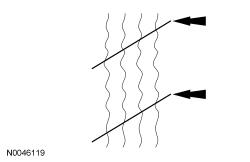
Diagonal Wear
Diagonal wear occurs diagonally across the tread area and around the circumference of the tire. To determine whether tires have this type of wear, visually inspect the tires to determine if the wear pattern runs diagonally across the tread and around the circumference of the tire. In some instances, the difference in tread depth along the diagonal wear pattern may need to be measured.
Symptom Chart: Tire Wear
| Condition | Possible Sources | Actions |
|---|---|---|
| Inner edge/shoulder wear | Excessive toe out and/or negative camber Incorrect wheel and tire assembly rotation intervals High-speed cornering |
GO to Pinpoint Test A |
| Outer edge/shoulder wear | Excessive toe in and/or positive camber Incorrect wheel and tire assembly rotation intervals High-speed cornering |
GO to Pinpoint Test B |
| Heel/toe wear | Excessive toe in/out Incorrect wheel and tire assembly rotation intervals |
ROTATE the wheel and tire assemblies. CHECK the alignment, ADJUST as necessary. |
| Diagonal wear | Excessive toe in/out Incorrect tire rotation intervals |
GO to Pinpoint Test C |
| Loose, worn or damaged suspension components | REFER to REFER to Suspension System - General Information . |