Parking Aid, Pre-COLLIS Ion And COLLIS Ion Avoidance System Diagnosis With No DTCS Present (20-7034)
Reference number: 20-7034
Supersedes refnos: 19-7027, 20-7026
PARKING AID, PRE-COLLIS ION AND COLLIS ION AVOIDANCE SYSTEM DIAGNOSIS WITH NO DTCS PRESENT
TECHNICAL SERVICE BULLETIN
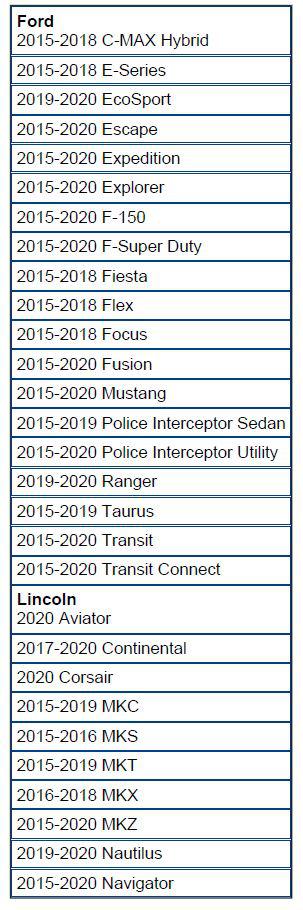
| FORD: | See list below |
| LINCOLN: | See list below |
MODEL
SUMMARY
This article supersedes GSB 20-7026 to update the Service Information and vehicle model years affected.
Use this document to aid in the diagnosis of park aid, pre-collision and collision avoidance systems when there is a system concern and no diagnostic trouble codes (DTCs) are present.
PARK AID SERVICE INFORMATION
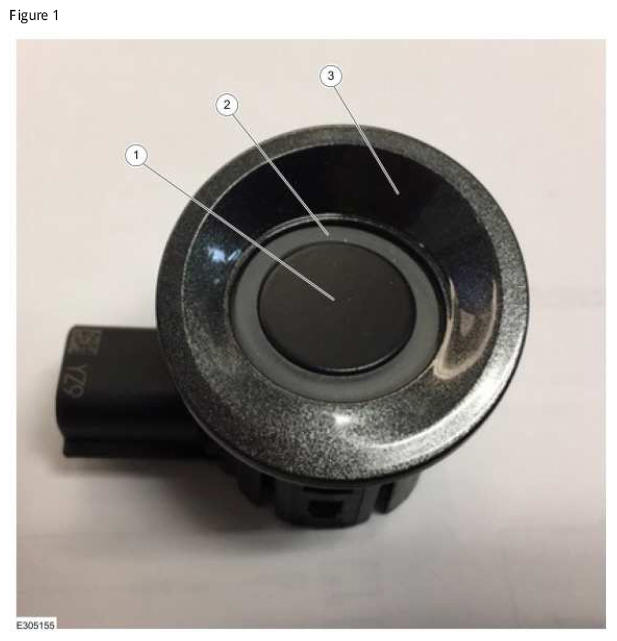
False park aid alerts with no DTCs in the park aid system are usually due to snow, slush, fog, salt, ice, frost build up, car wash and/or heavy rain. (Figure 1)
| Item | Description |
|---|---|
| 1 | Park aid sensor |
| 2 | Park aid silicon ring |
| 3 | Park aid retainer |
The purpose of the silicon ring (Figure 1 Callout 2) is to absorb vibrations and thus reduce false alerts. A thin film of ice may bridge over the silicon ring and/or sensor (Figure 1 Callout 1) and false alerts can occur. Upon visual inspection there maybe no obvious obstruction with the sensor. Often, when the vehicle is brought into the service bay, the ice will melt and all evidence of frost/ice would no longer be present.
Diagnostics should be performed but if no DTCs are present then ice bridging on the sensor was likely the issue. Verify sensor alignment and ring placement is symmetrical. Refer to the Workshop Manual (WSM) for diagnostics.
If no issues are found, advise the customer that this is a normal vehicle characteristic. Advise the customer they have the ability, on some vehicles, to turn the park aid system off in certain weather conditions.
COLLIS ION AVOIDANCE AND PRE-COLLIS ION SYSTEM INFORMATION
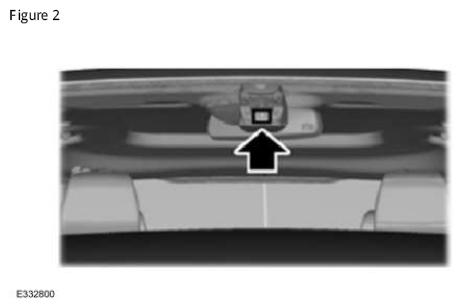
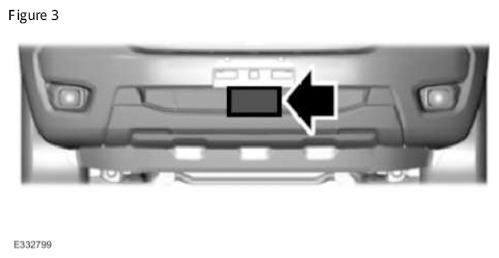
Collision avoidance systems can be a forward facing camera only such as image processing module A (IPMA) or a combination of IPMA and a cruise control module (CCM). Confirm which system needs diagnosing so the system evaluation is completed properly.
IPMA(near rear view mirror) (Figure 2)
Forward facing camera
CCM (in the front grill either visible or behind bumper) (Figure 3)
RADAR sensor (optional)
False collision avoidance warnings with no DTCs in the system can be due to inclement weather, dirt/mud, etc. False alerts can also occur on road curves or even in drive-through window curves. There are also sensitivity settings on the cluster for the collision avoidance system that will need to be checked. If the customer has the most sensitive setting selected false alerts can be more prominent.
Other considerations are windshield damage/distortion, bumper damage/protective cover damage, improper tire pressures or uneven wear, wrong tires/rims, loose or worn suspension parts, improper vehicle alignment. Normal conditions encountered that can affect the system are dawn/dusk or extremely bright lighting conditions. Basically, the IPMA is the eye of the collision avoidance system. Conditions that affect your vision may affect the IMPA as well. Diagnostics should be performed but if no DTCs and no other issues are suspected in the system, show the customer the collision avoidance/pre-collision assist section in the owners guide to help the customer understand system operation and performance and the conditions that can affect performance. Make sure the customer is made aware of any sensitivity changes to the collision avoidance system and the conditions that can affect system operation.