Suspension System - General Information
Wheel Alignment Angles
Camber
Negative and Positive Camber
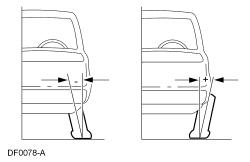
Camber is the vertical tilt of the wheel when viewed from the front. Camber can be positive or negative and has a direct effect on tire wear.
Caster
Caster is the deviation from vertical of an imaginary line drawn through the pivot points (top of strut and lower ball joint), when viewed from the side. The caster specifications in this service information will give the vehicle the best directional stability characteristics when loaded and driven. The caster setting is not related to tire wear. The caster setting is not adjustable.
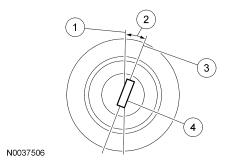
Caster
| Item | Description |
|---|---|
| 1 | True vertical |
| 2 | Positive caster angle |
| 3 | Strut-to-ball joint centerline |
| 4 | Pivot centerline |
A backward tilt is positive (+) and a forward tilt is negative (-). Front caster adjustment is not a separate procedure on this vehicle. The vehicle will tend to drift/pull toward the side with the lowest caster.
Toe
Positive Toe (Toe In)
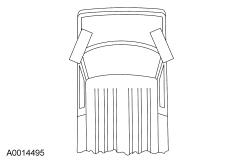
Negative Toe (Toe Out)
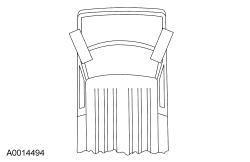
The vehicle toe setting affects tire wear and directional stability.
Incorrect Thrust Angle (Dog Tracking)
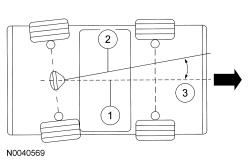
Incorrect Thrust Angle (Dog Tracking)
| Item | Description |
|---|---|
| 1 | Vehicle centerline |
| 2 | Axle centerline |
| 3 | Thrust angle |
Incorrect thrust angle (also known as dogtracking) is the condition in which the rear axle is not square to the chassis. Heavily crowned roads can give the illusion of dogtracking.
Wander
Wander is the tendency of the vehicle to require frequent, random left and right steering wheel corrections to maintain a straight path down a level road.
Shimmy
Shimmy, as experienced by the driver, is large, consistent, rotational oscillations of the steering wheel resulting from large, side-to-side (lateral) tire/wheel movements.
Shimmy is usually experienced near 64 km/h (40 mph), and can begin or be amplified when the tire contacts pot holes or irregularities in the road surface.
Nibble
Sometimes confused with shimmy, nibble is a condition resulting from tire interaction with various road surfaces and experienced by the driver as small rotational oscillations of the steering wheel.
Poor Returnability, Sticky Steering
Poor returnability and sticky steering are used to describe the poor return of the steering wheel to center after a turn or steering correction.
Drift, Pull
Pull is a tugging sensation felt by the hands on the steering wheel that must be overcome to keep the vehicle going straight.
Drift describes what a vehicle with this condition does with the hands off the steering wheel.
- A vehicle-related drift/pull on a flat road causes a consistent deviation from the straight-ahead path and requires constant steering input in the opposite direction to counteract the effect.
- Drift/pull may be induced by conditions external to the vehicle (for example, wind or road crown).