Electronic Power Assist Steering (EPAS) System: Notes
Overview
The EPAS system provides steering assist to the driver by replacing the conventional, hydraulic valve system with a steering gear equipped with an integrated electrical motor and PSCM. The motor operation and level of steering assist provided is controlled by the PSCM.
System Operation
System Diagram
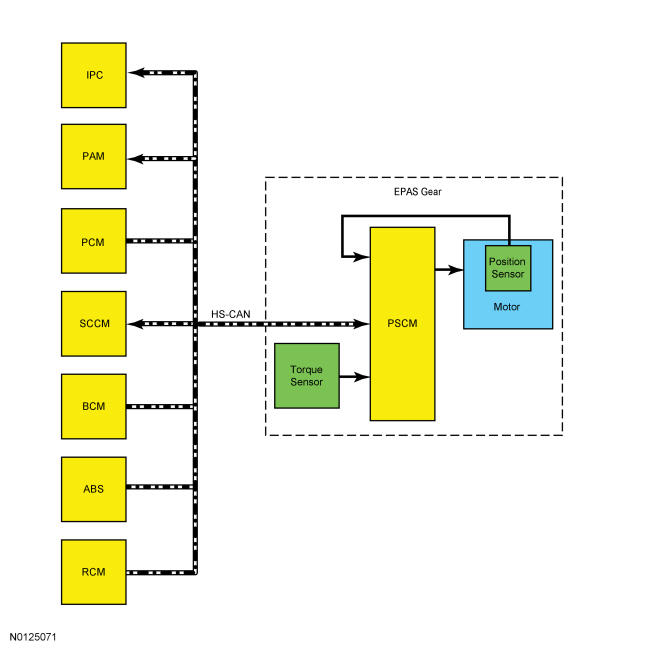
Network Message Chart
| Broadcast Message | Originating Module | Message Purpose |
|---|---|---|
| Steering wheel component angle | ABS Module | Used to determine the steering wheel position. |
| Wheel speed data | ABS Module | Used to validate the steering wheel component angle by confirming each individual wheel speed value is valid. |
| Steering angle count | SCCM | Message sent every 10 ms for comparison purposes to verify the validity of the steering angle message. |
| Steering angle initialization | SCCM | Used to determine the steering wheel position for vehicles equipped with active park assist. |
| Vehicle lateral acceleration | Restraints Control Module | Used by the PSCM to learn the vehicle straight ahead position. |
| Engine RPM | PCM | Engine Revolutions Per Minute (RPM) monitored to initiate EPAS activation and continued operation. |
| Vehicle speed | PCM | Used to determine the level of assist supplied. |
| Charging system status | BCM-B | Used to confirm the charging system is operating in a manner that can support EPAS operation. |
| Steering angle request | PAM | Information request message for comparison between SCCM and PSCM steering angle data for vehicles equipped with active park assist. |
Electronic Power Assist Steering (EPAS) System
The PSCM controls the functions of the EPAS system and communicates with other modules over the HS-CAN.
To activate the EPAS system, a 12-volt hot at all times and a 12-volt ignition/run input to the PSCM is required. The PSCM then monitors the HS-CAN to determine if the vehicle is operating in a manner capable of supporting the EPAS system.
The PSCM uses inputs from various modules over the HS-CAN, the steering torque sensor and the motor to determine the amount or level of assist provided by the EPAS system.
The steering torque sensor sends out 2 signals, one for left and one for right. When the steering wheel is turned to the left, the left signal increases while the right signal decreases. When the steering wheel is turned to the right, the right signal increases while the left signal decreases. This allows the PSCM to determine if the driver intends to turn left or right in order to spin the motor in the appropriate direction.
The EPAS gear uses a 12-volt reversible motor to control the steering effort. The motor is connected to the rack of the steering gear by a toothed belt and pulley/bearing assembly. The motor is used by the PSCM to move the rack inside the steering gear housing. The position of the motor is used to determine steering wheel angle/position instead of using a separate sensor.
The PSCM continually monitors and adjusts steering efforts based on the torque sensor, motor position and HS-CAN inputs to enhance the feel of the steering system. The level of steering assist is primarily based on vehicle speed. As vehicle speed increases, the amount of assist decreases to improve and enhance road feel at the steering wheel. As vehicle speed decreases, the amount of assist increases to ease vehicle maneuvering. Compensation is made to reduce the effect of pull or drift that can be experienced when driving on roads with a high degree of camber.
The PSCM is self-monitoring and is capable of setting and storing DTCs. Depending on the DTC set, the PSCM may enter a failure mode. Refer to Failure Mode below. , Failure Modes. In addition, the PSCM may send a request to the IPC over the HS-CAN to display a message in the message center, alerting the driver of a potential EPAS concern.
Failure Modes
When a DTC is present in the PSCM, the EPAS enters 1 of 2 modes of operation.
Reduced Steering Assist Mode
The EPAS enters a reduced steering assist mode to protect the internal components of the EPAS when a concern is detected by the PSCM, such as, low/high battery voltage or over-temperature concerns that are not considered to be a critical safety concern. The steering assistance sets to a default level and does not change with vehicle speed. This indicates that the steering assistance available for slow speed maneuvering is reduced, giving the steering a heavy feel. The assistance at high speed is greater than normal and can give the steering a lighter than normal feel.
Manual Steering Mode
The EPAS enters a manual steering mode (no electrical steering assistance is provided) when a concern that is considered to be a critical safety concern is detected or when a concern that caused the EPAS to enter reduced steering assist mode has been present for a predetermined number of key cycles. In manual steering mode, the vehicle has mechanical steering operation only, which gives steering operation a heavy feel.
Active Park Assist
Active park assist is an optional feature on this vehicle. REFER to Active Park Assist .