TPMS Reminder Reset - Procedure 01
NOTE:
For vehicles with dual rear wheels, see Procedure 07 .
NOTE:
If tire pressure sensor is replaced, it will need to be trained. The TPM system is not affected by wheel and tire rotation.
NOTE:
As ambient temperature decreases by 6°C (10°F), tire pressure decreases 1 psi (7 kPa). Because tire pressures fluctuate with temperature changes, tire pressures must be set when tires are at outdoor ambient temperatures. If the tire pressure may drop enough to be detected by the TPM system, which will activate the low pressure warning light.
NOTE:
When the tire pressure warning light comes on solid and message center displays "LOW TIRE PRESSURE", check the air pressure of all tires and adjust to the specified cold pressure listed on vehicle certification label (found on driver's door or door pillar). Drive the vehicle at 20 mph (32 km/h) for at least 2 minutes. If the vehicle has been stationary for more than 30 minutes, a TPM sensor Activation procedure may be needed. Make sure the warning light goes off. If the warning light stays on, there is a malfunction in the TPM system. See appropriate manufacturer service information.
NOTE:
When the tire pressure warning light flashes for 70 seconds and then remains illuminated, after bulb-check has been performed and message center displays warning messages, there is a malfunction in the TPM system. See appropriate manufacturer service information.
NOTE:
Under the following conditions, the TPM system may not function properly:
- Low tire pressure.
- Tire pressure sensor is missing or damaged.
- Spare tire is installed as a road wheel.
- Incorrect tire pressure sensor is installed.
- Tire pressure sensor installed incorrectly.
- Non-OEM wheels installed (aftermarket rims).
- Non-OEM equipped run-flat tires installed.
- Other non-OEM modifications (roll cages, service barriers, part racks, ladder racks, etc.)
NOTE:
The tire pressure sensor training procedure must be done on a single vehicle, in an area without Radio Frequency (RF) noise and at least 3 ft. (1 m) away from any other vehicle equipped with TPM system. RF noise is generated by electrical motor and appliance operation, cellular telephones and remote transmitters, power inverters and portable entertainment equipment.
NOTE:
A new tire pressure sensor is shipped in an OFF mode (or battery saver mode), and must be turned ON before it can be trained. To turn the sensor on, inflate the tire to the recommended inflation pressure and wait at least 2 minutes, then continue with the sensor training procedure.
- Turn ignition switch to OFF position, then press and release brake pedal.
- Turn ignition switch from OFF position to the RUN position 3 times, ending in RUN position. Do not wait more than one minute between each key cycle.
- Press and release the brake pedal.
- Turn ignition switch to OFF position.
- Turn ignition switch from OFF position to the RUN position 3 times, ending in RUN position. Do not wait more than one minute between each key cycle.NOTE: The horn will sound once and the tire pressure warning light will flash if train mode has been entered successfully (if equipped, the message center displays "TRAIN LF TIRE").
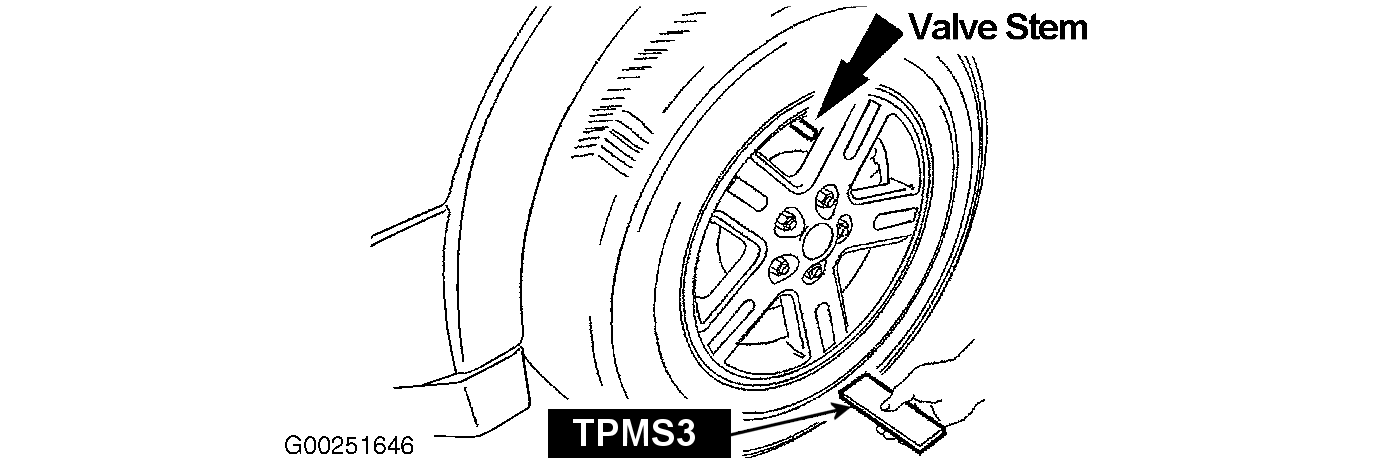
- Depending on TPMS sensor type, place transmitter activation tool on the left front tire wall:
- Band-On Type Sensor: Opposite (180 degrees) from the valve stem. See Fig 1
- Valve-Mounted Type Sensor: Near the valve stem.
NOTE: It may take up to 6 seconds to activate a tire pressure sensor. During this time, the transmitter activation tool must remain in place, in the appropriate position relative to the valve stem.NOTE: If a sensor does not respond to the activation tool, move the vehicle to rotate the wheels at least 1/4 of a turn and attempt to activate the same sensor again.NOTE: If the DDM does not recognize any one of the 4 tire pressure sensors during the 2 minute time limit for each sensor response, the horn will sound twice and the message center (if equipped) will display "TIRE NOT TRAINED REPEAT". The training procedure must be repeated from the beginning. - Within 2 minutes after the horn sounds, place transmitter activation tool on the right front tire wall, in the appropriate position relative to the valve stem. Then press the activation button to train the right front tire pressure sensor. Repeat procedure for right rear and left rear tires.NOTE: Do not wait more than 2 minutes between training each sensor. If the wait time is more than 2 minutes the DDM will stop and the training procedure must be repeated from the beginning.
- When the tire training procedure is complete, the message center (if equipped) will display "TIRE TRAINING COMPLETE". For vehicles not equipped with a message center, successful completion of the training procedure will be verified by turning the ignition switch to the OFF position without the horn sounding. If the horn sounds twice when ignition is turned off, the training procedure was not successful.