Electric Exhaust Gas Recirculation (EEGR) System
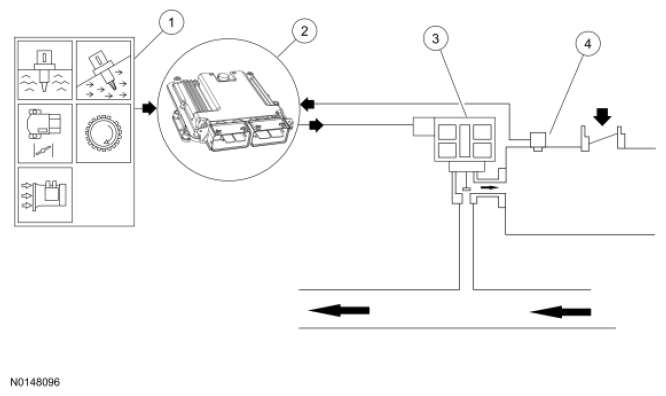
The EEGR system consists of an electric motor EGR valve integrated assembly, a manifold absolute pressure (MAP) sensor, PCM, and connecting wiring. For additional information on the EGR system components, refer to ENGINE CONTROL COMPONENTS in this service information. Operation of the system is as follows:
- The EEGR system receives signals from the engine coolant temperature (ECT) or cylinder head temperature (CHT) sensor, throttle position (TP) sensor, mass airflow (MAF) sensor, crankshaft position (CKP) sensor, and the MAP sensor to provide information on engine operating conditions to the PCM. The engine must be warm, stable, and running at a moderate load and RPM before the EEGR system is activated. The PCM deactivates the EEGR during idle, extended wide open throttle (WOT), or whenever a concern is detected in an EEGR component or EGR required input.
- The PCM calculates the desired amount of EGR for a given set of engine operating conditions.
- The PCM in turn outputs signals to control the EEGR motor to move (advance or retract) a calibrated number of discrete steps. The electric stepper motor directly actuates the EEGR valve, independent of engine vacuum. The EEGR valve is commanded from 0 to 52 discrete steps to get the EGR valve from a fully closed to a fully open position. The position of the EGR valve determines the EGR flow.
- A MAP sensor measures variations in manifold pressure as exhaust gas recirculation is introduced into the intake manifold. Variations in EGR being used correlate to the MAP signal (increasing EGR increases manifold pressure values).