Integrated Electronic Ignition System
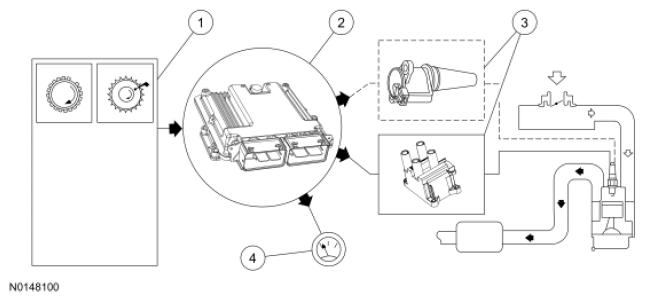
The integrated electronic ignition system consists of a crankshaft position (CKP) sensor, coil pack or coil on plug (COP), connecting wiring, and a PCM. For additional information on the ignition system components, refer to ENGINE CONTROL COMPONENTS in this service information. The COP integrated electronic ignition system uses a separate coil per spark plug, and each coil is mounted directly onto the plug. The COP integrated electronic ignition system eliminates the need for spark plug wires, but does require input from the camshaft position (CMP) sensor. Operation of the components are as follows:
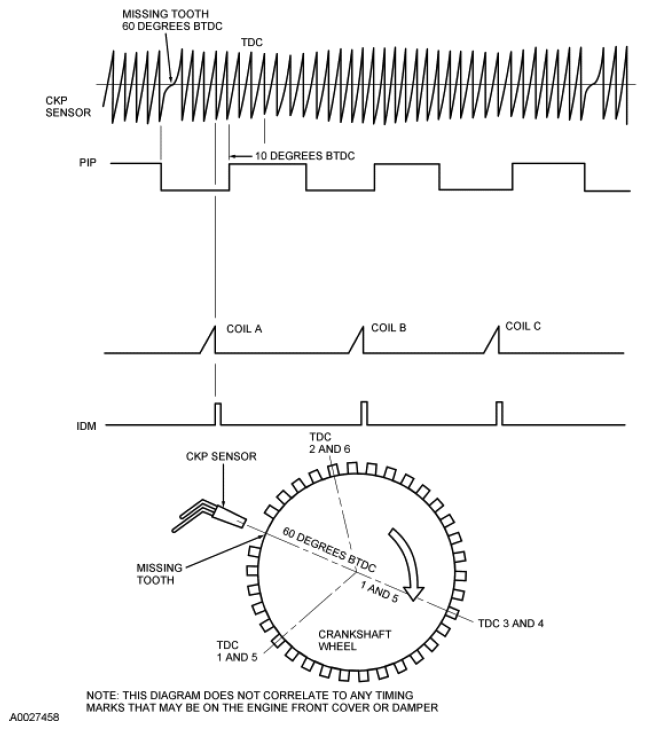
- The CKP sensor indicates the crankshaft position and speed by sensing a missing tooth on a pulse wheel mounted to the crankshaft. The COP integrated electronic ignition system uses the CMP sensor to identify the compression stroke of cylinder 1, and to synchronize the firing of the individual coils.
- The PCM uses the CKP sensor signal to calculate a spark target and then fires the coil pack or COP to that target illustrate. The PCM uses the CMP sensor signal to identify the compression stroke of cylinder 1, and to synchronize the firing of the individual coils.
- The PCM controls the ignition coils after it calculates the spark target. The COP system fires only one spark plug per coil upon synchronization during the compression stroke. For the coil pack ignition system, each coil within a pack fires 2 spark plugs at the same time. The plugs are paired so that as one fires during the compression stroke the other fires during the exhaust stroke.
The current flow, or dwell, through the primary ignition coil is controlled by the PCM by providing a switched ground path through the ignition coil driver to ground. When the ignition coil driver is switched ON, current rapidly builds up to a maximum value, determined by the coil inductance and resistance. When the current is switched OFF, the magnetic field collapses which induces a secondary high voltage surge and the spark plug is fired. This high voltage surge creates a flyback voltage which the PCM uses as a feedback during the ignition diagnostics. The PCM uses the charge current dwell time characteristics to carry out the ignition diagnostics.
- The PCM processes the CKP sensor signal and uses it to drive the tachometer as the clean tach output (CTO) signal.