EVAP System Monitor - 0.040" DIA. Vacuum Leak Check
Vehicles that meet enhanced evaporative requirements utilize a vacuum-based evaporative system integrity check. The evap system integrity check uses a Fuel Tank Pressure Transducer (FTPT), a Canister Vent Solenoid (CVS) and Fuel Level Input (FLI) along with a Canister Purge Valve (CPV) to find 0.040" diameter or larger evap system leaks. Federal vehicles can utilize a 0.040" leak check rather than the 0.020" leak check required for California vehicles. Additionally, some programs may elect to run a 0.090" / 0.020" detection configuration and turn the 0.040" leak test off as provided for in the regulations.
In the case of heavy duty gasoline engines (> 14, 000 lbs), the regulations require 0.150" leak detection only. Heavy Duty vehicle will not set a P0442 (0.040" leak). They will set a P0455 during the initial vacuum pulldown phase to meet the 0.0150" leak detection requirement.
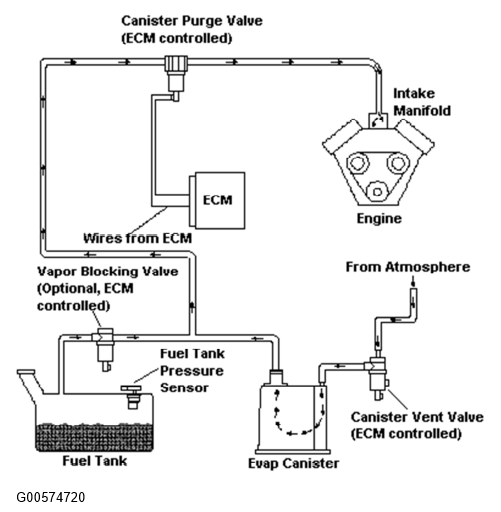
The evap system integrity test is done under conditions that minimize vapor generation and fuel tank pressure changes due to fuel slosh since these could result in false MIL illumination. The check is run after a 6 hour cold engine soak (engine-off timer), during steady highway speeds at ambient air temperatures (inferred by IAT) between 40 and 100 °F.
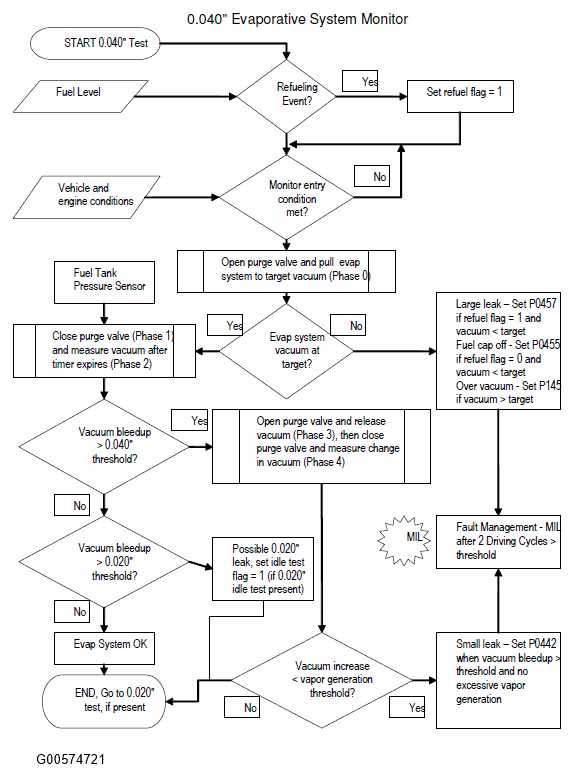
A check for refueling events is done at engine start. A refuel flag is set in KAM if the fuel level at start-up is at least 20% of total tank capacity greater than fuel fill at engine-off. It stays set until the evap monitor completes Phase 0 of the test as described below. Note that on some vehicles, a refueling check may also be done continuously, with the engine running to detect refueling events that occur when the driver does not turn off the vehicle while refueling (in-flight refueling).
As a precursor to running the evap system integrity, a conditioning test is carried out to ensure that there is no excessive vacuum condition (P1450). Excessive vacuum can cause damage to the evap system if the CVS becomes corked closed during evap testing. Basically, with the purge flow commanded off, the CVS is closed and a vacuum growth or a stagnant vacuum is monitored over time. If the vacuum grows or does not dissipate then P1450 DTC sets and the evap integrity check is prohibited from running. Hence, P1450 DTC can only set outside the monitor, not inside it.
If the 0.04" leak check monitor is ready to run but the excessive vacuum check test has not run, the leak monitor will force the excessive check to run.
The evap system integrity test is done in four phases.
Phase 0 - initial vacuum pulldown
First, the Canister Vent Solenoid is closed to seal the entire evap system, and then the Canister Purge Valve (CPV) is opened to pull an 8" H2 O vacuum. If the initial vacuum could not be achieved, a large system leak is indicated (P0455). This could be caused by a fuel cap that was not installed properly, a stuck open Capless Fuel Fill valve, a large hole, an overfilled fuel tank, disconnected/kinked vapor lines, a Canister Vent Solenoid that is stuck open, a CPV that is stuck closed, or a disconnected/blocked vapor line between the CPV and the FTPT.
2009 Model Year and beyond implementations require 2 or 3 gross leak failures in-a-row prior to setting a P0455 DTC.
On some vehicles, if the initial vacuum could not be achieved after a refueling event, a gross leak, fuel cap off (P0457) is indicated and the recorded minimum fuel tank pressure during pulldown is stored in KAM. A "Check Fuel Cap" light may also be illuminated. On vehicles with capless fuel fill, a message instructing the customer to check the Capless Fuel Fill valve will appear in conjunction with a P0457 DTC. Depending on calibration, the MIL may be illuminated in two or three trips with a P0457 failure.
If a P0455, P0457, or P1450 code is generated, the evap test does not continue with subsequent phases of the small leak check, phases 1-4.
Not all vehicles will have the P0457 test or the Check Fuel Cap light implemented. These vehicles will continue to generate only a P0455. After the customer properly secures the fuel cap, the P0457, Check Fuel Cap and/or MIL will be cleared as soon as normal purging vacuum exceeds the P0457 vacuum level stored in KAM.
Phase 1 - Vacuum stabilization
If the target vacuum is achieved, the CPV is closed and vacuum is allowed to stabilize for a fixed time. If the pressure in the tank immediately rises, the stabilization time is bypassed and Phase 2 of the test is entered.
For the 2010 MY, a new PI controller was implemented to control the vacuum pull exactly to target. By doing so, the phase one stabilization time has been reduced.
Phase 2 - Vacuum hold and decay
Next, the vacuum is held for a calibrated time and the vacuum level is again recorded at the end of this time period. The starting and ending vacuum levels are checked to determine if the change in vacuum exceeds the vacuum bleed up criteria. Fuel Level Input and ambient air temperature are used to adjust the vacuum bleed-up criteria for the appropriate fuel tank vapor volume. Steady state conditions must be maintained throughout this bleed up portion of the test. The monitor will abort if there is an excessive change in load, fuel tank pressure or fuel level input since these are all indicators of impending or actual fuel slosh. If the monitor aborts, it will attempt to run again (up to 20 or more times). If the vacuum bleed-up criteria is not exceeded, the small leak test is considered a pass. If the vacuum bleed-up criteria is exceeded on three successive monitoring events, a 0.040 " dia. leak is likely and a final vapor generation check is done to verify the leak, phases 3-4. Excessive vapor generation can cause a false MIL.
Phase 3 - Vacuum release
This stage of the vapor generation check is done by opening the CVS and releasing any vacuum. The system will remain vented to atmosphere for approximately 30 - 60 seconds and then proceed to phase 4.
Phase 4 - Vapor generation
This stage of the vapor generation check is done by closing the CVS and monitoring the pressure rise in the evaporative system. If the pressure rise due to vapor generation is below the threshold limit for absolute pressure and change in pressure, a P0442 DTC is stored.
| DTCs | P0455 (gross leak), P1450 (excessive vacuum), P0457 (gross leak, cap off), P0442 (0.040" leak) |
| Monitor execution | once per driving cycle |
| Monitor Sequence | HO2S monitor completed and OK |
| Sensors/Components OK | MAF, IAT, VSS, ECT, CKP, TP, FTP, CPV, CVS |
| Monitoring Duration | 360 seconds (see disablement conditions below) |
| Entry Condition | Minimum | Maximum |
| Engine off (soak) time OR ECT at start - IAT at start <= 12 °F |
4 - 6 hours | |
| Time since engine start-up | 330 seconds | 1800 to 2700 seconds |
| Intake Air Temp | 40 °F | 95 - 100 °F |
| BARO (<8, 000 ft altitude) | 22.0 " Hg | |
| Engine Load | 20% | 70% |
| Vehicle Speed | 40 mph | 90 mph |
| Purge Duty Cycle | 75% | 100% |
| Purge Flow | 0.05 lbm/min | 0.10 lbm/min |
| Fuel Fill Level | 15% | 85% |
| Fuel Tank Pressure Range | - 17 H2 O | 1.5 H2 O |
| Battery Voltage | 11 volts | 18 volts |
| Clean Canister |
| Change in load: > 30% |
| Change in tank pressure: > 1 " H2 O |
| Change in fuel fill level: > 15% |
| Number of aborts: > 255 |
| Vehicle Accel > 1 mph / sec |
| P1450 (Excessive vacuum): < -4.0 in H2 O delta vacuum from time that CVS is closed, or > -4. in H2 O stagnant vapor over a 10 second evaluation time. |
| P0455 (Gross leak): > -8.0 in H2 O over a 30 second evaluation time. |
| P0457 (Gross leak, cap off): > -8.0 in H2 O over a 30 second evaluation time after a refueling event. |
| P0442 (0.040" leak): > 2.5 in H2 O bleed-up over a 15 second evaluation time at 75% fuel fill. (Note: bleed-up and evaluation times vary as a function of fuel fill level and ambient air temperature) |
| P0442 vapor generation limit: < 2.5 in H2 O over a 120 second evaluation time |
| Test ID | Comp ID | Description | Units |
| $3A | $80 | Phase 0 end pressure result and test limits (data for P1450 - excessive vacuum) | Pa |
| $3A | $81 | Phase 4 vapor generation minimum change in pressure and test limits (data for P1450, CPV stuck open) | Pa |
| $3A | $82 | Phase 0 end pressure result and test limits (data for P0455/P0457 - gross leak/cap off) | Pa |
| $3B | $80 | Phase 2 0.040" cruise leak check vacuum bleed-up and test limits (data for P0442 - 0.040" leak) | Pa |
| Note: Default values (0.0 Pa) will be displayed for all the above TIDs if the evap monitor has never completed. Each TID is associated with a particular DTC. The TID for the appropriate DTC will be updated based on the current or last driving cycle, default values will be displayed for any phases that have not completed. | |||