EVAP System Monitor - 0.020" DIA. Engine Off Natural Vacuum
Some vehicles that meet enhanced evaporative requirements utilize an engine off natural vacuum (EONV) evaporative system integrity check that tests for 0.020" dia. leaks while the engine is off and the ignition key is off. The evap system integrity check uses a Fuel Tank Pressure Transducer (FTPT), a Canister Vent Solenoid (CVS) and Fuel Level Input (FLI) to find 0.020" diameter evap system leaks.
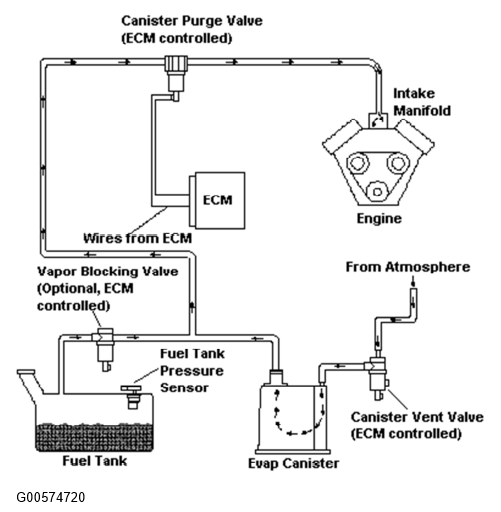
The Ideal Gas Law (PV=mRT) defines a proportional relationship between the Pressure and Temperature of a gas that is contained in a fixed Volume. Therefore, if a sealed container experiences a drop in temperature it will also experience a drop in pressure. In a vehicle, this happens when a sealed evaporative system cools after the engine has been run, or if it experiences a drop in temperature due to external environmental effects. This natural vacuum can be used to perform the leak check, hence the name Engine Off Natural Vacuum (EONV). Condensation of fuel vapor during cooling can add to the vacuum produced by the Ideal Gas Law.
In contrast to the vacuum produced by drops in temperature, an additional factor can be heat transfer to the evaporative system from the exhaust system immediately after key-off. Heat transfer from the exhaust at key-off aided by fuel vaporization may produce a positive pressure shortly after key-off, which can also be used for leak detection.
The EONV system is used to perform only the 0.020" leak check while 0.040" dia. leaks and larger (including fuel cap off) will continue to be detected by the conventional vacuum leak monitor performed during engine running conditions.
Ford's EONV implementation for California and Green State applications uses a separate, stay-alive microprocessor in the PCM to process the required inputs and outputs while the rest of the PCM is not powered and the ignition key is off. The stay-alive microprocessor draws substantially less battery current than the PCM; therefore, powering only the stay-alive micro during engine-off conditions extends vehicle battery life and allows the EONV monitor to run more often. The PCM is the only difference between California/Green State and Federal vehicles.
Inputs to EONV Microprocessor
- Fuel Tank Pressure
- Battery Voltage
Outputs from EONV Microprocessor
- Canister Vent Solenoid
- 0.020" leak data
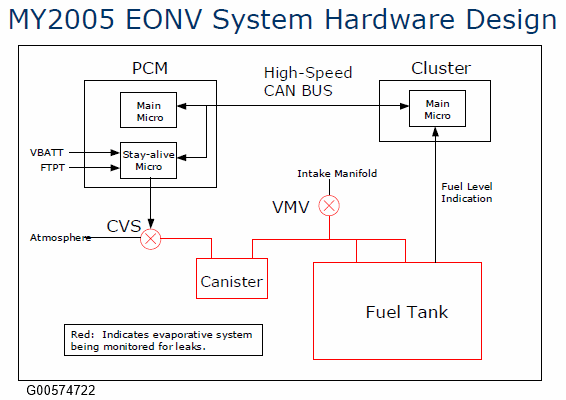
For new 2009 MY and beyond applications, EONV implementation is done in the main microprocessor. The main micro stays alive at key off in a special low power mode to run the EONV test. There is no longer a special standalone chip for EONV. The feature is called EONVM (EONV in the Main).
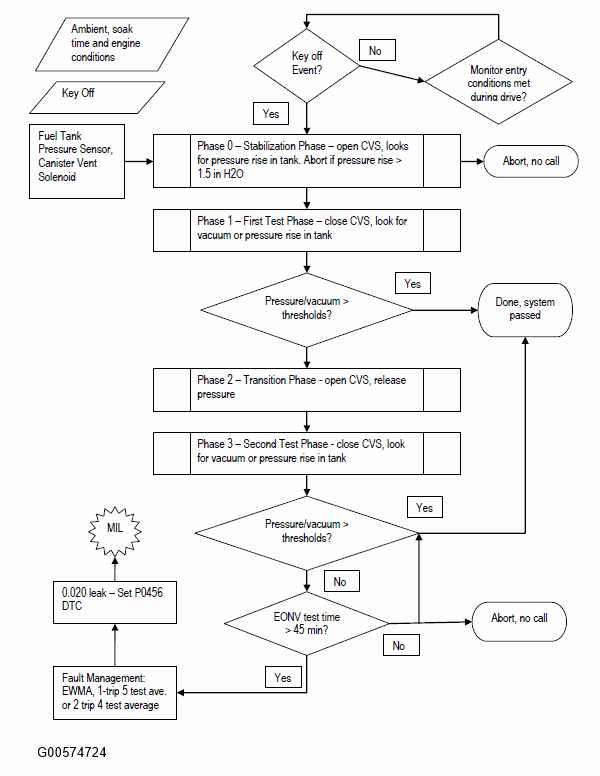
Phase 0- Stabilization Phase
The purpose of the Stabilization Phase is to allow tank pressure to stabilize after vehicle shutdown (i.e. ignition in the OFF position). During this phase, the Canister Vent Solenoid (CVS) is open, thus allowing the pressure in the fuel tank to stabilize at atmospheric pressure. The duration of the Stabilization Phase is approximately 2 minutes. A fuel volatility check is performed just prior to its completion.
The fuel volatility check measures tank pressure and will abort the test if more than 1.5 "H2 0 is observed in the tank. Because the CVS is open during this test, it would take a good deal of fuel vaporization to produce this level of pressure on a vented system. As an example, this condition may occur when a customer performs a long drive with highly volatile, winter fuel on a 100-deg F day. Note: This feature is not used in most applications.
If the fuel volatility check passes, a Fuel Tank Pressure Transducer (FTPT) offset correction factor is learned as the last step of this phase. This correction factor is applied to pressure measurements in the next phase to improve FTPT accuracy.
Phase 1 - First Test Phase
At the start of this phase, the CVS is commanded shut, thus sealing up the entire evaporative system. If the system is sufficiently sealed, a positive pressure or vacuum will occur during depending on whether the tank temperature change is positive or negative. Other effects such as fuel vaporization and condensation within the fuel tank will also determine the polarity of the pressure. As the leak size increases, the ability to develop a positive pressure or vacuum diminishes. With a 0.020" leak, there may be no measurable positive pressure or vacuum at all depending on test conditions.
During this phase, tank pressure is continuously measured and compared to calibrated detection thresholds (both positive pressure and vacuum) that are based on fuel level and ambient temperature. If either the pressure or vacuum threshold is exceeded, the test will be considered a pass, and the monitor will proceed to "Phase 4 - Test Complete". If a positive plateau occurs in tank pressure without exceeding the pass threshold, the monitor will progress to "Phase 2 - Transition Phase". If a vacuum occurs, the monitor will remain in Phase 1 until the test times out after 45 minutes have elapsed since key-off, or the pass threshold for vacuum is exceeded. In either case, the monitor will transition to "Phase 4 - Test Complete."
Phase 2- Transition Phase
This phase will occur if a positive pressure plateau occurred in Phase 1 without the positive pass threshold being exceeded. At the start of the Transition Phase, the CVS is opened and the evaporative system is allowed to stabilize. The Transition Phase lasts approximately 2 minutes, and a new FTPT offset correction is learned just prior to its completion. The monitor will then progress to "Phase 3 - Second Test Phase".
This phase is termed the Transition Phase because there is a chance that a vacuum will be seen in the next phase if a positive pressure plateau occurred in Phase 1. The reason for this is that a positive plateau may be coincident with vapor temperature starting to decrease, which is favorable for developing a vacuum in the fuel tank. This is not always the case, and it is possible to see a positive pressure in Phase 3 as well.
Phase 3- Second Test Phase
Upon completion of the Transition Phase, the CVS is commanded shut and the FTPT is monitored for any positive pressure or vacuum that develops. As with "Phase 1 - First Test Phase", if either the positive pressure or vacuum pass threshold is exceeded, the test is considered a pass and proceeds to "Phase 4 - Test Complete". Also, if the test times out after 45 minutes have elapsed since key-off, the test will be considered a fail (i.e. leak detected) and will also proceed to "Phase 4 - Test Complete".
Phase 4 - Test Complete
In this phase, the EONV test is considered complete for this key-off cycle. The resultant peak pressure and peak vacuum are stored along with total test time and other information. This information is sent to the main microprocessor via CAN at the next engine start. During this phase, the CVS is commanded open and the electrical components performing the EONV test are shutdown to prevent any further power consumption.
Test Aborts
During the EONV test, several parameters are monitored to abort the EONV test under certain conditions. The primary abort conditions are instantaneous changes in tank pressure and fuel level. They are used to detect refuel events and rapidly open the CVS upon detection of them. A list of abort conditions is given below.
Post-2009 Model Year Fault Filtering
To increase the IUMP (rate-based) numerator once per monitor completion, the fault filtering logic for EONV was revised. The logic incorporates several important CARB requirements. These are:
- Fast Initial Response (FIR): The first 4 tests after a battery disconnect or code clear will process unfiltered data to quickly indicate a fault. The FIR will use a 2-trip MIL. This will help the service technician determine that a fault has been fixed.
- Step-change Logic (SCL): The logic will detect an abrupt change from a no-fault condition to a fault condition. The SCL will be active after the 4th EONV test and will also use a 2-trip MIL. This will illuminate the MIL when a fault is instantaneously induced.
- Normal EWMA (NORM): This is the normal mode of operation and uses an Exponentially Weighted Moving Average (EWMA) to filter the EONV test data. It is employed after the 4th EONV test and will illuminate a MIL during the drive cycle where the EWMA value exceeds the fault threshold. (1 trip MIL). The recommended filter/time constant will produce filtering comparable to a previously-described 5-test average.
If there is a failure using any of the fault filtering logic shown above, a P0456 DTC will be set.
Phases of EONV Test
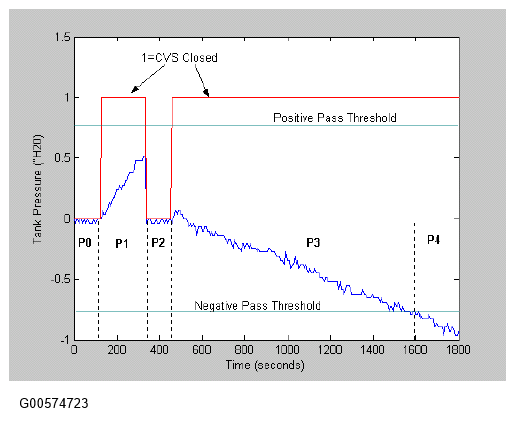
P0 = Phase 0 , Stabilization Phase - With CVS open, Tank Pressure is allowed to stabilize. A fuel volatility test is performed and FTPT offset correction is learned if volatility test passes.
P1 = Phase 1 , First Test Phase - CVS is closed and pressure peaks below positive pass threshold sending test to Phase 2. If the positive pass threshold were exceeded, the test would have completed and a pass would have been recorded.
P2 = Phase 2 , Transition Phase - CVS is opened and a second stabilization phase occurs. A second FTPT offset is learned during this time.
P3 = Phase 3 , Second Test Phase - CVS is closed again and a vacuum develops that eventually exceeds the negative pass threshold. When this occurs, the test proceeds to Phase 4, test complete.
P4 = Phase 4 , Test Compete - CVS opens (not pictured in above data file), results are recorded, and stay-alive electronics shutdown.
| DTCs | P0456 (0.020" leak) P260F (Evaporative System Monitoring Processor Performance) |
| Monitor Execution | Once per key-off when entry conditions are met during drive. Monitor will run up to 2 times per day, or 90 cumulative minutes per day (whichever comes first) |
| Monitor Sequence | none |
| Sensors/Components OK | EONV Processor, Canister Vent Solenoid, Fuel Tank Pressure Sensor, Fuel Level Input, Vapor Management Valve, CAN communication link |
| Monitoring Duration | 45 minutes in key-off state if fault present. Tests will likely complete quicker if no fault is present. |
| Entry conditions to allow EONV test (prior to key off) | Minimum | Maximum |
| Engine off (soak) time | 3.5 - 6 hours | |
| OR | ||
| Inferred soak criteria met: - (ECT at start - IAT at start) | 12 °F | |
| Inferred soak criteria met - ECT at start | 35 °F | 105 °F |
| Inferred soak criteria met - minimum engine off soak time | 0 sec | |
| Time since engine start-up to allow EONV test | 20 minutes | 90 minutes |
| Ambient Temperature at start-up | 40 °F | 95 °F |
| Battery Voltage to start EONV test | 11 volts | |
| Number of completed EONV tests in 24hr cycle | 6 | |
| Cumulative test time in 24hr cycle | 90 minutes | |
| Fuel level | 15% | 85% |
| ECU time since power-up to allow EONV test | 180 seconds | |
| Flex fuel inference complete | Learned | |
| BARO (<8, 000 ft altitude) | 22.0 " Hg | |
| Summation of air mass of the combustion engine since start ensures that vehicle has been operated off idle (function of ambient temperature). | 7500 to 15000 lbm/min | |
| Ratio of drive time to (drive + soak) time. (This allows for the driver to key-off for a short time without losing the initial soak condition.) | 0.8 |
| Tank pressure at key-off > 1.5" H2 0 during stabilization phase (indicates excessive vapor) |
| Tank pressure not stabilized for tank pressure offset determination |
| Rapid change in tank pressure > 0.5" H2 0 (used for refuel/slosh detection) |
| Rapid change in fuel level > 5% (used for refuel/slosh detection) |
| Battery voltage < 11 Volts |
| Rapid change in battery voltage > 1 Volt |
| Loss of CAN network (only for standalone satellite micro applications) |
| Canister Vent Solenoid fault detected |
| Driver turns key-on |
| P0456 (0.020" leak): < 0.75 in H2
O pressure build and < 0.50 in H2 O vacuum build over a 45 minute maximum evaluation time Note: EONV monitor can be calibrated to illuminate the MIL after two malfunctions (an average of four key-off EONV tests, eight runs in all) or after a single malfunction (an average of five key-off EONV tests, five runs in all), or using EWMA with Fast Initial Response and Step Change Logic. Most new 2006 MY and later vehicles will use the five-run approach, most new 2009 MY and later use the EWMA approach. |
| Monitor ID | Comp ID | Description | Units |
| $3C | $81 | EONV Positive Pressure Test Result and Limits (data for P0456) | Pa |
| $3C | $82 | EONV Negative Pressure (Vacuum) Test Result and Limits (data for P0456) | Pa |
| $3C | $83 | Normalized Average of Multiple EONV Tests Results and Limits (where 0 = pass, 1 = fail) (data for P0456) | unitless |
| Note: Default values (0.0) will be displayed for all the above TIDs if the evap monitor has never completed. The appropriate TID will be updated based on the current or last driving cycle, default values will be displayed for any phases that have not completed. | |||