EVAP Switching Valve (EVAPSV) Diagnostics
The Evap Switching Valve (EVAPSV) is included on HEV applications for 2009 Model Year. It is very similar to the Fuel Tank Isolation Valve (FTIV) used in previous model years. The Evap Switching Valve is also known as a Vapor Blocking Valve (VBV). The purpose of the EVAPSV is to isolate the fuel tank from the rest of the evaporative system so that the Canister Purge Valve (CPV) can purge more aggressively with minimal risk of purge vapor slugs being ingested into the intake.
The EVAPSV is normally closed during engine operation, but may vent during a drive to relieve positive pressure. The exact pressure points at which the valve opens and closes are vehicle dependent. When the vehicle is in a key-off state, the EVAPSV is not powered and the valve is open.
The VBV circuit and functional diagnostics will set the following DTCs:
P2418 - EVAPSV circuit fault
P2450 - EVAPSV stuck open fault
The EVAPSV circuit diagnostics are very similar to that of the Canister Purge Valve (CPV) and Canister Vent Solenoid (CVS). See Evap System Monitor Component Checks below.
A diagram of an evaporative system with an EVAPSV (shown as a VBV) is shown below:
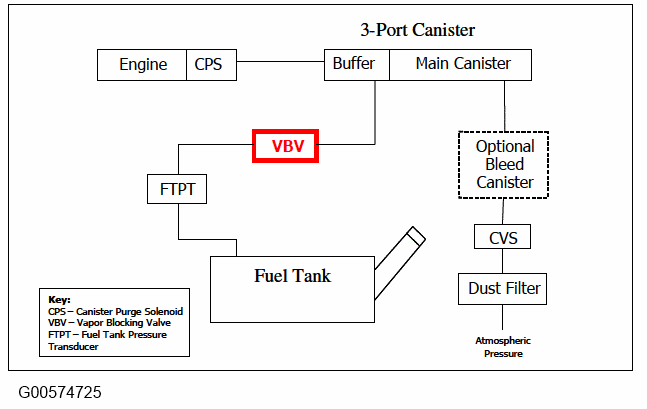
The Evaporative System monitor performs a functional check of the EVAPSV in Phase 3 of the evap monitor cruise tests if the 0.040" leak test passes. At the end of Phase 2, tank pressure will be in the range of -8 to -5 "H2 0 and the EVAPSV will be open. At the beginning of Phase 3, the EVAPSV is commanded closed and the CVS is commanded open. If the EVAPSV fails to close, there will be a rapid pressure loss in the fuel tank. If this pressure loss exceeds a calibrated threshold, a P2450 DTC is set. (Requires 2 or 3 failures in a row during a driving cycle (calibratable)). If the fault is present on a second driving cycle, the MIL will be illuminated.
| DTCs | P2450 |
| Monitor Execution | once per driving cycle |
| Monitor Sequence | Run after evap 0.040" cruise test |
| Sensors/Components OK | MAF, IAT, VSS, ECT, TP, FTP, CPV, CVS |
| Monitoring Duration | 30 seconds (see disablement condition below) |
| Entry Condition | Minimum | Maximum |
| 0.040" Cruise Test completes |
| Change in fuel fill level: > 15% |
| P2418: Presence of short, open, or intermittent fault for more than 5 seconds P2450: Pressure loss > 3" H2 0 during phase 3. |
| Test ID | Comp ID | Description | Units |
| $3D | $82 | Vapor blocking valve performance (P2450) | Pa |
|
NOTE:
Default values (0.0 Pa) will be displayed for all the above TIDs if the evap monitor has never completed. Each TID is associated with a particular DTC. The TID for the appropriate DTC will be updated based on the current or last driving cycle, default values will be displayed for any phases that have not completed.
|
|||