Air Fuel Ratio Imbalance Monitor - Torque Monitor (2016)
A new, torque-based, A/F Ratio Imbalance Monitor (AFITQ) has been developed. It has an advantage over O2 sensor based methods. O2 sensors require optimal placement of the sensor in the exhaust manifold so that all cylinders are uniformly sampled. Optimum sensor placement is often constrained by exhaust manifold and catalyst design due to packaging.
The new torque based monitor is supplemented by the existing O2 based monitor. The O2 based monitor is used to detect large levels of cylinder to cylinder air fuel imbalance, while the torque based monitor is used to detect small levels of cylinder to cylinder air fuel ratio imbalance.
The AFITQ monitor uses the crankshaft position sensor (CKP) to calculate an acceleration term during each cylinder firing event (similar to the misfire monitor). The calculated acceleration value is proportional to engine torque during the firing event. The monitor will intrusively modulate each cylinder's fuel mass multiplier to generate a calibratable AFR deviation relative to the stoich point of operation.
The monitor generates 5 total torque values for each cylinder - 2 torque points richer than stoich, 2 torque points leaner than stoich and 1 point at stoich. The monitor then uses the torque curve shape defined by these 5 points versus an ideal torque curve as a reference to estimate the cylinder AFR deviation. Finally, the monitor estimates each cylinder AFR deviation from the rest of the cylinders. See the ideal torque curve below.
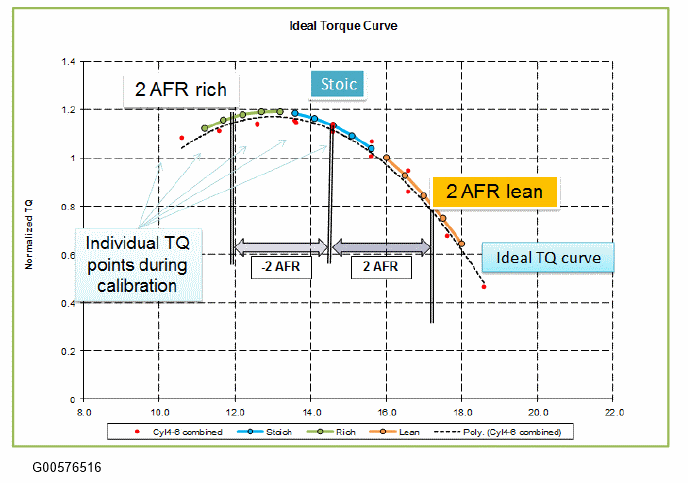
The AFITQ monitor is intrusive so it can affect engine operation and emissions. A fuel mass multiplier modulation table is designed to maintain stoich AFR per engine bank during the test. A positive fuel excursion on one cylinder is compensated by a negative fuel excursion on another cylinder. The fuel mass multiplier modulation table is also designed to minimize the change between AFR points in order to minimize torque/rpm disturbances for the customer.
To detect individual cylinder AFR, Ford is using an algorithm to correlate the shape of the 5 point torque curve to the ideal (calibrated) torque curve. Another algorithm identifies the individual cylinder deviation from the rest of the cylinders on the engine bank. For each cylinder, the monitor calculates the value of the AFR difference between the tested cylinder and the rest of the cylinders. This AFR deviation is converted to a value of fuel deviation where, for example, zero is no deviation, +0.15 is a 15% rich deviation and -0.15 is a 15% lean deviation.
- Spark deviation from spark at MBT too large
- Instantaneous load variations are too large
- Closed loop fuel deviation is too far from stoich
- Cam position is not a calibrated range
- Purge flow at idle too high or not steady
- Speed/load conditions outside calibrated limits
- Vehicle speed outside calibrated limits
The monitor results are based upon the torque calculation during the subsequent cylinder firing event and utilize the following entry conditions:
The AFITQ monitor is intended to run during idle, vehicle stopped, brakes on and transmission in drive. The total test duration is 18 seconds.
The initial applications for the AFITQ monitor are the 2016 MY Explorer 3.5L FWD V6 PFI and the 2016 MY Taurus/Flex 3.5L/3.7L FWD V6 PFI.
The AFITQ monitor is intended to detect very small AFR errors, in the order of +/- 2 AFR. (16% lean, 12% rich) The AFITQ monitor uses Exponentially Weighted Moving Average (EWMA) to reduce the variability of the raw cylinder data. Due to this variability, the Fast Initial Response (FIR) and Step-change Logic (SCL) are disabled. The AFITQ monitor will always operate using Normal EWMA mode. It is employed after the 4th monitor result following an OBD code clear; therefore, the monitor can illuminate the MIL following the fifth monitor result after a code clear in response to a threshold fault.
| DTCs | P219C Cylinder 1 Air-Fuel Ratio Imbalance P219D Cylinder 2 Air-Fuel Ratio Imbalance P219E Cylinder 3 Air-Fuel Ratio Imbalance P219F Cylinder 4 Air-Fuel Ratio Imbalance P21A0 Cylinder 5 Air-Fuel Ratio Imbalance P21A1 Cylinder 6 Air-Fuel Ratio Imbalance |
| Monitor Execution | Once per driving cycle during idle conditions, vehicle stopped, brakes on |
| Monitor Sequence | Monitor runs after fuel monitor has adapted |
| Sensors OK | ECT, IAT, MAF, VSS, TP, ETC, FRP, DPFE EGR, VCT, VMV, CVS, FTP, CKP, CMP, ignition coils, injectors, no system failures affecting fuel, no EVAP gross leak failure, UEGO heaters OK, no "lack of switching" malfunction, no "lack of movement" malfunction, no UEGO circuit malfunction, vehicle speed, AAT, PDL, fuel level, ACT,MAP, IMRC, no injector faults |
| Monitoring Duration | Time to complete monitor ranges from 17 to 18 seconds |
| Entry Condition | Minimum | Maximum |
| Closed Loop Fuel Control | ||
| Engine Speed | 500 rpm | 600 rpm |
| Engine Load | 17% | 37% |
| Instantaneous load change | 1.5% | 2% |
| PCV is not flashing oil | ||
| Closed loop fuel deviation from stoic | -3.5% | 3.5% |
| Measured AFR deviation from stoic | -5% | 3.5% |
| Change of intake camshaft position at idle | -10 deg | +10 deg |
| Change of exhaust camshaft position at idle | -10 deg | +10 deg |
| Engine Coolant Temp | 150 °F | 250 °F |
| Intake Air Temp | 20 °F | 150 °F |
| Vehicle speed | 0 mph | 3 mph |
| Fuel percentage from purge | 20% | |
| Fuel Level | 15% | |
| Fuel monitor has adapted | ||
| No purge on/off transition | ||
| Fuel type learning is complete (FFV only) | ||
| Stability time within monitor | 0.5 sec |
| Fuel deviation for Cylinder 1 < -0.12 (12% lean) or > +0.16 (16% rich) Fuel deviation for Cylinder 2 < -0.12 (12% lean) or > +0.16 (16% rich) Fuel deviation for Cylinder 3 < -0.12 (12% lean) or > +0.16 (16% rich) Fuel deviation for Cylinder 4 < -0.12 (12% lean) or > +0.16 (16% rich) Fuel deviation for Cylinder 5 < -0.12 (12% lean) or > +0.16 (16% rich) Fuel deviation for Cylinder 6 < -0.12 (12% lean) or > +0.16 (16% rich) |
| Monitor ID | Test ID | Description | |
| $81 | $81 | Cylinder 1 fuel deviation and min/max limits | Unitless |
| $81 | $82 | Cylinder 2 fuel deviation and min/max limits | Unitless |
| $81 | $83 | Cylinder 3 fuel deviation and min/max limits | Unitless |
| $82 | $84 | Cylinder 4 fuel deviation and min/max limits | Unitless |
| $82 | $85 | Cylinder 5 fuel deviation and min/max limits | Unitless |
| $82 | $86 | Cylinder 6 fuel deviation and min/max limits | Unitless |