PCV System Monitor - Turbo Or Naturally Aspirated With Map Sensor
The PCV valve is installed into the rocker cover using a quarter-turn cam-lock design to prevent accidental disconnection. The PVC valve is connected to the intake manifold hose using a quick connect. The PCV tube is swedged to the valve and fittings and is not removable. Because the PCV valve has locking tabs and cannot be removed from the rocker cover without the use of special removal tools, the quick connect will be disconnected first in the event vehicle service is required. Molded nylon lines are typically used from the PCV valve to the intake manifold. Disconnection causes a 10.92 mm diameter leak into the intake manifold from atmosphere. Unlike a MAF system, where an intake manifold leak will result in a lean condition, a speed density/MAP system does not have any fuel control errors with an intake leak. The only thing that happens is that idle speed increases, however, idle speed control is largely under control if an intake manifold leak exists. A persistent intake manifold leak would simply increase fuel consumption at idle and raise the engine idle speed slightly. A disconnection in the PCV inlet tube is made detectable by insuring that if it is disconnected a large (detectable) leak results. The PCV valve is semi-permanently affixed to the external oil separator or the rocker cover if an internal oil separator is used. Overcoming the toque provided by the locking tabs allows removal via a turn. It is replaceable, but needs to be "torqued out" of the assembly. Mechanically, the hose is easy to disconnect (detectable disconnection) and the PCV valve is difficult to disconnect (undetectable disconnection).
The detection method compares engine air flow rate as computed from the speed density air charge calculation with the throttle air flow rate. Should the air entering the engine exceed the air through the throttle by a threshold amount, a leak is detected.
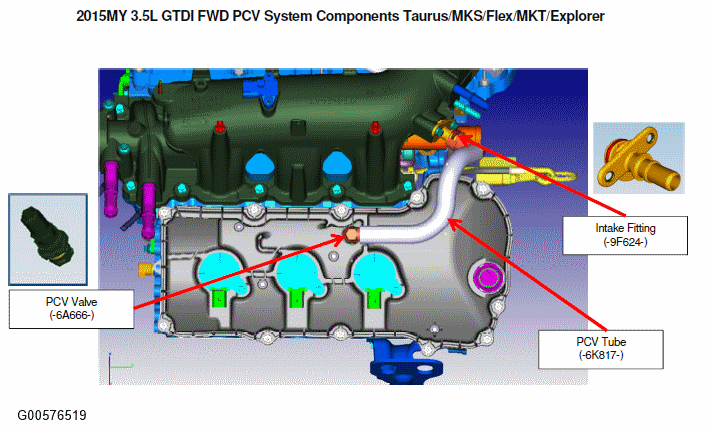 Courtesy of FORD MOTOR CO. Courtesy of FORD MOTOR CO.
|
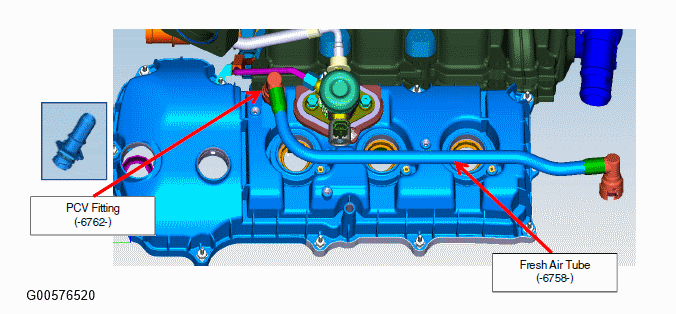 Courtesy of FORD MOTOR CO. Courtesy of FORD MOTOR CO.
|
PCV MONITOR OPERATION
| DTCs |
P2282 - Air Leak Between Throttle Body and Intake Valve |
| Monitor Execution |
Continuous |
| Monitor Sequence |
None |
| Monitoring Duration |
N/A |
| Sensors OK |
No fault is present in any of the sensors or systems affecting the PCV monitor. BARO sensor, MAP sensor, throttle charge temperature sensor, throttle inlet pressure sensor, manifold charge temperature sensor, no VCT malfunction |
TYPICAL P2282 CHECK ENTRY CONDITIONS
| Entry Condition |
Minimum |
Maximum |
| Throttle angle (at condition for 300 msec minimum) |
N/A |
4 deg |
| Intake Air Temp |
-20 deg. F. |
|
| Engine Coolant Temperature |
-20 deg. F. |
|
| Barometric Pressure |
20 in. Hg. |
|
TYPICAL P2282 MALFUNCTION THRESHOLDS
| Calculated air leak of 1 lbm/min or greater that persists for at least 5 seconds. |