Enhanced Thermostat Monitor
For the 2009 MY, the thermostat test has been enhanced to reduce the time it takes to identify a malfunctioning thermostat. The enhanced monitor includes a model which infers engine coolant temperature.
During a cold start, when the thermostat should be closed, the monitor uses a model of ECT to determine whether actual ECT should have crossed the Warm Up Temperature (WUT) threshold. . The engine coolant temperature warm-up model compensates for the following thermal characteristics:
- Coolant heating (heat source):
- Combustion heating (engine speed and load based).
- Cooling system heaters (electric or fuel-fired - new for 2013 MY)
- Coolant cooling (heat sink):
- Due to cylinder cut-out (DFSO or powertrain limiting).
- Injectors are cut but still pumping air through the engine. Increased cooling compared to engine shut-down.
- Due to engine shut-down. (Stop/Start and Hybrid - new for 2013 MY).
- Due to cylinder cut-out (DFSO or powertrain limiting).
- Coolant flow rate:
- Mechanical water pumps have been replace on some applications with clutched water pumps or electric water pumps.
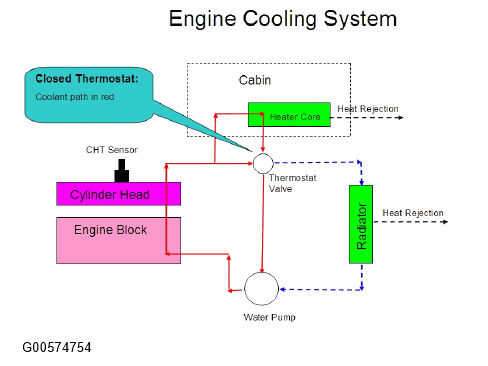
Once the ECT model exceeds the WUT threshold, after a calibratable time delay, measured ECT is compared to the same WUT threshold to determine if ECT has warmed up enough. If ECT has warmed up to at least the WUT threshold, the thermostat is functioning properly. If ECT is too low, the thermostat is most likely stuck open and a P0128 is set.
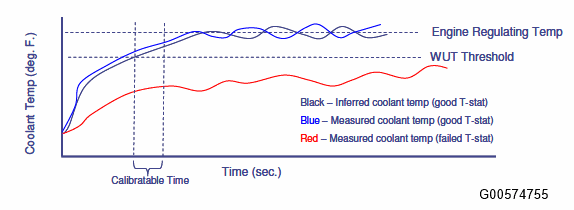
The WUT threshold is normally set to 20 degrees F below the thermostat regulating temperature.
There are some circumstances that could lead to a false diagnosis of the thermostat. These are conditions where the vehicle cabin heater is extracting more heat than the engine is making. One example where this can occur is on large passenger vans which have "dual" heaters, one heater core for the driver and front passengers and another heater core for the passengers in the rear of the vehicle. At very cold ambient temperatures, even a properly functioning thermostat may never warm up to regulating temperature. Another example is a vehicle that is started and simply sits at idle with the heater on high and the defroster fan on high.
There are two features that are used to prevent a false thermostat diagnosis. For vehicles with dual heaters, the WUT threshold is reduced at cold ambient temperatures below 50 deg F. For cases where the engine is not producing sufficient heat, a timer is used to track time at idle or low load conditions (e.g. decels). If the ratio of time at idle/low load versus total engine run time exceeds 50% at the time the fault determination is made, the thermostat diagnostic does not make a fault determination for that driving cycle, i.e. "no-call".
| DTCs | P0128 - Coolant Thermostat (Coolant temperature below thermostat regulating temperature) |
| Monitor Execution | Once per driving cycle, during a cold start |
| Monitoring Duration | Drive cycle dependent. Monitor completes in less than 300 seconds, when inferred ECT exceeds threshold (at 70 deg F ambient temperature) |
| Entry conditions | Minimum | Maximum |
| Engine Coolant Temperature at start | None | 125 °F |
| Intake Air Temperature at start (ambient temp) | 20 °F | None |
| Inferred Percent Ethanol (flex fuel vehicles only) | Learned | N/A |
| Completion condition | Minimum | Maximum |
| Modeled ECT | 172 °F | None |
| Time Since Modeled ECT Exceeded WUT Threshold | 3 sec | None |
| Time at Idle/Low Load Compared with Total Engine Run Time | None | 50% |
| Engine Coolant Temperature < 172 °F (for a typical 192 °F thermostat) |