WASTEGATE Pneumatic Solenoid Valve
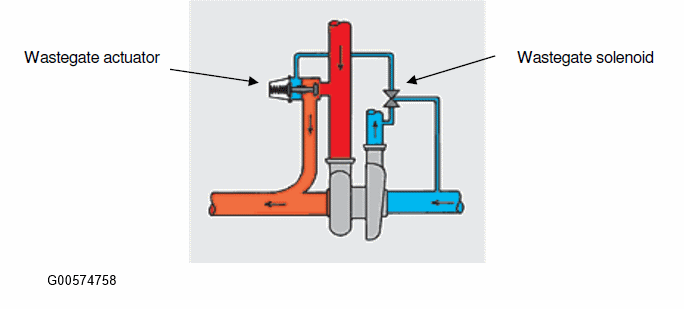
The wastegate (one per turbocharger) allows exhaust pressure to bypass the turbocharger's turbine, to control compressor speed (on the same shaft), and thus boost pressure. The wastegate controller is actually a mechanical-pneumatic boost pressure controller. Its boost pressure limit can be increased within a limited range by altering the pressure "seen" by the pneumatic actuator. The wastegates are only controlled indirectly by the PCM via the wastegate pneumatic solenoid.
A high pressure on the wastegate actuator's diaphragm tends to open the wastegate. The solenoid valve normally connects compressor out pressure (boost) to the wastegate actuator's diaphragm, resulting in the regulation of maximum boost pressure (to a constant value). Using the wastegate vent solenoid to partially vent (reduce) that control pressure increases the regulated maximum boost.
As the compressor outlet pressure increases, a pneumatically powered actuator opens each turbocharger wastegate to limit compressor outlet pressure. The wastegate pneumatic solenoid valve modulates that feedback pressure to increase the boost pressure limit. A duty cycle of 100% vents feedback thus eliminating any wastegate controlled boost limit. A duty cycle of 0% results in the base boost limit of approximately 5 psi gauge.
| DTCs | P0245 Turbocharger/Supercharger Wastegate Solenoid A Low P0246 Turbocharger/Supercharger Wastegate Solenoid A High |
| Monitor Execution | Continuous |
| Monitor Sequence | None |
| Monitoring Duration | 5 seconds |
| PCM smart driver hardware detects faults for circuit short to battery, short to ground, and open circuit. Fault status reported to PCM to set appropriate DTC. |