Clock Master (19-7002)
Reference number: 19-7002
CLOCK MASTER
TECHNICAL SERVICE BULLETIN
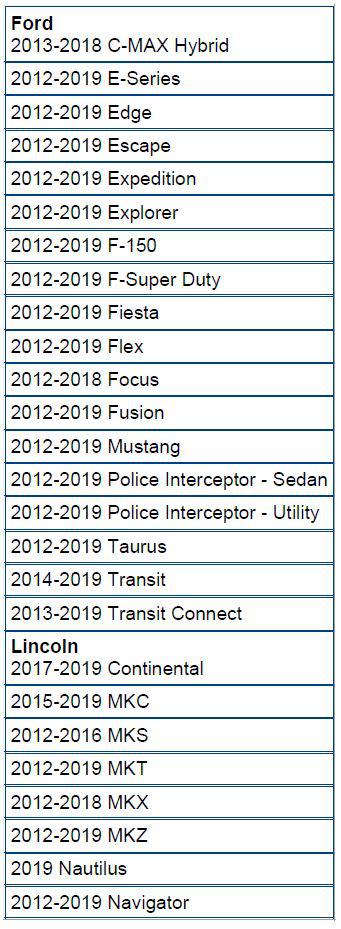
| FORD: | See list below |
| LINCOLN: | See list below |
MODEL
SUMMARY
Clock Master
This bulletin contains information to determine the clock master for Ford and Lincoln vehicles.
SERVICE INSTRUCTION
Most Ford and Lincoln vehicles are equipped with a clock display. However, the module that controls each vehicle line's clock may differ depending on vehicle equipment and model year. The following information is intended to assist with identifying the clock master and the strategies in which the clock operates.
The clock master is the master module responsible for keeping time and broadcasting this information to the slave module(s).
CLOCK DISPLAY TIME GAIN/LOSS
Normal allowance for clock time gain or loss on all vehicles and systems should be no more than 10.5 to 15.25 seconds per week. This gain/loss is dependent on temperature changes during that period of time, and can equate to 45 seconds to 1 minute per month.
The default time zone for North America is Eastern. This will always have an offset of 5 hours behind universal time clock (UTC) + any user offset.
UTC does not account for daylight savings time as this is a North American market legal requirement only.
VEHICLE LIST BY ARCHITECTURE TYPE
The clock master differs between each vehicle depending on the architecture type. There are three different architecture types currently used on all Ford and Lincoln vehicles.
Figure 1 - Clock Master Architecture Types
| Type A |
|---|
| Edge (2008-2014) |
| Expedition (2015) |
| Explorer (2011-2015) |
| F-150 (2009-2014) |
| Flex (Starting 2009) |
| MKT (Starting 2010) |
| MKS (2009-2015) |
| MKX (2008-2015) |
| Super Duty (2011-2014) |
| Taurus (2009-2015) |
| Type B |
|---|
| Continental (Starting 2017) |
| EcoSport (Starting 2018) |
| Edge (Starting 2015) |
| Expedition (Starting 2016) |
| F-150 (Starting 2015) |
| Fiesta (Starting 2017) |
| Fusion (Starting 2013) |
| Fusion HEV/PHEV (Starting 2013) |
| MKZ (Starting 2013) |
| MKC (Starting 2015) |
| MKS (2016) |
| MKX (2016-2018) |
| Mustang (Starting 2015) |
| Nautilus (2019) |
| Navigator (Starting 2016) |
| Taurus (Starting 2016) |
| Super Duty (Starting 2014) |
| Type C |
|---|
| C-Max HEV/PHEV (Starting 2012) |
| Escape (Starting 2012) |
| Focus (Starting 2012) |
| Transit (Starting 2014) |
| Transit Connect (Starting 2013) |
Type A - The SYNC Module (APIM) for vehicles equipped with SYNC Gen 2 or SYNC 3 is the clock master. If the vehicle is equipped with SYNC Gen 1, the front control/display interface module (FCDIM) is the clock master.
Figure 2
- GPSM/Antenna
- Receives the UTC Data
- Sends the UTC data to APIM
- APIM (Clock Master)
- Receives the UTC data from the GPSM
- Sends the UTC data to IPC
- IPC
- Displays clock data sent from APIM
Vehicles with navigation - The APIM receives a time and date message from the global positioning system module (GPSM)/satellite antenna. The time value provided is in terms of UTC. The APIM will then display the time, with the appropriate time zone offset provided by the navigation software.
Vehicles without navigation - The APIM is still the clock master. However, the APIM will calculate the offset by subtracting the current displayed time from the UTC time that is being broadcast by the GPSM/satellite antenna.
Vehicles with SYNC Gen 1 and FCDIM - All clock functionality is controlled by the FCDIM. The FCDIM is the clock master and broadcasts clock information to other modules.
Offset = UTC time - current displayed time
This offset value is used each time the APIM is powered up. Upon power up the offset is added to the UTC time provided by the GPSM/satellite antenna and then compared to the clock time that the APIM internally tracks. If the two do not match, the APIM will correct to the tracked time with the UTC time plus the offset.
Type B - The body control module (BCM) is the clock master. The APIM and FCDIM are slave modules.
Figure 3
- GPSM/Antenna
- Receives the UTC Data
- Sends the UTC data to APIM
- APIM
- Receives UTC data
- Sends clock change request
- BCM (Clock Master)
- Receives clock change request
- Sends clock data to APIM and IPC
- IPC
- Displays clock data sent from BCM
For vehicles with navigation - The APIM (slave module) is still responsible for reading the GPS data from the GPSM/satellite antenna, applying the appropriate time zone offset, and comparing that time to the current tracked time provided by the BCM (clock master). As a slave module, the APIM will not automatically update the time displayed on its own. The slave module will request a time change from the clock master. The clock master then sent a request to the slave modules to update the displays.
For vehicles without navigation - The slave module will still calculate the offset. It will also use this offset value and the time provided by the GPSM/satellite antenna to compare with the current time value from the clock master. If the times do not match, the slave module will send a time change request to the clock master instead of instantly updating. The clock master will then send the request to have the displays updated accordingly.
Offset = UTC time - current displayed time
This offset value is used every time the slave module powers up. Upon powering up, the offset is added to the UTC time provided by the GPSM/satellite antenna and then compared to the clock that the slave module internally tracks.
Type C - These vehicles follow the same rules as the Type B architecture type vehicles.
Older vehicles and vehicles that are not listed in Figure 1, the audio control module (ACM) is the clock master.
For vehicles equipped with SYNC Gen 2 or SYNC 3, the clock master can be determined through APIM Bezel Diagnostics > APIM Diagnostics > Configuration Status. To enter the bezel diagnostics, refer to the appropriate Workshop Manual (WSM), Section 415-00.
Vehicles equipped with SYNC 3 do not have a separate GPSM. Per the WSM Section 415-00 Description and Operation, the GPSM is internal to the APIM.