Warning Chimes
Overview
The warning chimes provide the driver with audible warnings that act as reminders and supplemental alerts to visual IPC indications (gauges, indicators and message center warnings). The deviation from this strategy is the air bag warning chime, which alerts the driver that the primary alerting system (air bag warning indicator) does not operate. The IPC controls all warning chimes based on messages received from external modules.
The warning chimes are an integral part of the IPC that receives and acts upon much of the same information that is input and used to operate the IPC gauges, indicators, warning indicators and message center warnings. The IPC prioritizes the chimes according to a preset hierarchy programmed into the IPC software. When more than one chime request is received by the IPC, the most important chime sounds. If a lower priority chime is currently sounding, the higher priority request takes over and replaces the lower priority chime.
System Operation
System Diagram
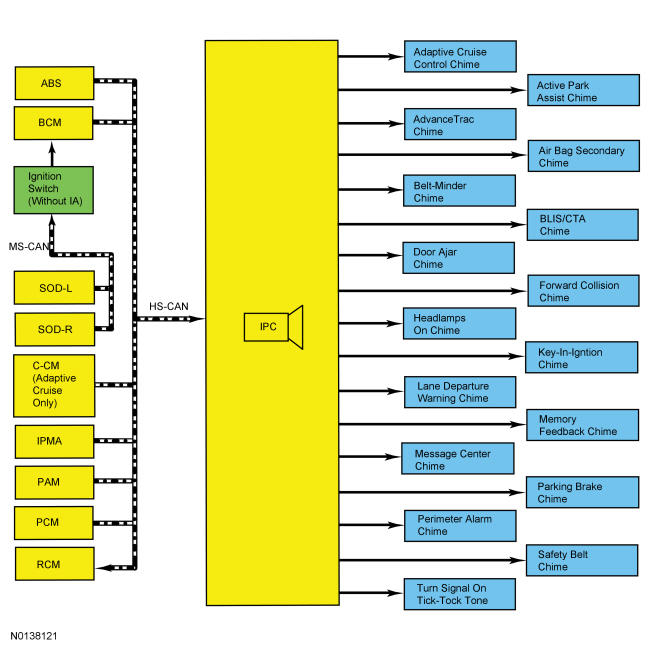
Network Message Chart
| Broadcast Message | Originating Module | Message Purpose |
|---|---|---|
| Air bag warning indicator request | RCM | Input used to control the air bag warning chime when a fault in the air bag indicator lamp exists. |
| Adaptive cruise control warning display | C-CM | Input used to control adaptive cruise control high priority warning chime. |
| AdvanceTrac ® warning chime request | ABS | Input used to control the AdvanceTrac ® warning chime. |
| Belt-Minder ® programming request | RCM | Input used to enable or disable and control the Belt-Minder ®. |
| Belt-Minder ® warning request | RCM | Input used to control the Belt-Minder ®. |
| Cruise control status | PCM | Input used to control adaptive cruise control low priority warning chime. |
| Driver alert warning | IPM-A | Input used to control the hands off driver alert chime. |
| Drivers door ajar status | BCM | Provides the driver door ajar input to control the door ajar warning chime. |
| Forward collision confirmation chime request | C-CM | Input used to control the forward collision confirmation chime. |
| Forward collision warning request | C-CM | Input used to control the forward collision warning chime. |
| Headlamps on warning chime command | BCM | Input used to control the headlamps on chime. |
| Ignition status | BCM | Ignition RUN, START and accessory states required for the IPC operating modes and fault reporting. |
| Key-in-ignition warning chime command | BCM | Input used to control the key-in-ignition warning chime. |
| Left rear door ajar status | BCM | Provides the left rear door ajar input to control the door ajar warning chime. |
| Liftgate ajar status | BCM | Provides the tailgate ajar input to control the door ajar warning chime. |
| Memory feedback request | DSM | Provides the chime request and update chime request inputs to control the memory feedback warning chime. |
| Parking aid audible warning status | PAM | Input used to control the active park assist chime. |
| Parking aid audible warning status front | PAM | Input used to control the active park assist chime. |
| Parking aid audible front target warning | PAM | Input used to control the active park assist chime. |
| Park brake chime request | BCM | Input used to control the parking brake warning chime. |
| Passenger door ajar status | BCM | Provides the passenger door ajar input to control the door ajar warning chime. |
| Passenger rear door ajar status | BCM | Provides the right rear door ajar input to control the door ajar warning chime. |
| Perimeter alarm chime request | BCM | Input used to control the perimeter alarm chime. |
| Safety belt warning chime request | RCM | Input used to control the safety belt warning chime. |
| Turn indicator command | BCM | Provides combined messages to control the RH Left Hand (LH) and hazard turn chime tone (tick-tock). |
Warning Chime Characteristics
The warning chimes use volume, chime frequency, length of time the chime sounds, decay of the chime tone and the number of chime tones to identify which chime is sounding. Most warning chimes have unique characteristics, however, there are chimes that do sound the same. For example, the parking brake warning chime and the key-in-ignition chime are repetitive 1 second chime tones that sound the same but the entry conditions for sounding the chime may differ. For additional information, refer to the component descriptions for each of the chimes. The chime characteristics are defined by the 3 basic chime types:
- Repetitive
- Single tone
- Tick-tock (on-off)
Active Park Assist Warning Chime
The active park assist chime uses several different chime tones depending on the nature of the requested chime and the urgency for acknowledgement of the chime as determined by the PAM. The IPC receives the active park assist warning chime command from the PAM.
The chime is either 1 of 3 single tone chimes with varying tone lengths or 1 of 2 repetitive chimes with varying tone lengths and number of chime tones. Refer to Active Park Assist or the Owner's Literature for additional information on the active park assist function.
Belt-Minder ® Feature
The Belt-Minder ® is configurable. Refer to Belt-Minder ® Deactivating/Activating .
The Belt-Minder ® feature supplements the current safety belt warning function and is enabled after the current safety belt warning is complete and receives the Belt-Minder ® warning request from the RCM. The Belt-Minder ® reminds the driver that the driver or front passenger safety belt is unbuckled by intermittently and simultaneously sounding a chime and illuminating the safety belt warning indicator in the IPC once the vehicle speed has exceeded 9.7 kmh (6 mph). The Belt-Minder ® remains active for 5 minutes from the time it is started. While activated, the Belt-Minder ® chime provides a series of 6 chimes/safety belt warning indicator flash sequences, which consist of a 1 second chime tone and safety belt warning indicator on/off state. The Belt-Minder ® chime and the safety belt warning indicator sound and flash for 6 seconds, then the chime stops and the safety belt warning indicator remains on for 25 seconds. The IPC repeats the chime cycle for 5 minutes.
If the vehicle speed drops below 4.8 kmh (3 mph) once the Belt-Minder ® chime has activated, the chime turns off and the safety belt warning indicator remains on. When the vehicle speed exceeds 9.7 kmh (6 mph) again, the Belt-Minder ® chime resumes.
When MyKey ® is in use, the driver cannot configure the Belt-Minder ® off. Once the Belt-Minder ® is activated, the Belt-Minder ® continues to chime periodically (does not time out after 5 minutes) and the audio system is muted until the driver and passenger safety belts are fastened. For more information on the MyKey ® feature, refer to the Owner's Literature.
Adaptive Cruise Control (ACC) Warning Chime
The adaptive cruise control warning chime supplements the message center displays to draw the driver's attention to the need to intervene and take control of the vehicle. There are 2 levels of chime output (high priority and low priority) based upon the nature and urgency of the warning. The IPC sounds the appropriate warning chime when the IPC receives adaptive cruise control warning (high priority chime) or cruise control status (low priority chime) message from the C-CM.
The low priority adaptive cruise control warning chime is a single-tone chime that sounds to alert the driver that the adaptive cruise control system has shut itself off due to low vehicle speed (approximately 32 kmh (19.9 mph)) and the driver needs to intervene if further braking is required or to resume the adaptive cruise control operation.
The high priority adaptive cruise control warning chime is also a single tone chime that is longer than the low priority chime. The chime increases in intensity and alerts the driver that the vehicle is approaching the vehicle ahead at a faster rate than the adaptive cruise control system can brake the vehicle and that the driver needs to apply the brakes to slow the vehicle down.
Air Bag Secondary Warning Chime
The air bag secondary warning chime warns that the air bag warning indicator light is inoperative and that a Supplemental Restraint System (SRS) fault condition exists. The IPC monitors the air bag warning indicator status internally. When a fault is detected in the air bag warning indicator during prove-out or while the RCM is requesting the air bag warning indicator on through the air bag warning indicator status message, the air bag secondary warning chime sounds five repetitive 1 second chime tones.
Door Ajar Warning Chime
The door ajar warning chime warns that a door is ajar. The IPC receives the driver door, passenger door, left rear door, passenger rear door ajar and liftgate ajar status from the BCM. When a door or liftgate becomes ajar while the ignition is in RUN with vehicle speed greater than 5 kmh (3 mph), the IPC displays the appropriate door ajar warning message, illuminates the door ajar message center warning indicator and sounds a single 1.6 second chime tone.
Forward Collision Warning Chime
The forward collision warning chime warns that a forward collision potential has been detected or the C-CM detects a forward collision warning system concern. The IPC receives the forward collision warning chime request from the C-CM.
Once the forward collision system detects a possible forward collision, the C-CM sends the HUD module a message to flash the forward collision warning, a message to the ACM to mute the audio system and a message to the IPC to sound a 1.5 second chime tone.
The forward collision warning system also provides a confirmation chime to inform the driver the forward collision system configuration (chime or system on/off) has been changed. When the forward collision warning chime has been selected off by the driver, the C-CM provides a forward collision confirmation chime message to the IPC to sound the chime.
The forward collision warning system and chime can be configured off using the message center. When MyKey ® is in use, the driver cannot configure the forward collision warning system or chime off. For more information on the MyKey ® feature, refer to the Owner's Literature. For more information on the forward collision configuration, refer to Collision Avoidance .
Headlamps On Warning Chime
The headlamps on warning chime warns that the headlamps are on when the driver door is ajar and the key is removed from the ignition lock cylinder (without IA) or when the ignition is OFF (With Intelligent Access). The IPC receives the headlamps on warning chime command from the BCM. The headlamps on warning chime sounds if the driver door is ajar, the headlamp switch is in the PARK or HEADLAMP position, and the ignition is OFF (key out without IA).
The chime sounds a repetitive 1.6 second chime tone for as long as the headlamps are on and the IPC receives the chime on command. The chime shuts off when battery saver has expired (approximately 30 minutes).
Key-In-Ignition Warning Chime
The key-in-ignition warning chime warns that the key is still in the ignition lock cylinder when the driver door is ajar (without IA) or that the ignition is in the accessory state (With Intelligent Access). The IPC receives the key-in-ignition warning chime command from the BCM. The key-in-ignition warning chime sounds when the driver door is ajar, the key is in the ignition lock cylinder and in the off/lock or accessory position (without IA) or when the ignition is in the accessory state (With Intelligent Access).
The chime sounds a repetitive 1 second chime tone for as long as the key is in the lock cylinder with the ignition off (except IA) or the ignition in accessory mode (With Intelligent Access) with the door ajar. The chime shuts off when battery saver has expired (approximately 30 minutes).
Memory-Stored Feedback Chime
The memory-stored feedback chime informs the driver their preferences have been successfully programmed through the memory set procedure. The IPC receives the memory feedback request from the BCM. The BCM receives the memory feedback request from the DSM over the MS-CAN.
The chime sounds for 0.1 second when the IPC receives a successful memory state change message.
Message Center Warning Chime
The message center warning chime feature draws the driver's attention to the message center display to view a new warning message. The IPC provides a single 1.6 second tone whenever a new warning message is displayed in the message center. If multiple warning messages are present, the IPC sounds a chime for each of the warning messages that are present as they cycle through the message center display.
Perimeter Alarm Warning Chime
The perimeter alarm warning chime alerts the driver the perimeter alarm is armed when the driver door is unlocked with a key. The warning chime is only functional when a key is used to unlock the driver door. If the key fob or keypad (if equipped) is used to unlock the door, the perimeter alarm is disarmed and the warning chime does not sound. The warning chime sounds for 12 seconds when the driver door is opened and turns off when the perimeter alarm is disarmed (either by using the key fob, keypad or turning the key to the ON position). The chime sounds 2 chime tones for the first 6 seconds followed by 3 chime tones for the next 4 seconds and finally 4 chime tones for the last 3 seconds. After the 12 second warning chime duration, the warning chime stops sounding and the perimeter alarm activates, sounding the horn and flashing the turn signal lamps. The IPC receives the perimeter alarm chime request from the BCM.
Safety Belt Warning Chime
The safety belt warning chime warns that the safety belt is not fastened. The safety belt warning chime sounds repetitive 1.6 second tones for 6 seconds when the driver safety belt is not fastened and the ignition is transitioned from OFF or accessory to ON or START. The safety belt warning chime stops sounding when the safety belt is fastened, when the ignition is transitioned from ON or START to OFF or accessory, or when the chime has sounded for approximately 6 seconds. The IPC receives the safety belt warning chime request from the RCM.
Turn Signal On Chime Tone
The IPC provides a repetitive tick-tock along with visual RH/LH turn indicator to inform the driver the turn signal or hazard lamp function is on. The IPC receives the turn indicator command from the BCM.
Parking Brake Warning Chime
The parking brake warning chime warns that the parking brake is engaged when the vehicle is in motion. The parking brake warning chime sounds if the ignition is in ON, the parking brake is engaged, and the vehicle speed is greater than 4.8 kmh (3 mph). The parking brake warning chime stops sounding and resets if the parking brake is released, the ignition is not in the ON state, if the vehicle speed is less than 4.8 kmh (3 mph), or after 90 seconds from the time the chime is activated. The IPC receives the park brake chime request from the BCM.
The chime sounds a repetitive 1 second chime tone for as long as the parking brake is applied and the IPC receives the park brake chime request.
Service AdvanceTrac ® Warning Chime
The service AdvanceTrac ® warning chime warns that the ABS module has detected a fault condition in the AdvanceTrac ® system. The ABS module provides the AdvanceTrac ® warning chime request to the IPC.
If a fault condition exists in the stability-traction control system, the ABS module sends the IPC the AdvanceTrac ® warning chime request to display SERVICE ADVANCETRAC in the message center and sound the chime. The chime sounds three repetitive 1.0 second chime tones 8 seconds after the IPC has stabilized in its normal operational mode, a fault condition has been detected by the ABS and a chime request has been received by the IPC.
Lane Keeping Aid Warning Chime
The lane departure warning chime sounds to alert the driver that they have removed their hands from the steering wheel.
The IPC receives the lane departure warning chime request from the image processing module. The image processing module receives a hands off status message from the IPM-A.
The lane departure warning chime is repeated every 6 seconds or until the IPM-A detects that the driver has placed their hands back on the steering wheel.