Side And Rear Vision: Notes
Component Location
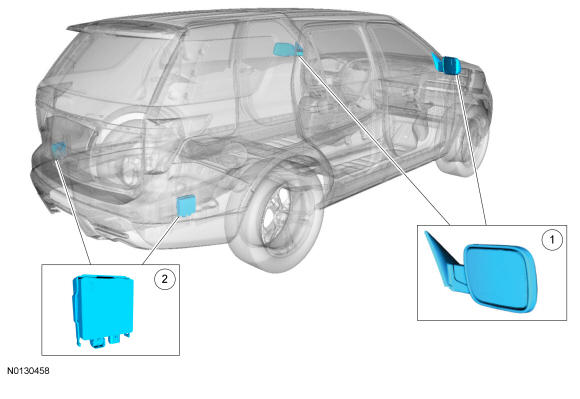
| Item | Description |
|---|---|
| 1 | Exterior rear view mirror |
| 2 | SOD-R and SOD-L |
Overview
BLIS ® is a vehicle feature that aids the driver in assessing whether another vehicle is within an area (blind zone) to either side of the vehicle extending rearward to approximately 3.05 m (10 ft) beyond the rear bumper while driving on roads and freeways. The system is not designed to prevent contact with other vehicles or objects. The CTA is a system that assists the driver in backing out of a parking space.
When a MyKey ® restricted key is in use, the BLIS ® and CTA system cannot be turned off in the IPC.
If the vehicle is towing a trailer the BLIS ® or CTA system may detect the trailer and cause a false alert.
System Operation
System Diagram
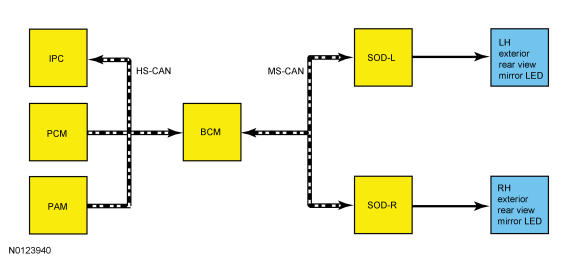
Network Message Chart SOD-L Network Input Messages
| Broadcast Message | Originating Module | Message Purpose |
|---|---|---|
| Active park assist status | PAM | Used to disable cross traffic alert during active park assist parking. |
| Cross traffic alert enable/disable command | IPC | Used to enable or disable the cross traffic alert system. |
| Cross traffic alert enable/disable status | SOD-R | Used to confirm system operation status on opposite side of vehicle. |
| Day/Night status | BCM | Used to determine day/night operation for correct system operation. |
| Ignition switch position | BCM | Used to enable the SOD-L and SOD-R. |
| Parklamp status | BCM | Used to determine day/night operation for correct system operation. |
| Right side obstacle detection enable/disable status | SOD-R | Used to confirm system operation status on opposite side of vehicle. |
| Right obstacle detection status | SOD-R | Used to communicate the sensing inputs from opposite side of vehicle. |
| Selector lever (PRNDL) status | PCM TCM | Used to enable the cross traffic alert when the transmission selector is in reverse (R). |
| Side obstacle detection enable/disable command | IPC | Used to enable or disable the side obstacle detection system. |
| Wiper motor status | BCM | Used to determine rain conditions for correct system operation. |
SOD-R Network Input Messages
| Broadcast Message | Originating Module | Message Purpose |
|---|---|---|
| Active park assist status | PAM | Used to disable cross traffic alert during active park assist parking. |
| Cross traffic alert enable/disable command | IPC | Used to enable or disable the cross traffic alert system. |
| Cross traffic alert enable/disable status (left) | SOD-L | Used to confirm system operation status on opposite side of vehicle. |
| Day/Night status | BCM | Used to determine day/night operation for correct system operation. |
| Ignition switch position | BCM | Used to enable the SOD-L and SOD-R. |
| Left side obstacle detection enable/disable status | SOD-L | Used to confirm system operation status on opposite side of vehicle. |
| Left obstacle detection status | SOD-L | Used to communicate the sensing inputs from opposite side of vehicle. |
| Parklamp status | BCM | Used to determine day/night operation for correct system operation. |
| Selector lever (PRNDL) status | PCM TCM | Used to enable the cross traffic alert when the transmission selector is in reverse (R). |
| Side obstacle detection enable/disable command | IPC | Used to enable or disable the side obstacle detection system. |
| Wiper motor status | BCM | Used to determine rain conditions for correct system operation. |
IPC Network Input Messages
| Broadcast Message | Originating Module | Message Purpose |
|---|---|---|
| Left side obstacle detection enable/disable status | SOD-L | Used to communicate the operation status of the SOD-L. |
| Left obstacle detection status | SOD-L | Used to communicate the sensing inputs from SOD-L. |
| Right side obstacle detection enable/disable status | SOD-R | Used to communicate the operation status of the SOD-R. |
| Right obstacle detection status | SOD-R | Used to communicate the sensing inputs from SOD-R. |
Blind Spot Information System (BLIS ®)
BLIS ® becomes active the first time the transaxle is placed in DRIVE (D) after starting the engine and driving forward at a vehicle speed greater than 4.8 kmh (3 mph). Upon that initial sequence, BLIS ® remains active for all speeds including 0 kmh (0 mph). BLIS ® is also active if the transaxle is placed in NEUTRAL (N). If the transaxle is selected out of DRIVE (D) or NEUTRAL (N), the system has entered the CTA mode. When the transaxle is shifted back into DRIVE (D), BLIS ® is activated once the vehicle is driven above 4.8 kmh (3 mph).
BLIS ® can trigger an alert for vehicles that enter the blind zone from the rear or merge into the blind zone from the side. The exterior mirror BLIS ®/Cross Traffic Alert (CTA) amber LED illuminates in the right and/or left exterior mirror. For vehicles that are being passed or enter the blind zone from the front, the system can trigger an alert only after the vehicle is present in the blind zone for more than 2 seconds. For vehicles that pass through the blind zone quickly, typically less than 2 seconds, BLIS ® cannot trigger an alert.
For correct operation of BLIS ®, the rear side bumper cover should be free of obstructions such as a large build up of mud, snow or ice. Small build up of debris and materials does not hinder the operation of the system. There should be no bumper stickers of any type placed in this area of the bumper cover.
Due to the nature of radar technology, false alerts and missed vehicles or objects (referred to as targets) may occur under certain circumstances. False alerts occur when the LED illuminates with no target present. False alerts up to 3% (3 out of 100 targets) is normal operation. Circumstances that cause false alerts are:
- freeway dividers
- concrete walls
- fencing
- sharp turns around a pole or building
- coming to a stop with a vehicle directly behind and very close
False alerts are temporary and self-correct.
Missed targets occur when a target is present and the LED does not illuminate. Missed targets up to 1% (1 out of 100 targets) are normal operation. Circumstances that cause missed targets are:
- debris build up on the rear bumper sides
- certain maneuvering of vehicles entering and exiting the blind zone
- vehicles passing through the blind zone at high rates of speed
- severe weather conditions
- when several vehicles forming a convoy pass through the blind zone
Cross-Traffic Alert System
The CTA system is an alert feature that assists the driver in backing out of a front-in parking space. The CTA system uses the SOD-L, SOD-R, exterior mirror BLIS ® /Cross Traffic Alert (CTA) LEDs, a warning chime from the parking aid speaker and a message in the IPC message center to notify the driver of impending traffic.
When the vehicle is in REVERSE (R) the CTA system can detect a vehicle that is approaching at a speed up to 24.1 kmh (15 mph) and is approximately 13.72 m (45 ft) from the side of the vehicle on the left or right side. The CTA system's response time and performance can degrade if vehicles are approaching at speeds greater than 24.1 kmh (15 mph).
The CTA system detects a vehicle approaching up to 13.72 m (45 ft) away (approximately the width of five parking spaces). Backing out of parking spots slowly increases the radar sensor coverage in close proximity situations. The CTA system coverage also decreases when parking at shallow angles, which is described in the Owner's Literature.
The CTA system utilizes the same SOD-L and SOD-R as the BLIS ®.
When the transaxle is in REVERSE (R), the CTA system is active. The driver is warned of an approaching vehicle when an audio alert chime from the parking aid speaker sounds, the right or left exterior mirror BLIS ®/Cross Traffic Alert (CTA) amber LED flashes, and the message center displays CROSS TRAFFIC VEHICLE COMING FROM RIGHT or CROSS TRAFFIC VEHICLE COMING FROM LEFT to warn the driver from which direction the vehicle is approaching.
The CTA system cannot normally detect stationary vehicles, humans, animals or objects such as fences, guard rails or trees. The system does not function when the transaxle is not in REVERSE (R).
The CTA system has some detection limitations due to the nature of the radar technology for the SOD-L and SOD-R. There can be certain instances where vehicles entering and exiting the blind spot zone may not be detected. The circumstances that may cause non-detection are:
- Debris build up on the rear bumper sides
- The rear quarter panel of the vehicle is obstructed or partially obstructed by an adjacently parked vehicle or object
- Approaching vehicle passing at speeds greater than 24.1 kmh (15 mph)
- Severe weather conditions
- Driving in REVERSE (R) faster than 4.8 kmh (3 mph)
- Backing out of an angled parking spot
Due to the nature of radar technology, there may be certain instances when the CTA system alerts the operator, however no object or vehicle (referred to as targets) is present when backing up. This is known as a false alert. False alerts up to 5% (5 times out of 100 reversals) are normal. A false alert may occur when backing out of a garage or backing into a parking space and objects or vehicles are very close to the radar sensors. False alerts are temporary and self-correct.
Exterior Mirror Indication
The SOD-L and SOD-R run a self-diagnostic check on each vehicle start cycle and illuminate the exterior mirror BLIS ®/Cross Traffic Alert (CTA) amber LEDs for approximately 3 seconds indicating the BLIS ® and CTA is operational.
If a BLIS ® fault is present, the LEDs remain illuminated and a message in the message center displays BLIND SPOT SYSTEM FAULT. System faults can occur that cause the associated left or right exterior mirror BLIS ®/Cross Traffic Alert (CTA) amber LED not to illuminate; only the message center message fault is displayed.
BLIS and CTA Message Display
BLIS ® can be turned off by selecting the blind spot on/off function in the message center. The message BLIND SPOT OFF is displayed in the message center. When turning BLIS ® from on to off or off to on, the exterior mirror BLIS ®/Cross Traffic Alert (CTA) amber LEDs flash twice. When BLIS ® is off, the driver cannot receive any alerts. The system is reactivated on the next ignition cycle.
BLIS ® can be disabled permanently (even after an ignition cycle) by using a scan tool. When using the scan tool disable function in the programmable parameters menu, BLIS ® remains disabled until it is reactivated using the scan tool. When the system is disabled the message center displays BLIND SPOT DISABLED. A system fault occurs if BLIS ® is not disabled in both the SOD-L and the SOD-R.
The CTA system can be turned off by selecting the CTA system on/off function in the message center. The message CROSS TRAFFIC OFF is displayed in the message center. The CTA system cannot be deactivated in the message center when the transaxle is in REVERSE (R). The system is reactivated on the next ignition cycle.
The CTA system can be disabled permanently (even after an ignition cycle) by using a scan tool. When using the scan tool disable function in the programmable parameters menu, the CTA system remains disabled until it is reactivated using the scan tool. When the system is disabled the message center displays CROSS TRAFFIC DISABLED. A system fault occurs if the CTA system is not disabled in both the SOD-L and the SOD-R.
An excessive build up of materials on the left and/or right rear bumper sides, such as mud or snow, can cause the BLIS ® or CTA system functionality to degrade. Heavy rain can have the same effect. If the system is in a blocked state, the radar misses targets, but still counts them. After approximately 4 counted/missed targets, the system sends a blocked sensor message over the MS-CAN to the IPC. The message center displays BLIND SPOT NOT AVAILABLE SENSOR BLOCKED or CROSS TRAFFIC NOT AVAILABLE SENSOR BLOCKED message. If the blocked condition is determined by either system the message center displays BLIND SPOT NOT AVAILABLE or CROSS TRAFFIC NOT AVAILABLE and the appropriate left and/or right exterior mirror BLIS ®/Cross Traffic Alert (CTA) LED illuminates.
The message center warning can be cleared by the driver but the exterior mirror BLIS ®/Cross Traffic Alert (CTA) LED remains illuminated. Once the blockage is removed, the system requires some drive time and a system detection of at least two vehicle objects prior to realizing it is unblocked. The ignition can also be cycled off to clear the blocked state. However, if the blockage is still present after the key cycle and after some drive time, the system detects again that it is blocked. The blocked message is displayed again in the message center.
Due to the nature of radar technology, it is possible to get a blocked sensor warning without the radar sensor being blocked. This is rare and is known as a false blockage warning. A false blocked condition either self-clears or clears after an ignition cycle.
There are some system faults that set DTCs which are logged in the SOD-L or SOD-R. These DTCs that are logged can set a message in the IPC message center that displays CROSS TRAFFIC SYSTEM FAULT or BLIND SPOT SYSTEM FAULT. There are also some symptom based faults that do not set a DTC.