Glass, Frames and Mechanisms: Notes
Overview
The accessory delay relay, located in the BCM, provides voltage for the operation of the power windows and the roof opening panel (if equipped). For additional information, refer to Delayed Accessory Power.
Standard power window features include:
Base
- One-touch down (LH front window only)
XLT, Limited
- One-touch up and one-touch down (LH and RH front windows only)
All Vehicles
The window control switch:
- can be used to manually raise or lower all windows from the LH front window control switch or the individual side window from the corresponding individual door switch.
- can automatically lower the LH front window (Base) when the LH front window control switch is momentarily pressed to the second detent position and released.
- can automatically lower/raise the LH and RH front windows (XLT and Limited) when the corresponding front window control switch is momentarily pressed/pulled to the second detent position and released.
- has a passenger window lock-out feature.
Rear Window Defrost
The HVAC module controls the rear window defrost relay (located in the BJB). The HVAC module activates the rear window defrost relay when the rear window defrost switch (integral to the FCIM) is pressed. If equipped, the rear window defrost can also be activated/deactivated by using a touchscreen interface or voice commands. When the rear window defrost relay is active, the rear window defrost grid is energized.
System Operation
System Diagram - Rear Window Defrost
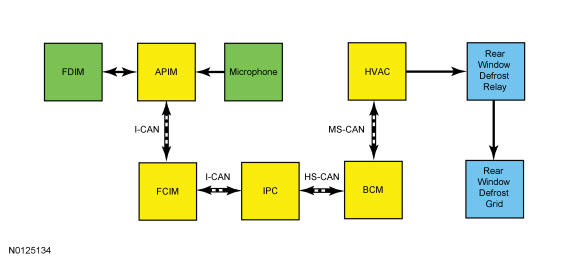
Network Message Chart - Rear Window Defrost
| Broadcast Message | Originating Module | Message Purpose |
|---|---|---|
| Climate control requests | APIM (If equipped with Premium Plus or Sony ® Sound) | The climate control requests message contains the rear window defrost request information. When the rear window defrost function is requested using voice command or the button is selected on the touchscreen, this input is used to activate the rear window defrost system. |
| Broadcast Message | Originating Module | Message Purpose |
|---|---|---|
| Climate control requests | FCIM | The climate control requests message contains the rear window defrost request information. When the rear window defrost function is requested, this input is used to activate the rear window defrost system. |
Rear Window Defrost
When the rear window defrost switch (integral to the FCIM) is pressed and the engine is running, the HVAC module activates the rear window defrost relay located in the BJB. When the rear window defrost relay is active, the rear window defrost grid is energized.
If equipped, the rear window defrost can also be commanded on and off using voice commands or by touching the rear window defrost button located on the touchscreen interface (FDIM). For additional information on voice or touchscreen commanded features, refer to the Owner's Literature.
The HVAC module deactivates the rear window defrost relay when one of these conditions is met:
- The rear window defrost switch is pressed when the feature is active.
- If equipped, the rear window defrost is commanded off using voice command or the touchscreen interface when the feature is active.
- Ignition state is changed from RUN to OFF.
- The 15-minute timer completes.
Delayed Accessory Power
The BCM controls voltage to the power windows, the audio system and the power roof opening panel (if equipped) with the accessory delay relay. The BCM activates the accessory delay relay whenever the ignition is in the RUN or the ACC position, or when the ignition is changed from RUN or ACC to the OFF position and the LH and RH front doors are closed.
The BCM deactivates the accessory delay relay when:
- the LH or RH front door is ajar and the ignition is in the OFF or key-out position.
- ten minutes have elapsed since the ignition was changed from ACC or RUN to the OFF position.
Front Power Windows - XLT or Limited
The LH and RH front window motors operate with the ignition in the RUN or ACC positions, or when the accessory delay relay is active. The high current required to move the front windows are supplied through the B+ and motor ground input.
The window control switch(es) sends 2 separate signals to the window motor: up and down. When the window control switch is pressed to the first detent position, a 12-volt signal is sent to the window motor to request an up or down operation. When auto up or auto down is requested (switch pressed to the second detent position), the window control switch provides a 12-volt signal on both the up and down line simultaneously. During an auto up or auto down request, the window motor determines intended window direction by the signal first received. If the window control switch is pressed too quickly to the second detent position (less than 5 milliseconds of time between first detent signal and second detent signal), the window motor will not be able to determine the intended direction request and will not operate until the window control switch is released and pressed again. The up and down contacts are floating within the window control switch when the switch is in the neutral position. The up and down feeds to the window motor are all low current.
When the LH or RH front window motor is operating in auto or manual mode and the window control switch is held in the opposite direction, the glass movement will pause for a half second, then change direction.
The LH and RH front window motors have a security override feature. If an obstacle has been detected in the window opening as the window glass is moving upward, the window motor automatically reverses direction and moves the glass toward the bounce-back position (in both manual up and one-touch up modes). Once the window motor stops the glass at its bounce-back position, and within 2 seconds the switch is released, then held in the auto UP position, the window motor moves the glass up with no bounce-back protection (security override). If the switch is released before the window glass reaches the fully CLOSED position, the window motor stops with bounce-back automatically enabled for the next window up movement. If the ignition is turned to OFF or START (without delayed accessory), the window motor stops. The only exception is when an obstacle is detected in the window opening while delayed accessory power is not present. In this case the window motor bounces back, then stops. Ice, contaminant buildup and environmentally induced tight spots in the front window seals are all possible conditions that can activate the bounce-back feature. If an obstruction occurs between 4 mm (0.15 in) and 200 mm (7.87 in) of window opening, the bounce-back position is 250 mm (9.84 in) of window opening. If an obstruction occurs at a position more than 200 mm (7.87 in) of window opening, the bounce-back position is 50 mm (1.96 in) below where the obstruction occurred.
Front Power Windows - Base
The LH front power window is equipped with a one-touch down feature (controlled by the LH window control switch integral electronics). This allows the LH front power window to be completely lowered when the LH window control switch is pressed to the second detent position and then released.
Passenger Windows Lock-Out
When the lock-out switch (part of the LH front window control switch) is in the LOCK position, the rear passenger power windows only operate from the LH front window control switch.
Police Option
For police vehicles only, there is an in-line connector which, if disconnected, will disable the LH and RH rear window operation except from the master window control switch (regardless of the lock-out switch position).
Remote Start - Rear Window Defrost Operation
The customer can select different climate control modes/preferences when the vehicle is started using the remote start feature. This can be accessed through the message center. For additional information on setting the remote start preferences, refer to the Owner's Literature. When the rear defrost is set to AUTO mode, the rear window defrost activates when the outside temperature is less than 0 °C (32 °F) and the vehicle is started using the remote start feature. No climate control adjustments are recognized during remote start operation. Once the ignition is cycled to the ON position, the climate control system returns to the previous settings (last ignition ON cycle) and adjustments can be made normally. If the previous setting was off, the climate control system turns off.