Component Description
Passive Start Antennas
There are 3 passive start antennas. The passive start antennas are hardwired to the RFA module and when activated by the RFA module they transmit a low frequency signal that activates an Intelligent Access (IA) key.
Interior Passive Start Antenna Ranges
There are 3 passive start antennas that are used solely for the purpose of starting the vehicle. When activated, each antenna sends out a low frequency signal with an approximate range of 1 m (3 ft). A programmed Intelligent Access (IA) key must be in range of 1 of the 3 antennas for PATS to operate.
If an Intelligent Access (IA) key is placed in the far outside edges of the interior, like above a sun visor or in a door map pocket, the vehicle might experience a no-start. If the Intelligent Access (IA) key is located in one of these areas and there is a no-start condition, move the Intelligent Access (IA) key out of the area and attempt to start the vehicle. If the key is outside the range of a passive start antenna, NO KEY DETECTED is displayed in the message center.
Backup Transceiver
The backup transceiver is used as a backup device. If the vehicle fails to start conventionally, an Intelligent Access (IA) key can be placed in the backup slot to allow the vehicle to start. The backup transceiver is located next to the slot and activates any Intelligent Access (IA) key that is placed in the slot. The transceiver is wired to the RFA module and when activated it sends out a signal to activate an Intelligent Access (IA) key. Once the key is activated, it sends a signal back to the transceiver which is then sent to the RFA module.
Intelligent Access (IA) Key
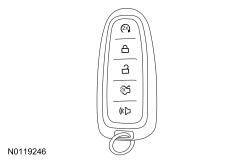
The Intelligent Access (IA) key incorporates both the PATS and the RKE transmitter functions in a single device. The Intelligent Access (IA) key must be located inside the vehicle for engine starting and on the outside for Intelligent Access (IA) features. During key programming procedures, the PATS and RKE transmitter of an Intelligent Access (IA) key are both programmed into the RFA module. The RFA module accepts programming of up to 4 Intelligent Access (IA) keys. Refer to Key Programming Using Diagnostic Equipment or Refer to Key Programming Using Two Programmed Keys for the key programming procedures.
The Intelligent Access (IA) key receives the low frequency signals from the passive start antennas. When the Intelligent Access (IA) key is activated by one of the low frequency signals, it sends out a high frequency signal that is received by the TPM module. The Intelligent Access (IA) key also contains a key blade that is used to enter the vehicle as a backup.
Tire Pressure Monitor (TPM) Module
The TPM module has a dedicated power and ground. It communicates all Intelligent Access (IA) and RKE information to the RFA module through a dedicated single circuit network. The TPM module is a receiving antenna that receives the high frequency signals from an Intelligent Access (IA) key. It also receives the signals from a RKE command.
Start-Stop Switch
The start/stop switch is a momentary contact switch that is hardwired to the RFA module, BCM, and the PCM. When the switch is pressed, it signals the RFA module, BCM, and the PCM that there is a request to either switch the ignition on or start the engine. The start/stop switch is connected to both the RFA module and BCM as a backup in case of a failure. If there is a circuit failure to either module from the start/stop switch, the modules communicate the start/stop switch request to each other over the MS-CAN.
If the vehicle is running and moving at a speed greater than 8 kmh (5 mph), the engine can be shut down by pressing the start/stop switch 3 times within 2 seconds.
Remote Function Actuator (RFA)
The RFA module is responsible for obtaining the Intelligent Access (IA) key data. It uses the passive start antennas and the TPM module to receive the Intelligent Access (IA) key data. The RFA module receives direct input from the TPM module over a dedicated single wire network and is hardwired to the passive start antennas. The RFA module communicates the Intelligent Access (IA) key data with the BCM over the MS-CAN.
The Intelligent Access (IA) keys are programmed to the RFA module, and the RFA module contains a unique ID that is checked by the BCM.
If the RFA module is replaced, at least two keys must be programmed to it and a parameter reset with the BCM must be performed to enable PATS.
Body Control Module (BCM)
The BCM is responsible for checking the identifications from both the RFA module and the PCM. It also controls the ignition states and determines if the engine should be started or turned off depending upon input from the start/stop and brake switches and if a programmed Intelligent Access (IA) key is inside the vehicle. The RFA module sends a MS-CAN message to the BCM indicating if a programmed Intelligent Access (IA) key is inside the vehicle.
If the BCM is replaced, the two parameter reset procedures must be performed to enable PATS. The two parameter reset procedures are between the BCM and RFA module, and the BCM and PCM.