Standard Procedure - Master Cylinder Bleeding
CAUTION:
When clamping master cylinder in vise, only clamp master cylinder by its mounting flange. Do not clamp the master cylinder piston rod, reservoir, seal or body.
- Clamp the master cylinder in a vise.
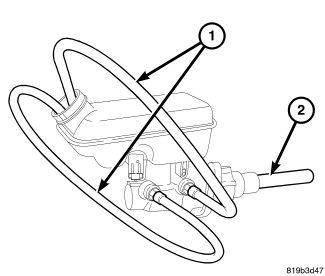
- Thread the Bleeder Tube, Special Tool (special tool #8358-1, Bleed Tube) (1), into each master cylinder outlet port. Tighten each tube. Flex the bleeder tubes and place open ends into the mouth of the fluid reservoir as far down as possible to keep them below the fluid level while bleeding.NOTE:
Make sure open ends of the bleeder tubes stay below surface of the brake fluid once the reservoir is filled to the proper level.
- Fill the brake fluid reservoir with Mopar® Brake Fluid DOT 3 Motor Vehicle or equivalent conforming to the DOT 3 specifications. Refer to FLUID, SPECIFICATIONS . Make sure the fluid level is above the tips of the bleeder tubes in the reservoir to ensure no air is ingested during bleeding.
- Using a wooden dowel as a push rod (2), slowly depress the master cylinder pistons, then release the pressure, allowing the pistons to return to the released position. Repeat several times until all air bubbles are expelled. Make sure the fluid level stays above the tips of the bleeder tubes in the reservoir while bleeding.
- Remove the bleeder tubes from the master cylinder outlet ports, then plug the outlet ports and install the fill cap on the reservoir.
- Remove the master cylinder from the vise.
- Install the master cylinder on the vehicle. Refer to MASTER CYLINDER, BRAKE, REMOVAL AND INSTALLATION .