Standard Procedure - Brake Rotor Machining
Refacing the rotor is not required each time the brake pads are replaced, only when the need is foreseen.
Any servicing of the rotor requires extreme care to maintain the rotor within service tolerances to ensure proper brake action.
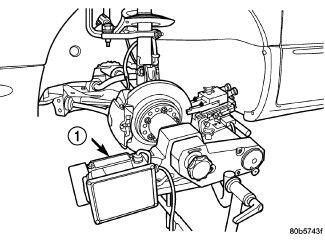
| 1 - ON-CAR BRAKE LATHE |
If the rotor surface is deeply scored or warped, or there is a complaint of brake roughness or brake pedal pulsation, the rotor should be refaced using a hub-mounted on-car brake lathe (1), or replaced.
The use of a hub-mounted on-car brake lathe (1) is highly recommended to eliminate the possibility of excessive runout. It trues the brake rotor to the vehicle's hub and bearing.
All brake rotors have markings for minimum allowable thickness cast on an unmachined surface of the rotor or stamped into the hat section. On this vehicle, the minimum thickness specification for the front brake rotor is located on the outer diameter of the brake plate. The minimum thickness specification for the rear brake rotor is located on the side of the hub mounting face.
Minimum allowable thickness is the minimum thickness which the brake rotor machined surface may be cut to.
Do not machine the rotor if it will cause the rotor to fall below minimum thickness.
Before lathe installation, verify the brake rotor face and the hub adapters are free of any chips, rust, or contamination.
When mounting and using the brake lathe, strict attention to the brake lathe manufacturer's operating instructions is required.
Machine both sides of the brake rotor at the same time. Cutting both sides at the same time minimizes the possibility of a tapered or uneven cut.
When refacing a rotor, the required (Total Indicator Reading) TIR and thickness variation limits MUST BE MAINTAINED. Extreme care in the operation of rotor turning equipment is required.