Description And Operation
DESCRIPTION
The TPM has been optimized for the original equipment tires and wheels. TPM pressures have been established for the tire size equipped on your vehicle. Undesirable system operation or sensor damage may result when using replacement equipment that is not of the same size, type, or style. After-market wheels can cause sensor damage. Do not use aftermarket tire sealants or balance beads if your vehicle is equipped with a TPM, as damage to the sensors may result.
After inspecting or adjusting the tire pressure always reinstall the valve stem cap. This will prevent moisture and dirt from entering the valve stem, which could damage the Tire Pressure Monitoring Sensor.
Tire pressure sensor valve stem caps and cores are specially designed for the sensors. Due to risk of corrosion, do not use a standard valve stem cap or core in a tire pressure sensor in place of the original equipment style sensor cap and core.
Any time a sensor is to be reinstalled in a wheel, a new valve stem assembly must be installed to ensure air tight sealing.
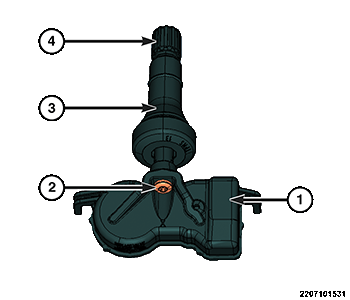
Replace the valve stem (3) assembly with each tire change or when the tire is removed from the wheel.
The tire pressure sensor (1), the valve stem (3), and all valve stem components including the cap (4) and the valve core can be serviced and replaced individually.
Install a NEW valve stem (3) and valve stem core if they are removed from the wheel or valve stem.
One tire pressure sensor is mounted to a valve stem (3) specifically designed for mounting the pressure sensor in each wheel in place of the traditional tire valve stem. Each sensor has an internal battery that lasts up to 10 years. The battery is not serviceable. At the time of battery failure, the sensor (1) must be replaced. The TPM system operates on a 433 MHz radio frequency. The tire pressure sensor valve stem (2) looks similar to a standard valve stem with the tire mounted on the wheel.
This vehicle uses the 433 MHz TPM sensor. Although 315 MHz and 433 MHz sensors are identical in size and shape, they are not interchangeable. Always make sure the correct sensor is being used. A RKE-TPM Analyzer can be used to determine the sensor's frequency without having to dismount the tire.
The TPM sensors are designed for original style factory wheels. It is not recommended to install a tire pressure sensor in an aftermarket wheel. This could cause sealing and system performance issues.
The OEM valve stem caps and cores used are specifically designed for the TPM sensors. Although similar to standard valve stem caps and cores, they are different. The valve stem cap has a special seal inside to keep moisture and corrosion out. The valve stem core has a special nickel coating to protect from corrosion.
OPERATION
TPM thresholds have been established for the original tire size equipped on the vehicle. Use original size tires only to maintain system accuracy.
The battery operated TPM is both a transmitter and a receiver. The TPM sensor can be forced to transmit if using a special tool such as a TPM-RKE Analyzer. The TPM-RKE Analyzer has the ability to change the sensor mode and to diagnose a faulty TPM sensor. Using a TPM-RKE Analyzer can take up to a minute to force a transmission from a sensor.
Each sensor transmitter broadcast is uniquely coded so that the module can monitor the state of each of the sensors on the four rotating road wheels. The module can automatically learn and store the sensor ID while driving within 20 minutes continuously above 32 km/h (20 mph) after a sensor has been replaced. The vehicle must be stationary for more then 20 minutes in order to initiate the learning sequence.
The sensor IDs can also be programmed using the TPM-RKE Analyzer Tool. Scan each TPM sensor at each road wheel, and store each sensor ID in the correct location. (LEFT FRONT, LEFT REAR, RIGHT FRONT, and RIGHT REAR) Connect the TPM-RKE Analyzer Tool to the diagnostic scan tool, then follow the programming steps outlined in the diagnostic scan tool for "Program Tire Pressure Sensor ID w/ TPM Tool".