Description And Operation
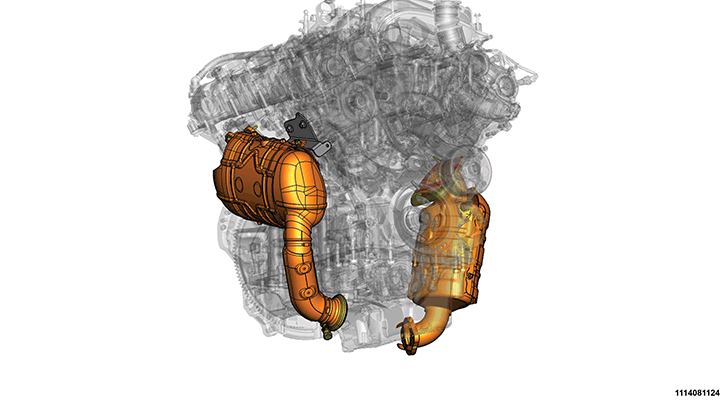
The catalytic converter assemblies are a hydra-form thin wall air gap design. This design is used to reduce heat, noise and improve emissions. When replacement is required, use original equipment parts (or their equivalent).
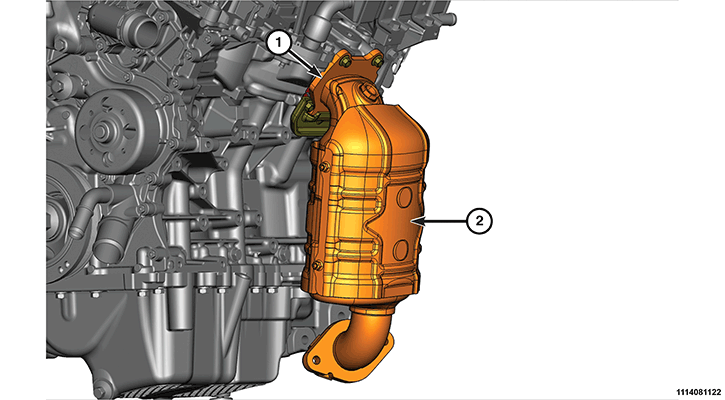
The left catalytic converter (2) is attached directly to the cylinder heads integrated exhaust manifold (1).
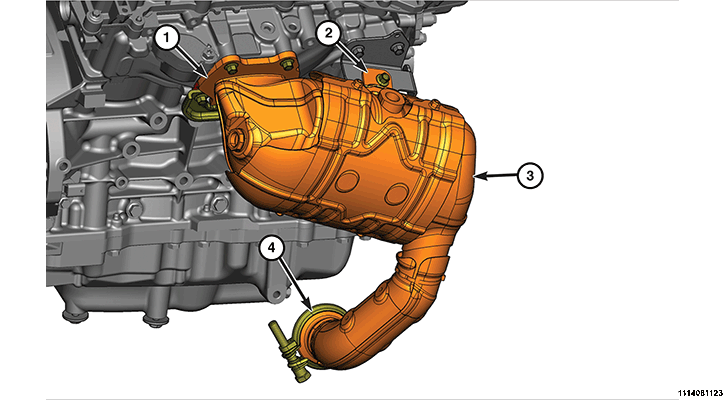
The right catalytic converter (3) is attached directly to the cylinder heads integrated exhaust manifold (1) and to a support bracket (2). The exhaust down pipes exit the converters and connect to the cross-under pipe with clamps (4). A cross-under pipe connects the left and right catalytic converters and merges them into a single output with a flexible coupling.
- The three-way catalytic converter simultaneously converts three exhaust emissions into harmless gases. Specifically, HC and CO emissions are converted into water (H2O) and carbon dioxide (CO2). Oxides of Nitrogen (NOx) are converted into Nitrogen (N) and Oxygen. The three-way catalyst is most efficient in converting HC, CO and NOx at a air fuel ratio of 14.7:1.
- The oxygen content in a catalyst is important for efficient conversion of exhaust gases. When a high oxygen content (lean) air/fuel ratio is present for an extended period, oxygen content in a catalyst can reach a maximum. When a rich air/fuel ratio is present for an extended period, the oxygen content in the catalyst can become totally depleted. When this occurs, the catalyst fails to convert the gases. This is known as catalyst "punch through."
- Catalyst operation is dependent on its ability to store and release the oxygen needed to complete the emissions-reducing chemical reactions. As a catalyst deteriorates, its ability to store oxygen is reduced. Since the catalyst's ability to store oxygen is somewhat related to proper operation, oxygen storage can be used as an indicator of catalyst performance. Refer to the appropriate Diagnostic Information for diagnosis of a catalyst related Diagnostic Trouble Code (DTC).
- The combustion reaction caused by the catalyst releases additional heat in the exhaust system, causing temperature increases in the area of the reaction under severe operating conditions. Such conditions can exist when the engine misfires or otherwise does not operate at peak efficiency. Do not remove ignition coils from spark plugs or by any other means short out cylinders during engine operation. Failure of the catalytic converter can occur due to temperature increases caused by unburned fuel passing through the converter. This deterioration of the catalyst core can result in excessively high emission levels, noise complaints, and exhaust restrictions.
- Unleaded gasoline must be used to avoid ruining the catalyst core.