Description And Operation: Description
Lamps of the front exterior lighting system:
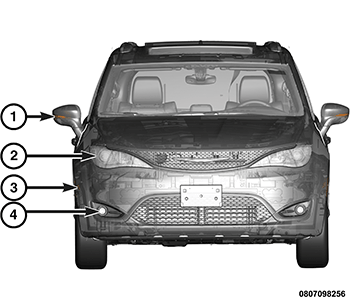
| # | Component - Front |
|---|---|
| 1 | Mirror Turn Signal |
| 2 | Front Headlamp Unit |
| 3 | Side Marker Lamp |
| 4 | Fog Lamp |
Lamps of the rear exterior lighting system:
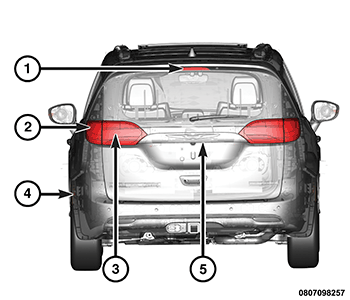
| # | Component - Rear |
|---|---|
| 1 | CHMSL |
| 2 | Outboard Turn/Brake Lamp |
| 3 | Inboard Turn/Brake Lamp |
| 4 | Rear Side Marker Lamp |
| 5 | License Plate Lamp |
This vehicle uses advanced forward lighting elements including:
- Quad Reflector Halogen headlamps (all base models)
- Quad Reflector Halogen Projector/Reflector headlamps with LED park lamp piping (all mid-line models)
- Quad HID Projector/Reflector Headlamps with LED daytime running lamp piping (all high-line models)
- Halogen fog lamps standard on base and mid-line models, LED fog lamps standard on high-line models.
- "Smart Beam" automatic high beam feature (optional)
Headlamps:
- The quad reflector halogen low beam headlamps feature an optimized curvature to ensure spread light capability and are equipped with pulse width modulation and high-efficiency, single-filament halogen bulbs.
- A separate high beam bulb also uses pulse width modulation and serves as daytime running lamp when high beams are not in use.
- Turn signal lamps are located inside the headlamp assembly and use a pulse width modulated single filament halogen bulb.
- The quad projector/reflector halogen low beam headlamps are also equipped with pulse width modulation and high-efficiency, single-filament halogen bulbs.
- A separate high beam bulb also uses pulse width modulation and serves as daytime running lamp when high beams are not in use.
- Turn signal lamps use a pulse width modulated single filament halogen bulb.
- Mid-level headlamps also feature non-pulse width modulated LED park lamp piping.
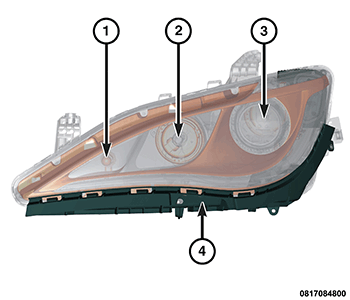
- The quad HID projector/reflector (3) increases spread light by 5% and delivers a 10% improvement in forward lighting.
- A separate high beam bulb (2) is used reducing the amount of perceived "pinpoint" glare associated with the HID lamps.
- Turn signal lamps (1) use a pulse width modulated single filament halogen bulb
- Premium-level headlamps also feature Non-pulse width modulated LED DRL/park lamp piping.
Auto Headlamps: The optional automatic headlamp system includes the headlamp switch, the Body Control Module (BCM) and the Electronic Climate Control (ECC) module. The auto headlamp system has two available sensors that give the BCM feedback for lamp control, the light rain sensor and the sun load sensor.
Automatic High Beam Control (AHBC): The automatic high beam system switches headlamps from high to low beam and back again when oncoming headlamps or forward lighting elements are sensed. It also switches from high to low beams when tail lamps are detected ahead of the vehicle.
The system uses a state-of-the-art CMOS (complimentary metal-oxide semiconductor) light sensor to sense oncoming or forward lights. When it detects an approaching vehicle's headlights or preceding vehicle's tail lamps, the system turns off the high beams. The system also detects and effectively ignores ambient light coming from streetlights, sign reflections, buildings and other light sources.
The system also monitors vehicle speed information transmitted on the CAN bus network to determine high beam light output. It will also vary the intensity of the high beams when the vehicle is traveling at or below a certain speed, such as when driving into a neighborhood at night.
Side Marker Lamps:
- The front side marker lamps are located in both front wheel wells. Both front marker lamps illuminate with the exterior lights and can be serviced by replacing a single bulb.
- The rear side marker reflectors are located in both rear wheel wells. Both rear marker lamps illuminate with the exterior lights and can be serviced by replacing a single bulb.
Supplemental Turn Signals:
- High line vehicles also feature turn signal lamp piping on the outside rear view mirrors. The lamps themselves are not serviced apart from the mirror assembly.
Tail Lamps
- Features of the low line tail lamps include:
- Body and liftgate mounting
- Incandescent stop/turn signal lamps
- Incandescent back-up lamps
- Features of the high line tail lamps include:
- Body and liftgate mounting
- LED surround running lamps
- Incandescent stop/turn signal lamps
- Incandescent back-up lamps
LED lamps are not serviceable. If an issue exists with any LED lamps, The tail lamp assembly must be replaced.
Center High-Mounted Stop Lamp (CHMSL) - The Center High-Mounted Stop Lamp (CHMSL) uses an array of LED elements positioned in the center of the liftgate spoiler.
The exterior lighting system for this vehicle includes the following exterior lamp units:
- Center High Mounted Stop Lamp - A standard equipment Center High Mounted Stop Lamp (CHMSL) is located at the center of the rear liftgate spoiler.
- Front Fog Lamps - Optional front fog lamp units are mounted near each outboard end of the front fascia, below the front lamp units and outboard of the lower fresh air intake.
- Headlamps - A standard equipment front headlamp unit is mounted to the front end sheet metal outboard of each of the front fascia grille openings.
- License Plate Lamps - Two standard equipment rear license plate lamp units are integral to the light bar and handle assembly, just above the license plate tub formation in the outer liftgate panel.
- Rear Lamp Units - A standard equipment rear lamp unit is mounted to the rear of each quarter panel on either side of the rear cargo door opening.
- Repeater Lamps - A repeater lamp is mounted to each front fender just behind the front wheel opening.
- Side Marker Lamps - A side marker lamp is integral to the front fascia forward of each front wheel opening and to the rear fascia behind each rear wheel opening.
These exterior lighting lamp units and their controls are combined to provide the following front exterior lighting features:
- Backup Lamps - In all vehicles, the backup (or reverse) lamps include a clear bulb, reflector and clear lens that are integral to each liftgate lamp unit.
- Brake Lamps - The brake (or stop) lamps include a clear bulb, reflector and red lens that are integral to each rear lamp unit, and the red lens and multiple LEDs of the CHMSL.
- Daytime Running Lamps - Daytime Running Lamps (DRL) are standard equipment. When DRL is enabled, the high beams at reduced voltage will illuminate on base and mid-line models, or the DRL light pipe will illuminate on high-line models. The DRL function can be turned on or off using the Electronic Vehicle Information Center (EVIC) display menus.
- Front Fog Lamps - The optional equipment front fog lamps include the clear bulb, reflector and clear lens of each adjustable front fog lamp unit.
- Hazard Warning Lamps - The hazard warning lamps include the bulbs, reflectors and lenses of each lamp in the right and left, front and rear turn signal circuits.
- Headlamp Delay - The standard equipment low beam headlamps and front clearance (position or park) lamps are illuminated for a customer-selected delay period when the left (lighting) multi-function switch control stalk is pulled toward the steering wheel and released within two minutes after the ignition switch has been turned to the OFF position.
- Headlamps - The headlamps include separate low and high beam halogen bulbs, with reflectors and/or projectors depending on model.
- Optical Horn - The left (lighting) multi-function switch control stalk has a momentary rearward position that allows the headlamp high beams to be flashed momentarily, without changing the headlamp beam selection.
- Park Lamps - The front park lamps include amber bulbs on base models, or white LED's on mid-line and high-line models, integral to the front combination lamp unit. The rear park (tail) lamps include the clear bulbs, reflectors and red lenses integral to each rear lamp unit.
- Turn Signal Lamps - The front turn signal lamps include the amber bulbs, reflectors and clear lenses that are integral to the combination lamp unit. The amber bulbs and clear lenses of the repeater lamps on each front fender are also included in the front turn signal circuits. The rear turn signal lamps include an amber bulb, a reflector and a clear lens that is integral to each rear lamp unit.
Other components of the exterior lighting system for this vehicle include:
- Backup Lamp Switch - On vehicles with automatic transmission a stand-alone Transmission Range Sensor (TRS) performs the backup lamp switch function.
- Body Control Module - The Body Control Module (BCM) is located beneath the instrument panel to the left of the steering column in the passenger compartment.
- Brake Lamp Switch - A plunger-type brake lamp switch is located on the brake pedal support bracket under the instrument panel and is actuated by the brake pedal arm when the brake pedal is depressed.
- Clockspring - The clockspring includes an integral turn signal cancel cam and both the left (lighting) and right (wiper) multi-function switches. The clockspring is located near the top of the steering column, directly beneath the steering wheel.
- Fog Lamp Switch - Vehicles equipped with optional front or both front and rear fog lamps have a momentary fog lamp switch integrated into the headlamp switch located on the left side of the instrument panel.
- Hazard Switch - A momentary push button-actuated hazard switch is integral to the upper instrument panel switch pod located in the center of the instrument panel just below the radio and above the heater and air conditioner controls.
- Instrument Cluster - The Instrument Cluster (IC) is located in the instrument panel above the steering column opening, directly in front of the driver.
- Instrument Panel Switch Pod - A momentary push button-actuated hazard switch is integral to the upper instrument panel switch pod located in the center of the instrument panel just below the radio.
- Left Multi-Function Switch - The left (lighting) multi-function switch is integral to the clockspring located on the steering column, just below the steering wheel. A control stalk that extends from the left side of the switch is used to select the turn signal lamps (right or left) and to select the headlamp beam (low, high or optical horn).
- Park Brake Switch - A park brake switch is located on the park brake lever mechanism on the floor panel transmission tunnel between the two front seats.