Theory Of Operation - Fuel Level Rationality
SINGLE TANK FUEL LEVEL RATIONALITY DIAGNOSTIC DESCRIPTION: The intent of the Fuel Level Rationality is to check for a "stuck" fuel level reading. This is done to keep high or low fuel levels that are stuck from disabling OBD monitors. Since the amount of fuel consumed from trip to trip varies based on customer drive cycles, this diagnostic can accumulate fuel consumption over multiple drive cycles. The diagnostic will run until enough fuel has been consumed to make a decision. The PCM compares the difference between the fuel level value at the start of the diagnostic and the fuel level value after a calibrated amount of fuel consumption should have occurred. If the difference is less than a calibrated threshold, the test fails. Once a decision is made, a new diagnostic test will start. If a fault is set, the fuel level will default to a value that will allow other OBD diagnostics to run.
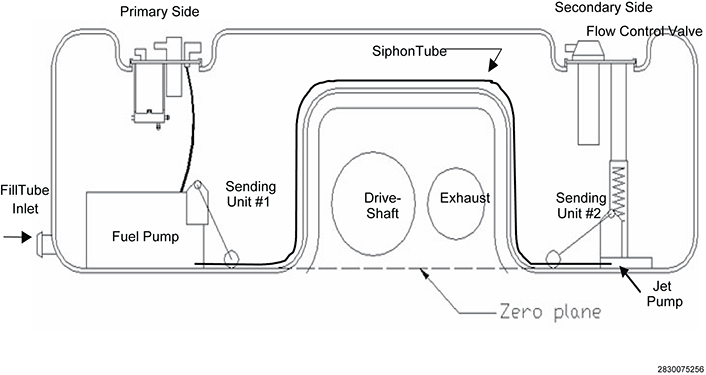
SADDLE TANK FUEL LEVEL RATIONALITY GENERAL INFORMATION: The Fuel Level Sensor information is a direct input to the Body Control Module (BCM) which is sent to the Powertrain Control Module (PCM) via CAN bus. On the primary side of the saddle tank is the Electric Fuel Pump Module that feeds the engine and the Primary Fuel Level Sensor. On the secondary side of the saddle tank is a Venturi Jet Pump and the Secondary Fuel Level Sensor. The Jet Pump is connected to the Electric Fuel Pump Module on the primary side by way of a siphon tube. The PCM uses the average from both sides to determine the total fuel volume.
SADDLE TANK FUEL LEVEL RATIONALITY DIAGNOSTIC DESCRIPTION: On a properly operating system, the fuel volume on the secondary side of the Fuel Tank will be at empty before the primary side of the Fuel Tank will begin to decrease due to the siphon tube flow rate always exceeding the engines fuel consumption rate. Using this assumption, the PCM performs a diagnostic to check the rationality of both Fuel Level Sensors, as well as the operation of the jet pump and siphon tube as follows;
- When the total fuel volume is greater than 50% the primary tank should remain at the full position. As fuel is consumed, or sloshes over to the secondary tank while driving, the jet pump and siphon tube will replenish the primary tank to the full position and the secondary fuel level should decrease.
- When the total fuel volume is less than 50%, the secondary tank should be at empty and the primary fuel volume should start to decrease as fuel is consumed by the engine.
If either scenario fails to happen the PCM will determine that one of the Fuel Level Sensors is stuck in range, or that the Jet Pump or siphon tube is faulty not allowing fuel to transfer from the secondary side to the primary side of the Fuel Tank.
- The rationality diagnostic for the primary side of the tank will not become enabled until the secondary side level is near empty.
- The rationality diagnostic for the secondary side of the tank is based on the average fuel volume in the tank. It is enabled when there is enough total fuel to fill the primary tank plus enough fuel to check the rationality of the Secondary Fuel Level Sensor when a calibrated amount of fuel is consumed.
Since the amount of fuel consumed from trip to trip varies based on customer drive cycles, this monitor can accumulate fuel consumption over multiple drive cycles. The monitor will run until enough fuel has been consumed to make a decision. Once a decision is made, a new test will start.
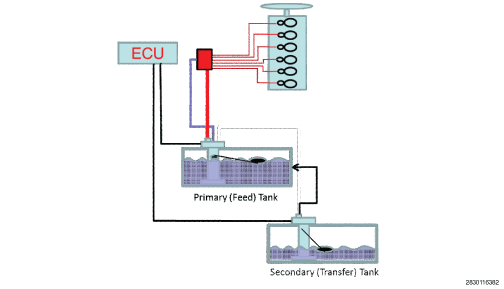
DUAL FUEL TANK FUEL LEVEL RATIONALITY DIAGNOSTIC DESCRIPTION: Some D-Trucks add a second Fuel Tank (Auxiliary Fuel Tank) to allow the fuel capacity to be increased. Both Fuel Tanks have an independent Fuel Pump Module and Fuel Level Sensor (located inside the tanks); and fuel fill tube. The Fuel Level Sensor information is a bussed message from the Body Control Module (BCM) to the Powertrain Control Module (PCM).
- The Main Fuel Tank supplies fuel to the engine for consumption. The PCM performs the Primary Fuel Level Rationality diagnostic to check for a "stuck" fuel level reading in the same way as on a single tank system. Refer to the Single Tank Fuel Level Rationality Diagnostic Description above.
- The Auxiliary Fuel Tank is used to fill the Main Fuel Tank when the fuel level in the Main Fuel Tank reaches a minimum threshold. It does not supply the fuel directly to the engine. The Auxiliary Fuel Pump will be de-activated when the Main Fuel Tank fuel level reaches the maximum threshold, or the Auxiliary Fuel Tank fuel level reaches a minimum threshold before or during a tank transfer event. This is to prevent an overfill of the Main Fuel Tank or the Auxiliary Fuel Pump running in a dry condition. The PCM performs the Secondary Fuel Level Rationality diagnostic during a fuel transfer event.
There are 2 relays that control the Auxiliary Fuel Pump: The Fuel Pump 2 Relay and the Fuel Pump 2 On/Off Relay. The PCM controls the low side driver of the Fuel Pump 2 Relay. The Fuel Pump 2 Relay is supplied power from the Fuel Pump 2 On/Off Relay, which is controlled by the BCM. In the event that the Fuel Pump 2 Relay is stuck on and over filling the Main Fuel Tank, the BCM can turn off the Fuel Pump 2 On/Off Relay. This will turn off the power supply to the Fuel Pump 2 Relay and the Auxiliary Fuel Pump Module.