Testing A 12-Volt Switched Battery B(+) Circuit
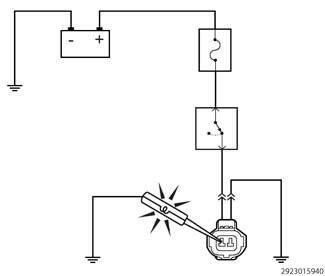
- TESTING 12-VOLT SWITCHED BATTERY B(+) CIRCUIT VOLTAGE WITH A TEST LIGHT NOTE:
Before testing any circuits, first verify the 12-volt test light is operating properly. Connect the 12-volt test light to battery ground or to any other known good ground. Touch the lead of the test light to Battery(+). If the test light is operational, it should illuminate brightly.
- Turn the ignition off.
- Disconnect the wire harness connector from the component that is being tested.NOTE:
Check connectors - Clean/repair as necessary.
- At this time, leave all in-line connectors connected.
- Connect the 12-volt test light to a known good ground.
- Use the test light lead to carefully probe the Battery or Ignition voltage circuit in the harness connector.
- First check with the ignition off, next check with the ignition on, and lastly check while cranking the engine.
Does the test light illuminate brightly?
Yes
- The circuit is not open at this time or the condition that originally caused the open may not be present at this time. Continue to monitor the test light and wiggle the wire harness and connectors to check for an intermittent open or excessive resistance condition.
- Use the wiring diagram as a guide to trace the circuits and look for any in-line connectors where the open could occur intermittently.
- Look for any chafed, pierced, pinched, or partially broken wires.
- Look for broken, bent, pushed out or corroded terminals. Verify that there is good pin to terminal contact in the related wire harness connectors.
- Perform any Technical Service Bulletins (TSBs) that may apply.
No
- Repair the open in the circuit. Use the wiring diagram as a guide to trace the circuit and look for any in-line connectors where the open could occur.
- One method to help isolate the open is to disconnect any in-line connectors and measure the resistance from one side of the in-line connector to the matching component harness connector. If the open goes away, the open is on the other side of the in-line connector.
- If this is a fused circuit, make sure to inspect the fuse. If the fuse is open, check the circuit for a short to ground before installing a new fuse. The circuit may have a short to ground causing the fuse to open. This short to ground could be in the wire harness or in one of the components the circuit is supplying voltage to.
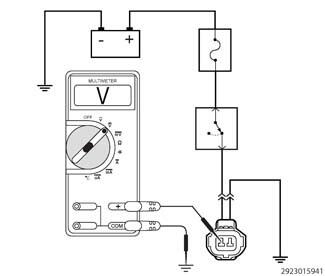
- TESTING 12-VOLT SWITCHED BATTERY B(+) CIRCUIT VOLTAGE WITH A VOLTMETER NOTE:
The connector displayed in the graphics are only an example.
- Turn the ignition off.
- Disconnect the wire harness connector from the component that is being tested.NOTE:
Check connectors - Clean/repair as necessary.
- At this time leave all in-line connectors connected.
- Use a multimeter set to measure DC voltage.
- Connect the ground lead of the meter to a known good ground.
- Use the positive lead of the multimeter and probe the circuit that is being checked for voltage.
- Ignition on, engine not running.
Is the voltage within specifications for this circuit?
Yes
- The circuit is functioning properly or the condition that originally caused the open or short may not be present at this time. Continue to measure the voltage and wiggle the wire harness and connectors while checking for an intermittent open or short.
- Use the wiring diagram as a guide to trace the circuits and look for any in-line connectors where the short could occur intermittently.
- Look for any chafed, pierced, pinched, or partially broken wires.
- Look for broken, bent, pushed out or corroded terminals. Verify that there is good pin to terminal contact in the related wire harness connectors.
- Perform any Technical Service Bulletins (TSBs) that may apply.
No
- Repair the open or short to ground in the circuit. Use the wiring diagram as a guide to trace the circuits and look for any in-line connectors where the short could occur.
- One method to help isolate the open or short is to disconnect any in-line connectors that the circuit being checked runs through and check for the voltage again. If the voltage is present, the open or short is on the other side of the in-line connector.