Description And Operation: Operation
Both the Manual Temperature Control (MTC) and the Automatic Temperature Control (ATC) HVAC systems are dual zone, blend-air type systems. In a dual zone blend air HVAC system, two blend air doors control the amount of conditioned air that is allowed to flow through, or around the heater core. The two blend air doors provide completely independent side-to-side temperature control of the discharge air. The temperature controls determine the discharge air temperatures by operating the blend door actuators, which move the blend air doors. This design allows almost immediate control of the output air temperatures.
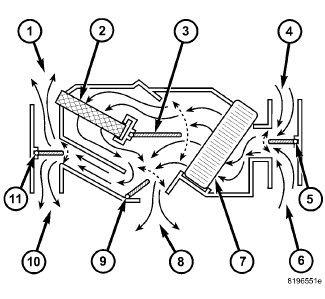
Typical blend air type HVAC system shown in illustration above.
The HVAC system pulls outside (ambient) air through the fresh air intake (4) located at the cowl panel at the base of the windshield and into the air inlet housing above the HVAC housing and passes through the A/C evaporator (7). Air flow is then directed either through or around the heater core (2). This is done by adjusting the position of the blend air door(s) (3) with the temperature control(s) located on the A/C heater control in the Integrated Center Stack (ICS) Module. Air flow is then directed out the floor outlet (8), instrument panel outlet (10) or the defroster outlet (1) in various combinations by adjusting the position of the mode doors (9 and 11) using the mode control located on the A/C heater control in the ICS module. The temperature and mode control uses electrical actuators to operate the air doors.
The fresh air intake can be shut off by pressing the Recirculation button on the A/C heater control in the ICS module. This will operate the electrically actuated recirculation air door (5), which closes off the fresh air intake. With the fresh air intake closed, the conditioned air within the vehicle is pulled back into the HVAC housing through the recirculation air intake (6) located within the passenger compartment.
The A/C compressor can be engaged by pressing the A/C (snowflake) button on the MTC A/C heater control in the ICS module or is automatically engaged on the ATC system when set temperatures require conditioned air cooling. On both systems, the A/C compressor will automatically engage when in any Mix to Defrost position. This will remove heat and humidity from the air before it is directed through or around the heater core.
It is important to keep the HVAC air intake opening clear of debris. Leaf particles and other debris that is small enough to pass through the cowl opening screen can accumulate within the HVAC housing. The closed, warm, damp and dark environment created within the housing is ideal for the growth of certain molds, mildews and other fungi. Any accumulation of decaying plant matter provides an additional food source for fungal spores, which enter the housing with the fresh intake air. Excess debris, as well as objectionable odors created by decaying plant matter and growing fungi can be discharged into the passenger compartment during heater and A/C operation if the air intake opening is not kept clear of debris.
The A/C system is designed for the use of non-CFC refrigerant and uses an A/C expansion valve to meter the flow of refrigerant to the A/C evaporator. The A/C evaporator cools and dehumidifies the incoming air prior to blending it with the heated air. To maintain minimum evaporator temperatures and prevent evaporator freezing, an evaporator temperature sensor is used. This sensor is located downstream of the evaporator and supplies an evaporator temperature signal to the A/C heater control in the ICS module.