Diagnostic Test
- CHECK FOR AN ACTIVE CONDITION
- Start the engine and allow it to idle.WARNING:
When the engine is operating, do not stand in direct line with the fan. Do not put your hands near the pulleys, belts or fan. Do not wear loose clothing. Failure to follow these instructions may result in possible serious or fatal injury.
- With the scan tool, read the target charging voltage.
- Measure the voltage on the Alternator output stud.
Is the voltage more than 1.0 volt above the target charging voltage?
Yes
- Go To 2
No
- Perform the INTERMITTENT CONDITION diagnostic procedure. Refer to INTERMITTENT CONDITION .
- Start the engine and allow it to idle.
- BATTERY
- Use the (special tool #GR8-1220KIT-CHRY, AGM Battery Tester/Charger Station) or equivalent to load test the Battery.
Did the Battery pass or fail?
Passed
- Go To 3
Failed
- Perform the appropriate repair according to the Battery tester.
- Perform the POWERTRAIN VERIFICATION TEST. Refer to POWERTRAIN VERIFICATION TEST .
- Use the (special tool #GR8-1220KIT-CHRY, AGM Battery Tester/Charger Station) or equivalent to load test the Battery.
- CHECK THE ALTERNATOR DUTY CYCLE
- With the scan tool, check the Duty Cycle reading for the Alternator.NOTE:
During normal operation the typical duty cycle of the field control at idle with minimal loads is approximately 35-40%, which will equate to between 4.0 and 5.0 volts. Depending on the charging issue, the PCM can drive the duty cycle to off (0%), which will equate to zero volts, or full field (100%), which will equate to between 11.0 and 12.0 volts.
What is the Alternator duty cycle on the scan tool?
0%
- Go To 4
100%
- Go To 5
- With the scan tool, check the Duty Cycle reading for the Alternator.
- CHECK THE (K20) ALTERNATOR FIELD CONTROL CIRCUIT FOR A SHORT TO VOLTAGE
- Back probe the (K20) Alternator Field Control circuit at the Alternator harness connector.WARNING:
When the engine is operating, do not stand in direct line with the fan. Do not put your hands near the pulleys, belts or fan. Do not wear loose clothing. Failure to follow these instructions may result in possible serious or fatal injury.
- Measure the voltage on the (K20) Alternator Field Control circuit at the Alternator harness connector.
Is there any voltage present?
Yes
- Repair the (K20) Alternator Field Control circuit for a short to voltage.
- Perform the POWERTRAIN VERIFICATION TEST. Refer to POWERTRAIN VERIFICATION TEST .
No
- Verify that there is good pin to terminal contact in the Alternator and Powertrain Control Module connectors. If no problem is found, replace the Alternator in accordance with the Service Information. Refer to GENERATOR, REMOVAL AND INSTALLATION .
- Perform the POWERTRAIN VERIFICATION TEST. Refer to POWERTRAIN VERIFICATION TEST .
- Back probe the (K20) Alternator Field Control circuit at the Alternator harness connector.
- CHECK THE (A804) ALTERNATOR SENSE CIRCUIT FOR A SHORT TO GROUND
- Turn the ignition off.
- Disconnect the Alternator harness connector.
- Disconnect the PCM C2 harness connector.
- Check for continuity between ground and the (A804) Alternator Sense circuit at the Alternator harness connector.
Is there continuity between ground and the (A804) Alternator Sense circuit?
Yes
- Repair the (A804) Alternator Sense circuit for a short to ground.
- Perform the POWERTRAIN VERIFICATION TEST. Refer to POWERTRAIN VERIFICATION TEST .
No
- Go To 6
- CHECK THE (A804) ALTERNATOR SENSE CIRCUIT FOR AN OPEN/HIGH RESISTANCE CAUTION:
Do not probe the PCM harness connectors. Probing the PCM harness connectors will damage the PCM terminals resulting in poor terminal to pin connection. Install the GPEC Diagnostic Adaptor to perform the diagnosis.
- Connect the (special tool #10436, Adapter, GPEC Diagnostic).
- Measure the resistance of the (A804) Alternator Sense circuit between the Alternator harness connector and the GPEC Adaptor.
Is the resistance below 3.0 Ohms?
Yes
- Go To 7
No
- Repair the (A804) Alternator Sense circuit for an open or high resistance.
- Perform the POWERTRAIN VERIFICATION TEST. Refer to POWERTRAIN VERIFICATION TEST .
- CHECK THE PCM GROUND CIRCUITS FOR HIGH RESISTANCE BY LOAD TESTING THE CIRCUIT
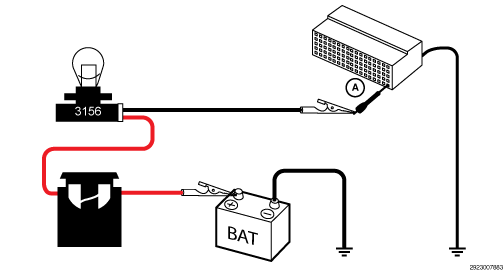
- Disconnect the PCM harness connectors to isolate the ground circuit.
- Connect the positive lead of the load test tool to the positive side of the Battery.
- Connect the negative lead of the load test tool to the ground circuit at the PCM harness connector (A). Note: refer to the diagram below.
- The bulb on the load test tool should be illuminated and bright if there is no resistance in the circuitry.NOTE:
Why load test a circuit? A load test is used to determine if a circuit is capable of carrying the amperage needed to perform properly. The 3156 bulb in the load tool illustrated, is a simple but effective method of testing circuit functionality. A 3156 Bulb has approximately 6.0 Ohms of resistance when the bulb is powered and draws approximately 2.0 amps of current. Read the CIRCUIT LOAD TESTING PROCEDURE for information on building a simple load test tool and for additional load testing information and alternative methods of load testing or voltage drop testing a circuit. Refer to CIRCUIT LOAD TESTING PROCEDURES .
NOTE:A 12-volt test light can be substituted for the load test tool, but only if the test light draws enough current to effectively load test the circuit. Many high impedance test lights draw very little amperage (less than 0.1 amps) and are not reliable to load test a circuit. To perform a proper load test of a circuit, the tool being used should draw more than approximately 0.75 amps.
NOTE:Why perform a Voltage Drop Test? To verify with certainty there is not any resistance in the circuit being tested, perform a simple voltage drop test across the 3156 bulb of the load test tool. To do so perform the following:
- 1. Connect the leads of a DVOM to the alligator clips on the load test tool while the load test tool is connected in series with the circuit.
- 2. Compare the voltage drop across the bulb to the voltage reading across the Battery terminals.
- 3. The voltage dropped across the bulb should be equal to the voltage reading across the Battery terminals if there is no resistance in the circuit being tested.
Example: 2.0 Ohms of resistance in the circuit being tested will cause the voltage measurement across the bulb to be 25% less than when compared to Battery voltage. The reason for this is that the 2.0 Ohms in the circuit makes up 25% of the total circuit resistance of 8.0 Ohms. Read the CIRCUIT LOAD TESTING PROCEDURE for information on building a simple load test tool and for additional load testing information and alternative methods of load testing or voltage drop testing a circuit. Refer to CIRCUIT LOAD TESTING PROCEDURES .
CAUTION:Do not probe the PCM harness connectors. Probing the PCM harness connectors will damage the PCM terminals resulting in poor terminal to pin connection. Install the GPEC Diagnostic Adaptor to perform the diagnosis.
NOTE:IMPORTANT - The GPEC Diagnostic Adaptor can add up to 1.5 Ohms of resistance to the circuit.
- If it is necessary to probe a terminal at a PCM harness connector, connect the (special tool #10436, Adapter, GPEC Diagnostic) to the appropriate PCM harness connector.NOTE:
Compare the brightness of the bulb in the load test tool to that of a direct connection to Battery.
Is the load test bulb illuminated and bright for each ground circuit?
Yes
- Go To 8
No
- Repair the faulty ground circuit for an open or high resistance.
- Perform the POWERTRAIN VERIFICATION TEST. Refer to POWERTRAIN VERIFICATION TEST .
- CHECK RELATED PCM AND COMPONENT CONNECTIONS
- Perform any Service Bulletins that apply.
- Disconnect all PCM harness connectors.
- Disconnect all related in-line harness connections (if equipped).
- Disconnect the related component harness connectors.
- Inspect harness connectors, component connectors, and all male and female terminals for the following conditions:
- Proper connector installation.
- Damaged connector locks.
- Corrosion.
- Other signs of water intrusion.
- Weather seal damage (if equipped).
- Bent terminals.
- Overheating due to a poor connection (terminal may be discolored due to excessive current draw).
- Terminals that have been pushed back into the connector cavity.
- Check for spread terminals and verify proper terminal tension.
Repair any conditions that are found.
- Reconnect all PCM harness connectors. Be certain that all harness connectors are fully seated and the connector locks are fully engaged.
- Reconnect all in-line harness connectors (if equipped). Be certain that all connectors are fully seated and the connector locks are fully engaged.
- Reconnect all related component harness connectors. Be certain that all connectors are fully seated and the connector locks are fully engaged.
- With the scan tool, erase DTCs.
- Test drive or operate the vehicle in accordance with the when monitored and set conditions.
- With the scan tool, read DTCs.
Did the DTC return?
Yes
- Replace the Powertrain Control Module in accordance with the Service information. Refer to MODULE, POWERTRAIN CONTROL (PCM), REMOVAL AND INSTALLATION .
- Perform the POWERTRAIN VERIFICATION TEST. Refer to POWERTRAIN VERIFICATION TEST .
No
- Perform the POWERTRAIN VERIFICATION TEST. Refer to POWERTRAIN VERIFICATION TEST .
- Test complete.