Noise Diagnosis
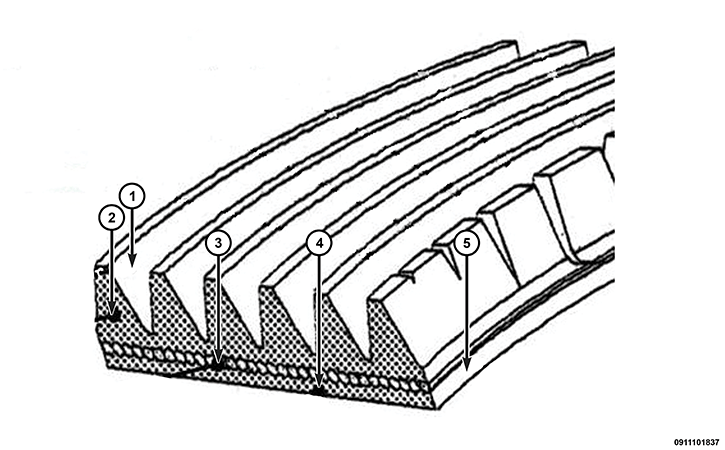
The accessory drive belt is constructed as follows:
- Profile Surface (1)
- Rib Rubber (2)
- Cord/Tensile Member (3)
- Backing Rubber (4)
- Cutting Edge (5)
Noises generated by the accessory drive belt are most noticeable at idle. Before replacing a belt to resolve a noise condition, inspect all of the accessory drive pulleys for alignment, glazing, or excessive end play.
ACCESSORY DRIVE BELT DIAGNOSIS CHART
| CONDITION | POSSIBLE CAUSES | CORRECTION |
|---|---|---|
| RIB CHUNKING - One or more ribs has separated from belt body (Class C) | 1. Foreign objects imbedded in pulley grooves. | 1. Remove foreign objects from pulley grooves. Replace belt. |
| 2. Installation damage | 2. Replace belt | |
| RIB OR BELT WEAR - Visual change in profile surface of belt, surface is glazed or shiny | 1. Pulley misaligned | 1. Align pulley(s) |
| 2. Abrasive environment | 2. Clean pulley(s). Replace belt if necessary | |
| 3. Rusted pulley(s) | 3. Clean rust from pulley(s) | |
| 4. Sharp or jagged pulley groove tips | 4. Replace pulley. Inspect belt. | |
| 5. Belt rubber deteriorated | 5. Replace belt | |
| BELT SLIPS | 1. Belt slipping because of insufficient tension | 1. Inspect tensioner and replace if necessary |
| 2. Belt or pulley exposed to substance that has reduced friction (belt dressing, oil, ethylene glycol) | 2. Replace belt and clean pulleys | |
| 3. Driven component bearing failure (seizure) | 3. Replace faulty component or bearing | |
| 4. Belt glazed or hardened from heat and excessive slippage | 4. Replace belt. | |
| LONGITUDINAL BELT CRACKING (Between two ribs or on backside of belt) | 1. Belt has mis-tracked from pulley groove | 1. Replace belt |
| 2. Pulley groove tip has worn away rubber to tensile member | 2. Replace belt | |
| 3. Rock contamination (rock stuck between ribs) | 3. Replace belt | |
| "GROOVE JUMPING" (Belt does not maintain correct position on pulley) |
1. Incorrect belt tension | 1. Inspect tensioner and replace if necessary |
| 2. Pulley(s) not within design tolerance | 2. Replace pulley(s) | |
| 3. Foreign object(s) in grooves | 3. Remove foreign objects from grooves | |
| 4. Pulley misalignment | 4. Align component | |
| 5. Belt cord line is broken | 5. Replace belt | |
| BELT BROKEN (Note: Identify and correct problem before new belt is installed) |
1. Incorrect belt tension | 1. Inspect tensioner and replace if necessary |
| 2. Tensile member damaged during belt installation | 2. Replace belt | |
| 3. Severe misalignment | 3. Align pulley(s) | |
| 4. Bracket, pulley, or bearing failure | 4. Replace defective component and belt | |
| NOISE (Objectionable squeal, squeak, or rumble is heard or felt while drive belt is in operation) |
1. Incorrect belt tension | 1. Inspect tensioner and replace if necessary |
| 2. Bearing noise | 2. Locate and repair | |
| 3. Belt misalignment | 3. Align belt and pulley(s) | |
| 4. Belt to pulley mismatch | 4. Install correct belt | |
| 5. Driven component induced vibration | 5. Locate defective driven component and repair | |
| 6. Belt flat surface coming apart | 6. Replace belt | |
| 7. Contamination | 7. Replace belt | |
| TENSION SHEETING FABRIC FAILURE (Woven fabric on outside, circumference of belt has cracked or separated from body of belt) |
1. Tension sheeting contacting stationary object | 1. Correct rubbing condition |
| 2. Excessive heat causing woven fabric to age | 2. Replace belt | |
| 3. Tension sheeting splice has fractured | 3. Replace belt | |
| EDGE CORD FAILURE (Tensile member exposed at edges of belt or separated from belt body) |
1. Incorrect belt tension | 1. Inspect tensioner and replace if necessary |
| 2. Belt contacting stationary object | 2. Replace belt | |
| 3. Pulley(s) out of tolerance | 3. Replace pulley and inspect belt | |
| 4. Insufficient adhesion between tensile member and rubber matrix | 4. Replace belt | |
| CONTAMINATION (Belt is contaminated with foreign substances) |
1. Contamination on belt, such as oil, coolant, brake fluid, belt dressing and others. | 1. Inspect for leaks and replace belt |