Removal And Installation: Installation
CAUTION:
Whenever the crankshaft is replaced, the rear crankshaft oil seal must also be replaced. Failure to do so may result in engine fluid leakage.
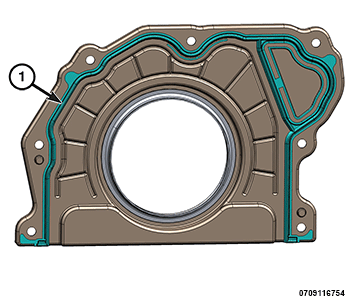
- Inspect the seals (1) for damage. If any issues are found, the seal retainer must be replaced.
- Inspect the crankshaft to make sure there are no nicks or burrs on the seal surface.
- Clean the engine block sealing surfaces thoroughly.NOTE:
It is not necessary to lubricate the seal or the crankshaft when installing the seal retainer. Residual oil following installation can be mistaken for seal leakage.
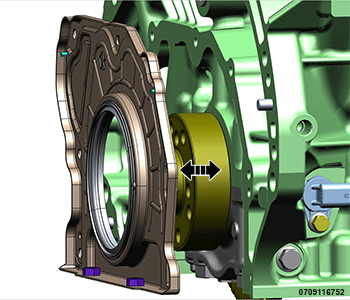
- Carefully position the oil seal retainer assembly, and seal protector on the crankshaft and push firmly into place on the engine block (during this step, the seal protector will be pushed from the rear oil seal assembly as a result of installing the rear oil seal).
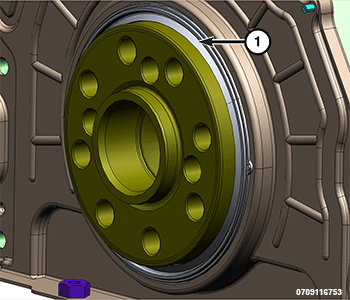
- Verify that the seal lip (1) on the retainer is uniformly curled inward toward the engine on the crankshaft.NOTE:
Make sure that the seal retainer flange is flush with the engine block oil pan sealing surface.
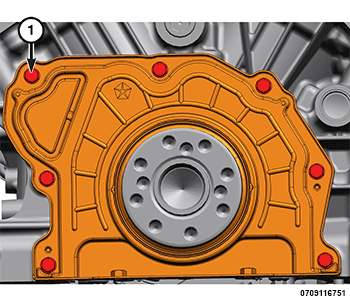
- Install the seven seal retainer bolts (1) and tighten to the proper torque specification. Refer to TECHNICAL SPECIFICATIONS .
- Install the flexplate. Refer to FLEXPLATE, REMOVAL AND INSTALLATION .
- Install the oil pan. Refer to PAN, OIL, REMOVAL AND INSTALLATION .
- Fill the engine crankcase with the proper oil to the correct level. Refer to CAPACITIES AND RECOMMENDED FLUIDS, SPECIFICATIONS .