Diagnosis And Testing - Rear Seal Area Leaks
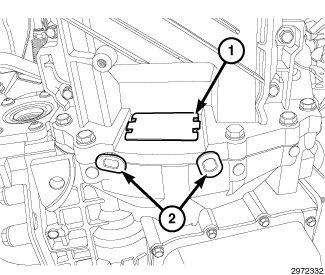
Since it is sometimes difficult to determine the source of an oil leak in the rear seal area of the engine, a more involved inspection is necessary. The following steps should be followed to help pinpoint the source of the leak.
If the leakage occurs at the crankshaft rear oil seal area:
- Disconnect and isolate the negative battery cable. If equipped with an Intelligent Battery Sensor (IBS), disconnect the IBS connector first before disconnecting the negative battery cable.
- Raise and support the vehicle. Refer to HOISTING, STANDARD PROCEDURE .
- Remove the torque converter dust shield (1).
- Remove two rubber plugs (2) covering the rear oil seal retainer flange bolts.
- Inspect the flexplate and rear of the block for evidence of oil. Use a black light to check for the oil leak:
- Circular spray pattern generally indicates seal leakage or crankshaft damage.
- Where leakage tends to run straight down, possible causes are a porous block, rear oil seal retainer, oil galley pipe plug and rear seal retainer to oil pan mating surfaces.
- If no leaks are detected, use the Air Leak Detection Method as outlined in Engine Oil Leak. Refer to LUBRICATION, DIAGNOSIS AND TESTING .CAUTION:
Do not subject the engine assembly to more than 20.6 kPa (3 PSI) of test pressure.
- If the leak is not detected, very slowly turn the crankshaft and watch for leakage. If a leak is detected between the crankshaft and seal while slowly turning the crankshaft, it is possible the crankshaft seal surface is damaged. The seal area on the crankshaft could have minor nicks or scratches that can be polished out with emery cloth.CAUTION:
Use extreme caution when crankshaft polishing is necessary to remove minor nicks or scratches. The crankshaft seal flange is specially machined to complement the function of the rear oil seal.
- For bubbles that remain steady with shaft rotation, no further inspection can be done until disassembled. Refer to SEAL, CRANKSHAFT OIL, REAR, REMOVAL AND INSTALLATION .