EVAP Emissions System - Non Turbo
The complete Evaporative Emissions System consists of the following configuration and operational components:
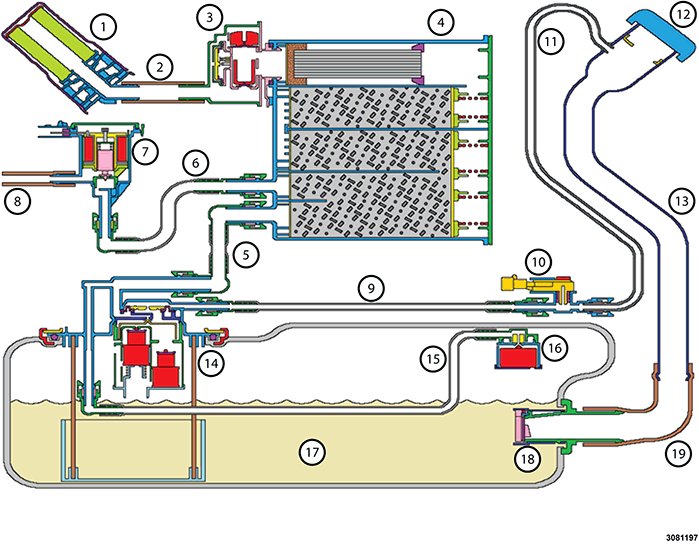
This generic graphic is designed to show the system components and configuration.
| CALLOUT | DESCRIPTION | CALLOUT | DESCRIPTION |
|---|---|---|---|
| 1 | Filter - Fresh Air Inlet | 11 | Recirculation Tube (metal portion) (FTPS to Fuel Filler Tube) |
| 2 | Filter Hose (Filter to ESIM) | 12 | Gas Cap or Cap-less Refueling Unit (if equipped) |
| 3 | Evaporative System Integrity Monitor (ESIM) | 13 | Fuel Filler Tube |
| 4 | Evaporative Charcoal Canister | 14 | Multi-Function Control Valve (MFCV) in the Fuel Delivery Flange |
| 5 | Canister Tube (Fuel Tank to Canister) | 15 | Grade Vent Valve (GVV) Tube (GVV to MFCV) |
| 6 | Purge Tube (Purge Solenoid to Canister) | 16 | GVV |
| 7 | Purge Solenoid | 17 | Fuel Tank |
| 8 | Manifold Hose (Purge Solenoid to Engine Manifold) | 18 | Inlet Check Valve (ICV) |
| 9 | Recirculation Tube (Fuel Tank to FTPS) | 19 | Hose - Fuel Filler Tube to ICV |
| 10 | Fuel Tank Pressure Sensor (FTPS) | - | - |
The Emission System Integrity Monitor (ESIM) Switch alone is used for all leak check diagnostics. The FTPS is not used for diagnosing the system for a leak.
ESIM SWITCH MONITOR - STUCK CLOSED At ignition OFF, the state of the ESIM switch is evaluated. If the switch is open, a pass flag is set and the PCM will complete power down. If the switch is closed, the PCM will wait a calibrated delay time and open the purge solenoid. In a normally functioning system, this will relieve the vacuum trapped in the charcoal canister allowing the switch to open. If the switch opens, a pass flag is set and the PCM will power down. If the PCM detects that the ESIM switch is still closed after a calibrated time, an error is detected and a switch stuck closed failure is set at the next engine RUN cycle. Two consecutive failed events will mature a fault (P0452) .
SMALL LEAK MONITOR
This is an accumulative monitor and the data from each valid event is recorded and added to the previously recorded events. The PCM timer records the engine ON/drive cycle and engine OFF time for each small leak monitor event. For an event to be valid the PCM must see the following:
- An engine ON/drive cycle for a minimum of 2-5 minutes.NOTE:
The engine ON timer will stop counting after a maximum of 26 minutes.
- And, when the engine is shut down, an engine OFF timer starts. There is a 12 minute delay time in which the PCM will ignore ESIM switch input. The engine OFF timer period will continue to count until one of these three conditions exist:
- The engine is started without a switch closure during the event.NOTE:
At the next key ON cycle, a determination is made as to whether the event was valid and the information is kept.
- An ESIM switch closed input is received after the 12 minute delay during the event.NOTE:
If the switch closed input is received, the PCM records that the switch has closed and stores the engine shut down time.
- After a maximum of 17.5 hours without an ESIM switch closure during the event.
- The engine is started without a switch closure during the event.
This monitor will increment the accumulation fail timers until both have reached a calibrated threshold (engine ON - 100 minutes and engine OFF - 70 hours). When the monitor records a valid switch closure (small leak passing event) , the fail timers are reset.
LEAK SIZE DETERMINATION: If the PCM did not see an ESIM switch closed signal during the previous ignition OFF cycle and there is a cold start (the event was valid), an intrusive leak test is run to determine if a large leak is present. Immediately after start-up, while the engine is cold, the purge solenoid is opened to create vacuum in the evaporative system to a calibrated vacuum point that is beyond the ESIM switch closing threshold. The pass/fail time will vary based on the total fuel volume at the time of the test.
- If the switch does not close at all during purging because of a switch that is stuck open or vacuum cannot be created below -250 Pa within a calibrated time, it is determined to be a general evaporative system failure (P0440) Diagnostic Trouble Code (DTC) .
- If vacuum is created and the switch has closed, the PCM stops purging and monitors the switch closure time. If the switch opens before a calibrated time, a large leak is present. Two consecutive failure events will mature a fault (P0455) DTC .
- If vacuum is created and the switch has closed, the PCM stops purging and monitors the switch closure time. If the switch stays closed longer than a calibrated period of time, it is determined that a large leak is not present and the Small Leak Monitor will continue to run until the accumulative monitor reaches its threshold. If no ESIM switch closures were recorded during the entire accumulated timer , it is determined that a small leak is present (P0456) DTC .
It is important to understand how extreme temperature changes can effect your results when diagnosing the system. It can either mask a leak by creating vacuum too rapidly, temporarily overcoming the leak, or make a sealed system appear to be leaking due to excessive vapor build-up decaying vacuum too rapidly. This could be from the vehicle heat soaking after a long drive cycle or being brought into a shop environment that is vastly different from the outside environment. Be aware of these factors when performing the checks on the system .
PURGE FLOW MONITOR
The Purge Flow Monitor Diagnostic will only run if the Small Leak Monitor recorded a pass on the previous ignition OFF event and the test data was valid. Because the leak detection diagnostics can only verify that the fuel tank system is sealed while the purge valve is closed, it cannot determine if the purge line between the solenoid and intake manifold is pinched or leaking. The Purge Flow Monitor is needed to verify these failure modes. The Purge Flow Monitor works on the premise that as flow through the system increases, so does the pressure drop in the system. The PCM monitors the FTPS and looks for increasing vacuum in the fuel tank with increasing purge flow. Conversely, it looks for decreasing vacuum in the fuel tank with decreasing flow.
- The non-intrusive purge monitor runs during normal operation once the enable conditions are met and looks for a calibrated increase in vacuum in the fuel tank with increased purge flow, referred to as side 1. If side 1 passes, the purge monitor looks for a calibrated decrease in vacuum in the fuel tank with decreasing purge flow, referred to as side 2. If side 2 passes, the purge monitor is complete. If the purge flow monitor fails either side 1 or side 2, or does not complete both side 1 and side 2 within a specified time, an intrusive test is initiated to verify the results from the non-intrusive test.
- The intrusive diagnostic increases and decreases the purge flow in a more controlled manner to allow a more accurate test result. If the PCM detects a failure during the intrusive test, a purge system performance fault is set (P0441) .
The FTPS alone is used for Purge Performance diagnostics. The ESIM switch is not used for diagnosing the purge system.