Removal And Installation: Installation
Be certain to adjust the refrigerant oil level when servicing the A/C refrigerant system. Failure to properly adjust the refrigerant oil level will prevent the A/C system from operating as designed and can cause serious A/C compressor damage.
When replacing multiple A/C system components, refer to the Refrigerant Oil Capacities chart to determine how much oil should be added to the refrigerant system. Refer to OIL, REFRIGERANT, STANDARD PROCEDURE .
If only the A/C evaporator is being replaced, add 60 milliliters (2 fluid ounces) of refrigerant oil to the refrigerant system. Use only refrigerant oil of the type recommended for the A/C compressor in the vehicle.
Replacement of the seals is required anytime a refrigerant line or expansion valve is disconnected. Failure to replace the rubber and metal dual-plane seals may result in a refrigerant system leak.
- Install the foam seal, tapping block and A/C expansion valve onto the A/C evaporator
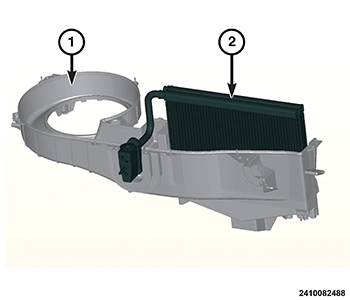
- Install the A/C evaporator (2) into the lower half of the HVAC housing (1). Make sure that the evaporator drain is clean and unrestricted and that the evaporator insulator is properly installed.
- Assemble the HVAC housing.
- Install the HVAC housing. Refer to HOUSING, HVAC, REMOVAL AND INSTALLATION .
- If the A/C evaporator is being replaced, add 60 milliliters (2 fluid ounces) of refrigerant oil to the refrigerant system. When replacing multiple A/C system components, refer to the Refrigerant Oil Capacities chart to determine how much oil should be added to the refrigerant system. Refer to OIL, REFRIGERANT, STANDARD PROCEDURE . Use only refrigerant oil of the type recommended for the A/C compressor in the vehicle.