Description And Operation
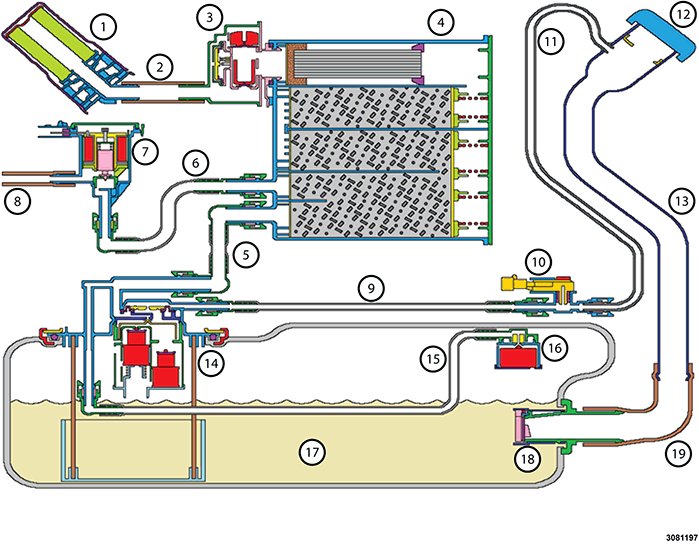
DESCRIPTION
The Evaporative Emissions system consists of the following components:
| CALLOUT | DESCRIPTION | CALLOUT | DESCRIPTION |
|---|---|---|---|
| 1 | Refer to CANISTER FRESH AIR FILTER . | 11 | Recirculation Tube (metal portion) (FTPS to Fuel Filler Tube) |
| 2 | Filter Hose (Filter to ESIM) | 12 | Gas Cap or Cap-less Refueling Unit (if equipped) |
| 3 | Refer to EMISSION SYSTEM INTEGRITY MONITOR (ESIM) . | 13 | Fuel Filler Tube |
| 4 | Refer to CHARCOAL CANISTER . | 14 | Multi-Function Control Valve (MFCV) in the Fuel Delivery Flange Refer to INTERNAL TANK VENT VALVES . |
| 5 | Canister Tube (Fuel Tank to Canister) | 15 | Grade Vent Valve (GVV) Tube (GVV to MFCV) |
| 6 | Purge Tube (Purge Solenoid to Canister) Refer to EXPANSION CHAMBER . |
16 | Grade Vent Valve (GVV) Refer to INTERNAL TANK VENT VALVES . |
| 7 | Refer to EVAPORATIVE EMISSIONS PURGE SOLENOID . | 17 | Fuel Tank |
| 8 | Manifold Hose (Purge Solenoid to Engine Manifold) | 18 | Inlet Check Valve (ICV) |
| 9 | Recirculation Tube (Fuel Tank to FTPS) | 19 | Hose - Fuel Filler Tube to ICV |
| 10 | Refer to FUEL TANK PRESSURE (FTP) SENSOR . | - | - |
OPERATION
EVAP SYSTEM OPERATION: The Evaporative Emissions System is designed to manage fuel vapors. The Powertrain Control Module (PCM) monitors the performance of the Evaporative Emission System. The system uses the principle of Natural Vacuum Leak Detection (NVLD) to determine the integrity of the system. When fuel vapors build and exit the Fuel Tank they are routed and stored in the Charcoal Canister. Fuel vapors entering the Charcoal Canister are absorbed by the charcoal filter until they can be drawn into the Intake Manifold during purging and burned by the engine.
The two main areas being monitored are the integrity of the system against leaks and the ability of the system to purge fuel vapor from the canister to the Intake Manifold.
- The basic strategy used for leak testing is that in a sealed system , pressure will naturally increase or decrease in relation to temperature. The Evaporative System Integrity Monitor (ESIM) Switch is used for all leak fault detection. There is a vacuum actuated switch that closes when the vacuum reaches a calibrated threshold. If the switch closes it indicates that the system is not leaking.
- The basic strategy used for purge performance testing is that as flow through the system increases, so does the pressure drop in the system. The Fuel Tank Pressure (FTP) Sensor is used for purge fault detection. The PCM monitors the Fuel Tank Pressure Sensor and looks for increasing vacuum in the Fuel Tank with increasing purge flow. Conversely, it looks for decreasing vacuum in the Fuel Tank with decreasing purge flow.
| Refer to NO TITLE . |
The PCM controls the operation of the normally closed Purge Solenoid. During the cold start warm-up period and the hot start time delay the purge solenoid is not energize. When de-energized the solenoid is closed and no vapors are purged from the Charcoal Canister. The engine enters closed loop operation after it reaches a specified temperature and the time delay ends. Once in closed loop the Purge Solenoid is controlled using a Pulse Width Modulated (PWM) control circuit. The normally closed Purge Solenoid will open and allow engine vacuum from the Intake Manifold to draw vapors from the Charcoal Canister into the Intake Manifold to be burned by the engine. The PCM varies the vapor flow rate by changing the duty cycle on the purge solenoid control circuit. The PCM adjusts the pulse width of the Purge Solenoid based on engine operating conditions.
| Refer to NO TITLE . |
There are three internal Tank Vent Valves on the Fuel Tank. During refueling the liquid fuel enters the Fuel Tank through the filler tube and displaces the vapor in the Fuel Tank. The Fuel Tank vapors escape through the Tank Vent Valves to the Charcoal Canister side of the system, including the Recirculation Tube, in a controlled approach to meet On-Board Refueling Vapor Recovery (ORVR) requirements.
- Tank Vent Valves: The fill limit vapor valve and liquid vapor separator drain valve are open when the fuel level is at lower levels. As the fuel level increases above 75% the float valves start to close. When the tank reaches fuel capacity the float valves are fully closed preventing liquid fuel from entering the Charcoal Canister, Recirculation Tube and Purge Tube. The float valves are also designed to close during a roll over event.
- Grade Vent Valve: The Fuel Tank has a vapor space that is approximately 10% of the fuel volume to allow for expansion of the Fuel Tank vapors when the tank is full. The Grade Vent Valve is located in this portion of the Fuel Tank. The Grade Vent Valve is a float valve design like the other valves. It is used to allow the vapors to escape into the canister side of the system when the Fuel Tank is full. The float valve will close preventing fuel from entering the canister side of the system if the Fuel Tank is significantly over-filled or during a roll over event.
- Fuel Filler Check Valve: The inlet check valve at the bottom of the Fuel Filler allows the fuel to enter the tank while also deterring vapor from coming back up the filler tube.
| Refer to NO TITLE . |
A maintenance free vapor canister is used on all vehicles. The Charcoal Canister is filled with granules of an activated carbon mixture. Fuel vapors entering the Charcoal Canister are absorbed by the charcoal filter until they can be drawn into the Intake Manifold during purging and burned by the engine.
| Refer to NO TITLE . |
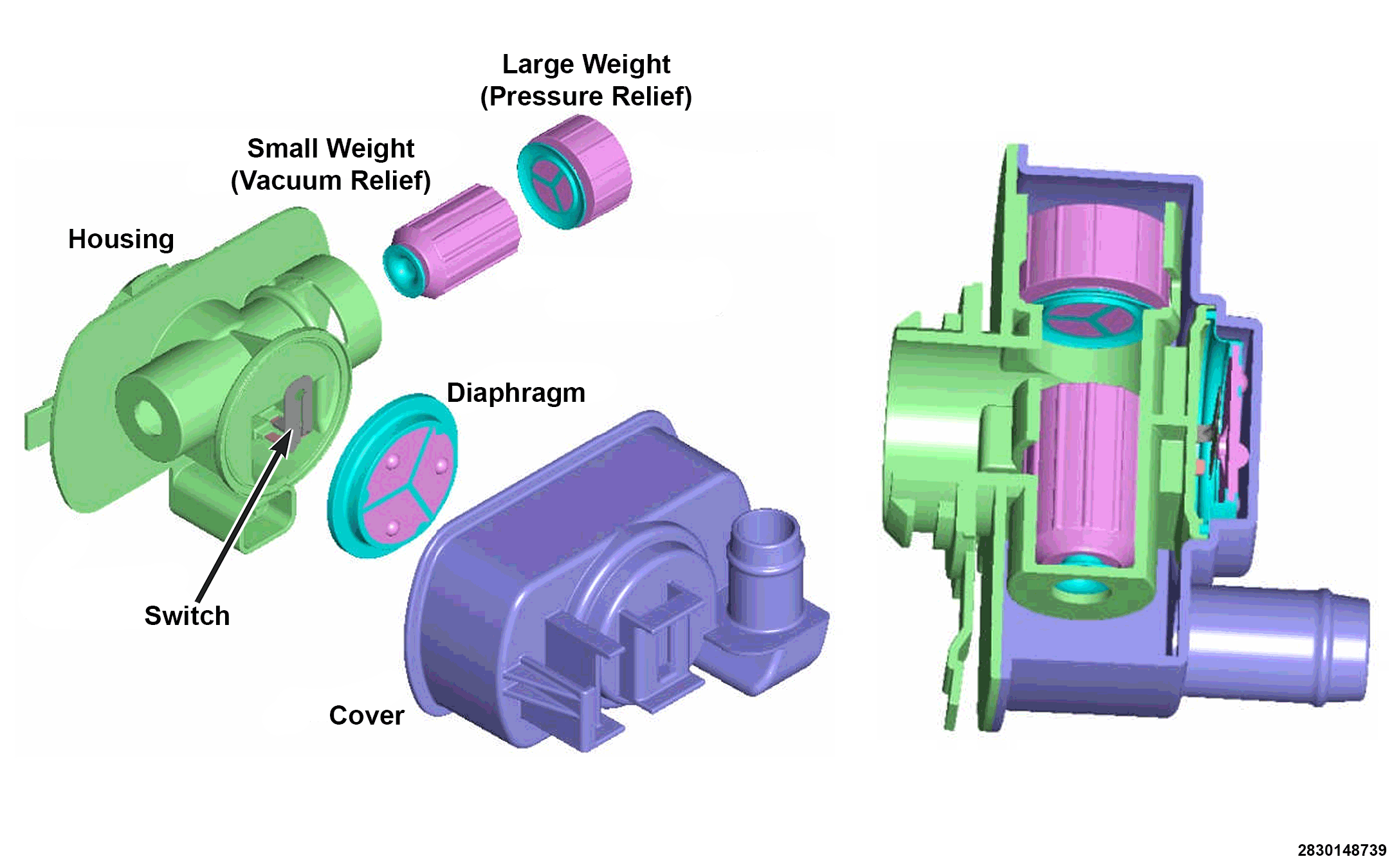
The ESIM is configured with a normally open vacuum switch and normally closed vacuum relief and pressure relief valves (see figure above). The PCM uses the ESIM for all system leak diagnostics (P0440, P0455 and P0456. The relief valves regulate the system pressure between approximately 250Pa and -500Pa.
- When the system vacuum reaches between (-187Pa) and (-250Pa) it acts on the diaphragm and closes the vacuum switch. When the switch closes it allows continuity between the terminals. This allows the ESIM Signal to pass through the switch, pulling the signal low to ground. The PCM monitors the signal to determine the state of the switch (open or closed). The ESIM Signal can be a 5.0 volt or 12.0 volt signal depending on the vehicle . When the PCM reads voltage on the signal circuit it determines the switch is open and when the signal is pulled low the PCM determines the switch is closed.
- The vacuum relief valve is intended to maintain the seal on the system during engine off events. However if the vacuum exceeds the regulation point the valve will pull off the seat to protect the system from excessive vacuum conditions. During purging, the vacuum relief valve inside, the ESIM is opened allowing fresh air to be drawn through the fresh air filter and Charcoal Canister to aid in drawing the fuel vapor from the canister.
- The pressure relief valve limits any pressure build up in the Fuel Tank during refueling and allows the tank pressure to normalize during increasing temperature events. This is additionally beneficial because it achieves a switch closed state (pass threshold) sooner than if the tank has to decay from a much higher pressure.
When installing an ESIM on the Charcoal Canister the O-ring can stick and roll causing a leak. To avoid this situation, talcum powder is recommended to lubricate the seal before installation. Also make sure that the ESIM is installed to the correct orientation with the connector at the 3 o'clock position so that the internal weights are in the correct position. Failure to do either of these could cause a failure and unnecessary replacement of the ESIM.
| Refer to NO TITLE . |
The Canister Fresh Air Filter is mounted at a high point of the vehicle next to the filler so that in the event the vehicle is used in deeper water the tank can still vent through the Charcoal Canister. A hose connects the Fresh Air Filter to the Evaporative System Integrity Monitor (ESIM). The Fresh Air Filter prevents dirt and contamination from entering the system during purging.
| Refer to NO TITLE . |
The FTP Sensor is located on the Recirculation Tube. It measures the pressure in the Evaporative Emissions System and converts it into a voltage. The PCM uses the FTP Sensor for the purge system performance diagnostics (P0441). The Sensor is used in the following manner:
- When the Purge Solenoid is actuated and the PCM monitors the change in the FTP Sensor reading over time. The PCM expects to see the pressure/vacuum reading decrease more than a calibrated threshold.
- When the Purge Solenoid is then deactivated and the PCM monitors the change again over time. The PCM expects to see the pressure reading increase more than a calibrated threshold over a period of time.
| Refer to NO TITLE . |
The Expansion Chamber is attached to the tube located between the Charcoal Canister and the purge solenoid to help reduce noise during operation.