Theory Of Operation
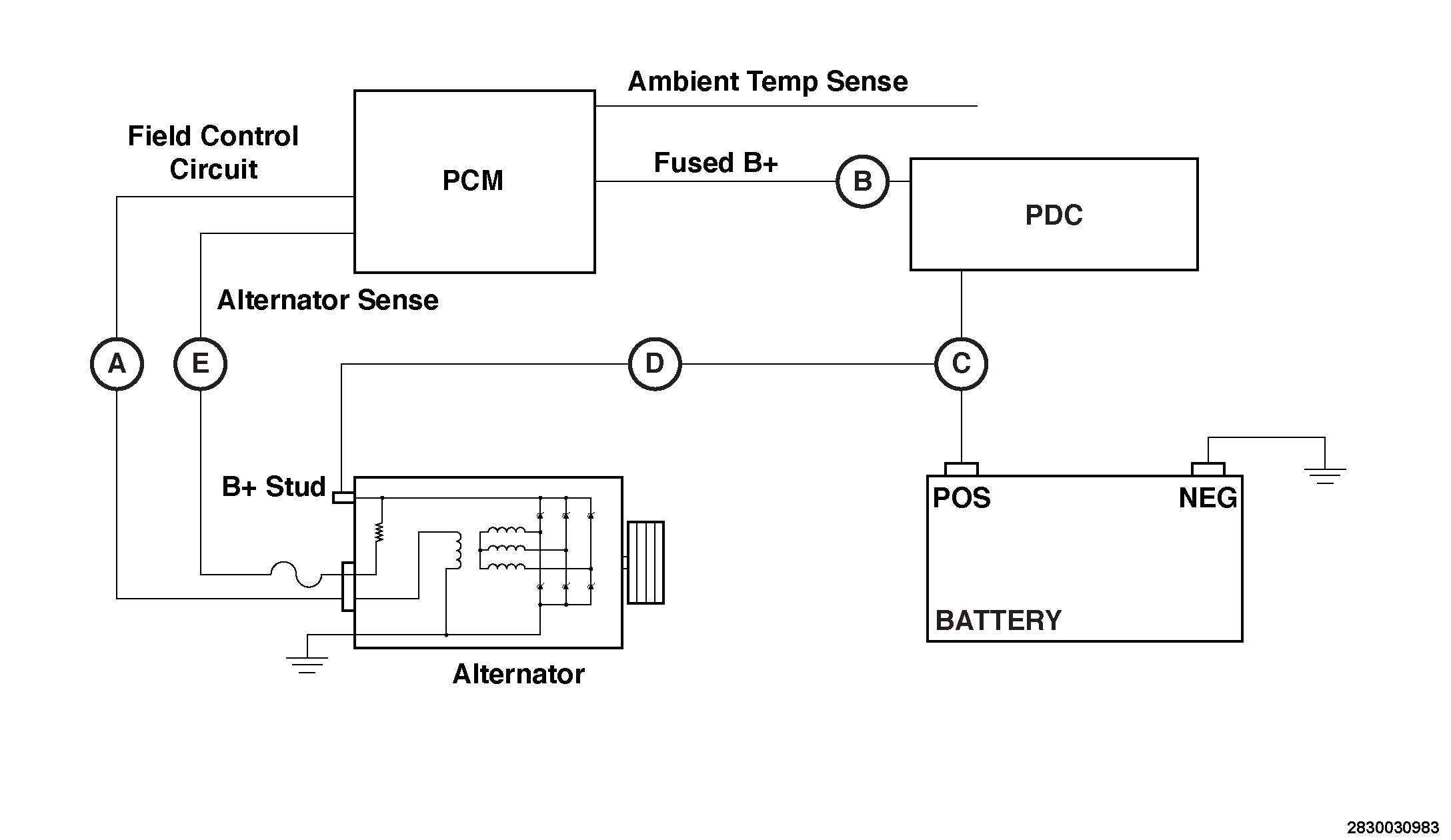
The Electronic Voltage Regulation (EVR) system maintains the system voltage at a desired level by turning the Pulse Width Modulated (PWM) Alternator Field Control circuit (A) on and off. When the Alternator field is turned on, the system voltage increases. When the Alternator field is turned off, the system voltage slowly drops. The rate at which this happens is dependent upon the existing electrical loads, ambient under hood temperature, and the engine RPM. A constant system voltage (B, C, D) can be maintained only when the Alternator field is switched on and off at a duty cycle that very accurately emulates the existing electrical loads given the existing ambient under hood temperature and engine RPM.
During normal operation, the voltage reading at the Alternator output stud will be very close to the target charging voltage viewed on the scan tool. This is the system voltage and is sensed by the Powertrain Control Module (PCM) through the Fused B+ circuit (B). With the Alternator connector plugged in, the voltage reading on the Alternator Sense circuit will be approximately 3.5 volts less than the voltage at the Alternator output stud due the resistor inside the Alternator. This is the Alternator Sense (E) input to the PCM. These two voltage sense inputs are used and compared during the different diagnostics performed on the EVR System by the PCM.
Diagnostic Mode: The PCM will run the Alternator Voltage High diagnostic to determine that the Alternator voltage sense (E) is higher than the system voltage (B, C, D) by a calibrated amount. It will give a rapid warning that the Alternator output terminal, Alternator output wiring or the fuse/fuse link in this output wiring had conductivity problems. This can include permanent or intermittent disconnections, or excessive resistance in the wiring caused by either corrosion or a loose connection.